Cannot unscrew nut engine mounting

Wup

New member
Location
Eindhoven NL
Concerns a Laverda 1000 3C
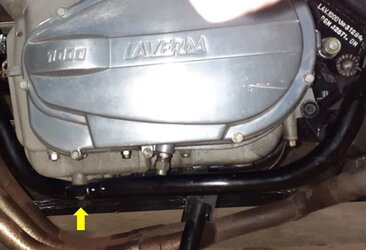
Hi, I cannot unscrew the nut at the left bottom of the engine See arrow in picture.
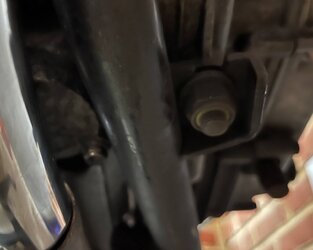
Not enaugh space for a tool between nut and frame.
Has somebody a tip to solve this issue?
 

Attachments

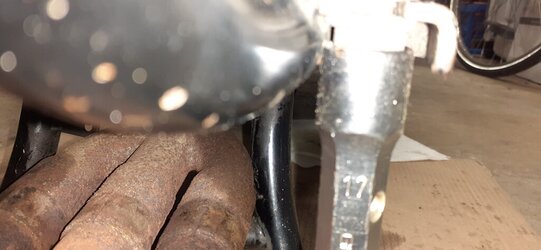
  • Pijpsleutel klemt.jpg
    Pijpsleutel klemt.jpg
    72.2 KB · Views: 108
  • Laverda mounting engine.jpg
    Laverda mounting engine.jpg
    82.3 KB · Views: 107
I''ve plenty of space, on mine. Makes me wonder if there's any distortion in the frame.
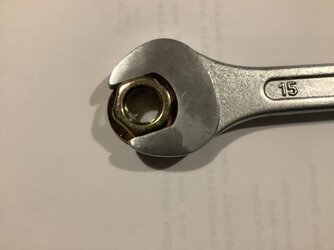
Maybe try a thin-walled socket or an open-ended spanner.IMG_5354.JPG
 
Last edited:
Concerns a Laverda 1000 3C
Hi, I cannot unscrew the nut at the left bottom of the engine See arrow in picture.
Not enaugh space for a tool between nut and frame.
Has somebody a tip to solve this issue?
My observation is that the gap between frame tube and nut are tighter on some frames than others, I think it's usually the left where it's tighter than the right. On some frames you can fit a really thin wall socket (you can also machine down sockets to make custom super thin sockets to suit), but others (like my 79 Jota) the tip of the hex nut only clears the tube by fractions of a mm and no kind of socket will fit. I believe this can only be a production variance.
Should I admit it here? It's not nice, but in that instance I use a 17mm open end spanner vertically up, and fit a well adjusted large shifting spanner across the blades of the 17mm as close as possible to the nut.
M10x1.25 nuts can be found in hex sizes down to 14mm, in these cases it would be better to refit a non standard nut with a smaller hex (or a 12-point nut) to allow use of a normal socket next time. But then you would not have the correct yellow nyloc nut there and some types of people would complain about the non-originality. :D
 
Thx for the answers.
The external diameter of the pipe wrench (= pijpsleutel in Dutch) is 23 mm.
At the right site the space between the pipe wrench and frame tube is between 0,25 and 0,3 mm. The engine is a little bit shifted to the richt. Indeed a production variance.
@ Paul; good tip. I'll try. Hopefully the socket will not burst. The power to unscrew at the beginning needs much power.
@ Breganzane; is 'use a 17mm open end spanner vertically up, and fit a well adjusted large shifting spanner across the blades of the 17mm as close as possible to the nut' a suggestion or a "proven" solution?
The tip to use another nut in the future is a good one. Maintainability above originality. ;)
 
Last edited:
Or put an Allen bolt in next time around?
You'd have to remove the stud from the crankcases, I prefer not to do that unless absolutely necessary as they are usually in there bloody tight after all these years.
The external diameter of the pipe wrench (= pijpsleutel in Dutch) is 23 mm.
The diagonal of a 17mm nut is about 19.6mm, so in theory a socket could be as slim as (or machined down to) around 21mm, or perhaps a bit less. While a socket is still a 'full circle' it retains a surprising amount of strength even if wall thickness at the thinnest part is <1mm. You wouldn't use it as a general purpose socket but fine for a special purpose like this.
@ Breganzane; is 'use a 17mm open end spanner vertically up, and fit a well adjusted large shifting spanner across the blades of the 17mm as close as possible to the nut' a suggestion or a "proven" solution?
Yes, I've had to do it on my bike as there is literally no gap between the diagonal of the nut hex and the frame tube. There is just no room for a fully circular tool like a socket in there. As soon as it's not fully circular it needs to be considerably thicker in section to work in any manner because you don't have the hoop stress of the circular bit holding the tool together. Maybe a really robust socket like an impact socket, with a third of it ground/machined away would fit in and be a better solution.
See if a really slim socket can be made (or modified) to fit first.
 
Would one of these suit? Too chunky perhaps. I bought one years ago cos it looked interesting. Never found a use for it.
270429_2252719_F.jpg
 
I have come accross this as well, it can be a pain in the derrier, when you get it off/out dont replace the stud with an allen bolt (correct term socket cap screw) because it is a stud for a reason, that being every time you (would) remove it, if a bolt you will lose some of the aluminium, the longer between removal the more alloy you will lose or even all of it (big nut oil cooler anyone???) the factory did supply a side stand kit to fit onto this bolt and that can cause problems as well, crash damage maye have closed the gap, and if crashed with a side stand even more so, sometimes even tearing the bolt out of the case, the stud is also required for dropping the engine unit back in the chassis, it aligns itself and the slot is so you can install the motor and then slide it 15mm to the correct position, but how I solved the problem was buying a six point "flank drive" Snap On socket, expensive yes, worthy? hugely, I have a few Snap on items, but I have never wasted 1,000's buying their stuf that I would not use regularly or when cornered, eg, as here, or, spark plugs from a Rover V8 etc
CLEM
 
Last edited:
I found a flange nut that has a smaller AF than normal. I can't suggest where to get one from though, as mine was just in my 'weird and wonderful' fixings box. Mine may have come from a race car specialist - you know the every-gram-counts guys.
 
Hi, thx for all suggestions.
I don't intend to replace the stud (thx. Clemto)
My first attempt will be a customized socket. Only a small part has to be ground away. I assume that as soon as the nut has turned about 30 degrees life becomes easier. To use an impact socket is a good tip (thx. Breganze).
@ Rwodypat; unfortunatly no space.
@ Haggis; what do you mean with a smaller AF?
 
Hi, thx for all suggestions.
I don't intend to replace the stud (thx. Clemto)
My first attempt will be a customized socket. Only a small part has to be ground away. I assume that as soon as the nut has turned about 30 degrees life becomes easier. To use an impact socket is a good tip (thx. Breganze).
@ Rwod
@ Haggis; what do you mean with a smaller AF?
 
The sexual innuendos of this thread are difficult to put up with.
Screws, mounts, nuts...what next?
Across the flats leaves me wondering.

Paul
 
Back
Top