Cars and bikes I’ve come across in my travels

MV's.... When Chris Cutler told me about the one piece cranks with roller bearings and how the mains had to be cracked and reassembled onto the crank the the whole lot carefully fed into the crankcases or some such thing. Yeah, nah, they can keep those. :D
That won't bring the prices down.
Paul
 
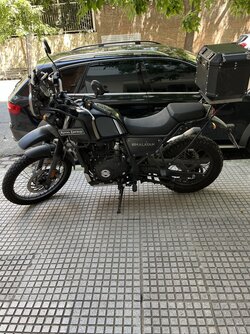
There are lots of ADV bikes on the road, not so many here in the city. Here is one I saw the other day, notice the double front fenders! My guess is that this part of South America has all sorts of great places to explore on the appropriate machines.

5F535100-16B7-4B08-8405-5CF27626B689.jpeg
 
A friend bought one when he came back from the Vietnam War, it was the first English car I ever drove. And the hottest girl in high school drove a GT-6!
GT-6 nice. After the Spitfires I wanted a TR6. Always nice to watch help girls getting into and out of them cars. Now with my "mature" figure I doubt I could get into any of those models.

Years ago I got Mario Andretti Enterprises to be a distributor of some car wash equipment I was representing. The manager
John Thorman took me to one of their garages that housed some old race cars, open wheel stuff. John said go ahead and get in it. I told him I would need one for each foot. If I was able to get in I would NEVER get out w/o help.
 
MV's.... When Chris Cutler told me about the one piece cranks with roller bearings and how the mains had to be cracked and reassembled onto the crank the the whole lot carefully fed into the crankcases or some such thing. Yeah, nah, they can keep those. :D

Nah, it's not a one-piece crank.

Admittedly I've not seen into the innards of a 750S, but I've done some research. I'm 99.9% sure it's a pressed together crank, just like any other roller bearing crank. I read somewhere that it's 9 pieces but I dunno where the splits are. The main bearings are mounted on the bottom of the cylinder block and the whole lot lifts out of the top of the crankcase, cassette style (primary drive is by gears so no chain to unhook). The crankcase is basically just a tub of oil that the top end and crank assembly simply bolts into. The main bearing housings split so that the crankshaft, complete with rods and pistons drop out of the bottom of the cylinder block. I think the main bearing outer races also split so you can replace the rollers without pressing the crank apart, which is a bit unusual. That would require some pretty precise engineering, so the rollers don't hit a step in the race as they go around. It seems like an innovative idea, making the crankshaft very easy to access. The conrods and big end bearings are similar to the Laverda arrangement, requiring the crank to be pressed apart to disassemble.

Beauty is in the eye of the beholder, but I think it's one of the most beautiful bikes ever built. Unfortunately, I can only afford a Minichamps model.

There's some tech info here. https://classictwowheels.com.au/1972-mv-agusta-750-s/
And disassembled photos here. https://online.doningtonauctions.co...4/lot/4815?url=/m/view-auctions/catalog/id/24
 
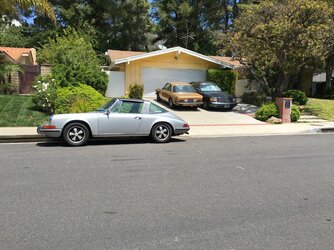
I love this guys car collection, I drove by several times a week on my way to the dog park. 911 Targa, 3.0 csi and 560 SEC, I can only imagine what is in the garage!B0F6EA66-D321-408E-BB4E-D42BBCE8A38F.jpeg
 
Nah, it's not a one-piece crank.

Admittedly I've not seen into the innards of a 750S, but I've done some research. I'm 99.9% sure it's a pressed together crank, just like any other roller bearing crank. I read somewhere that it's 9 pieces but I dunno where the splits are. The main bearings are mounted on the bottom of the cylinder block and the whole lot lifts out of the top of the crankcase, cassette style (primary drive is by gears so no chain to unhook). The crankcase is basically just a tub of oil that the top end and crank assembly simply bolts into. The main bearing housings split so that the crankshaft, complete with rods and pistons drop out of the bottom of the cylinder block. I think the main bearing outer races also split so you can replace the rollers without pressing the crank apart, which is a bit unusual. That would require some pretty precise engineering, so the rollers don't hit a step in the race as they go around. It seems like an innovative idea, making the crankshaft very easy to access. The conrods and big end bearings are similar to the Laverda arrangement, requiring the crank to be pressed apart to disassemble.

Beauty is in the eye of the beholder, but I think it's one of the most beautiful bikes ever built. Unfortunately, I can only afford a Minichamps model.

There's some tech info here. https://classictwowheels.com.au/1972-mv-agusta-750-s/
And disassembled photos here. https://online.doningtonauctions.com.au/m/lot-details/index/catalog/24/lot/4815?url=/m/view-auctions/catalog/id/24
Not quite Cam.

The crank is built up from 5 pieces, 3 pairs of webs, each with an integral main bearing journal, and a closing web at each end. The centre pair of webs has 2 mains and carries the cam drive gear and has bores for crank pins, the outer pairs have integral pins that press into the inner pair. Getting clearances right for the otherwise inaccessable roller mains is rather tricky, assembling these is a fiddly job. Apparently, many cranks are doomed the moment they are fitted! The outer races of the mains are very stable and shouldn't distort under the bearing caps. They are split by cracking, each pair of halves completely unique. The halves are held together with a wire ring in a circumferential groove until they are bolted up. The bearing caps that locate the split main bearing races have a tendency to shift these under the pressure of torqueing the caps, resulting in a step forming in the race. Doesn't take long for the crank to self destruct if run in this condition. I always wondered why so many of these sounded like a stone crusher at idle, quite clear now!

The rest of the crank drive and its mounting is impressive, as is the precision involved all round. Big end bearings are conventional, conrods are a work of art. Heads are another matter, not very much was changed since the engine was first drawn up in the '50s, very stone-age.

Engine is wonderfully smooth, as would be expected from a four. But it revs up totally differently than a Honda 4 for example, lots "looser", crank seems to have far less overall weight. Ride was a disappointment though, I reckon it couldn't hold a candle to a good SF2, let alone a SFC.

piet
 
Last edited:
Not quite Cam.

The crank is built up from 5 pieces, 3 pairs of webs, each with an integral main bearing journal, and a closing web at each end. The centre pair of webs has 2 mains and carries the cam drive gear and has bores for crank pins, the outer pairs have integral pins that press into the inner pair. Getting clearances right for the otherwise inaccessable roller mains is rather tricky, assembling these is a fiddly job. Apparently, many cranks are doomed the moment they are fitted! The outer races of the mains are very stable and shouldn't distort under the bearing caps. They are split by cracking, each pair of halves completely unique. The halves are held together with a wire ring in a circumferential groove until they are bolted up. The bearing caps that locate the split main bearing races have a tendency to shift these under the pressure of torqueing the caps, resulting in a step forming in the race. Doesn't take long for the crank to self destruct if run in this condition. I always wondered why so many of these sounded like a stone crusher at idle, quite clear now!

The rest of the crank drive and its mounting is impressive, as is the precision involved all round. Big end bearings are conventional, conrods are a work of art. Heads are another matter, not very much was changed since the engine was first drawn up in the '50s, very stone-age.

Engine is wonderfully smooth, as would be expected from a four. But it revs up totally differently than a Honda 4 for example, lots "looser", crank seems to have far less overall weight. Ride was a disappointment though, I reckon it couldn't hold a candle to a good SF2, let alone a SFC.

piet
Yikes
Paul
 
Yikes
Paul
Sounds complicated, and it is. But, I'm quite convinced that, put together properly with due care, these can be very durable engines. From an engineering POV, the build is impressive, with outstanding precision. Materials seem well up to the job, lots of bits are much stronger than they need be, weight-saving was not a priority. Despite that, ties to their aviation engineering are very evident.

Still, it's an old design, well past its best-by date, and should be accepted for just that. I can imagine the later versions with 1000 and 1100 cc to be rather fragile if these are entirely based on the original 750 design (Zane Lavs are a good example of what happens if you expect a base engine to deliver almost twice of what it initially was designed for). Although the bigger MVs were quoted as delivering well over 100hp, I'd seriously doubt that, given the antiquated head design. These engines have nothing in common with the dominating triples and fours of the '70s Grand Prix bikes under Reid, Ago or Bonera, except the decals on the tank.

MV 750S is definitely a beautiful machine, don't think I'd want one though. The riding experience doesn't live up to the hype.

piet
Or the price, since riding is what it's about above all.

Paul
 
As Caustic Chris put it so succinctly, "waiting for the rush that never comes" my prompting of certain Ducati motorcycles, he is of course most erudite, when we ride the bike of legend, the reality would be better served in the dream and not ridden.

Hard to beat a triple 4c HC pistons on the cam at 4krpm... there is most certainly a rush... and grin.. Piet has the reality in evidence.. mind you a stock 3c is an ordinary ride... heretics... found in many places, am but one...j
 
. These engines have nothing in common with the dominating triples and fours of the '70s Grand Prix bikes under Reid, Ago or Bonera, except the decals on the tank.


piet
From pics of disassembled engines it looks like the "crank carrier" is in one piece with the barrel on the race engines, separated on road versions.
But the late race engines still use that layout.
It would have to be much cheaper/easier to cast and machine than horizontally split cases. Also any frame loads fed into the lower "sump piece" are less likely to affect the crank alignment.
 
I'm pretty sure I recall Chris talking about a one piece crank and cracked bearings, but I think it was in the context of a GP500 triple - perhaps even a newly-made replica which might have been built using an updated design? Though why you'd stick with roller bearings in that case is a head-scratcher. Maybe I imagined the whole thing. I'll ask him, haven't caught up for a while.

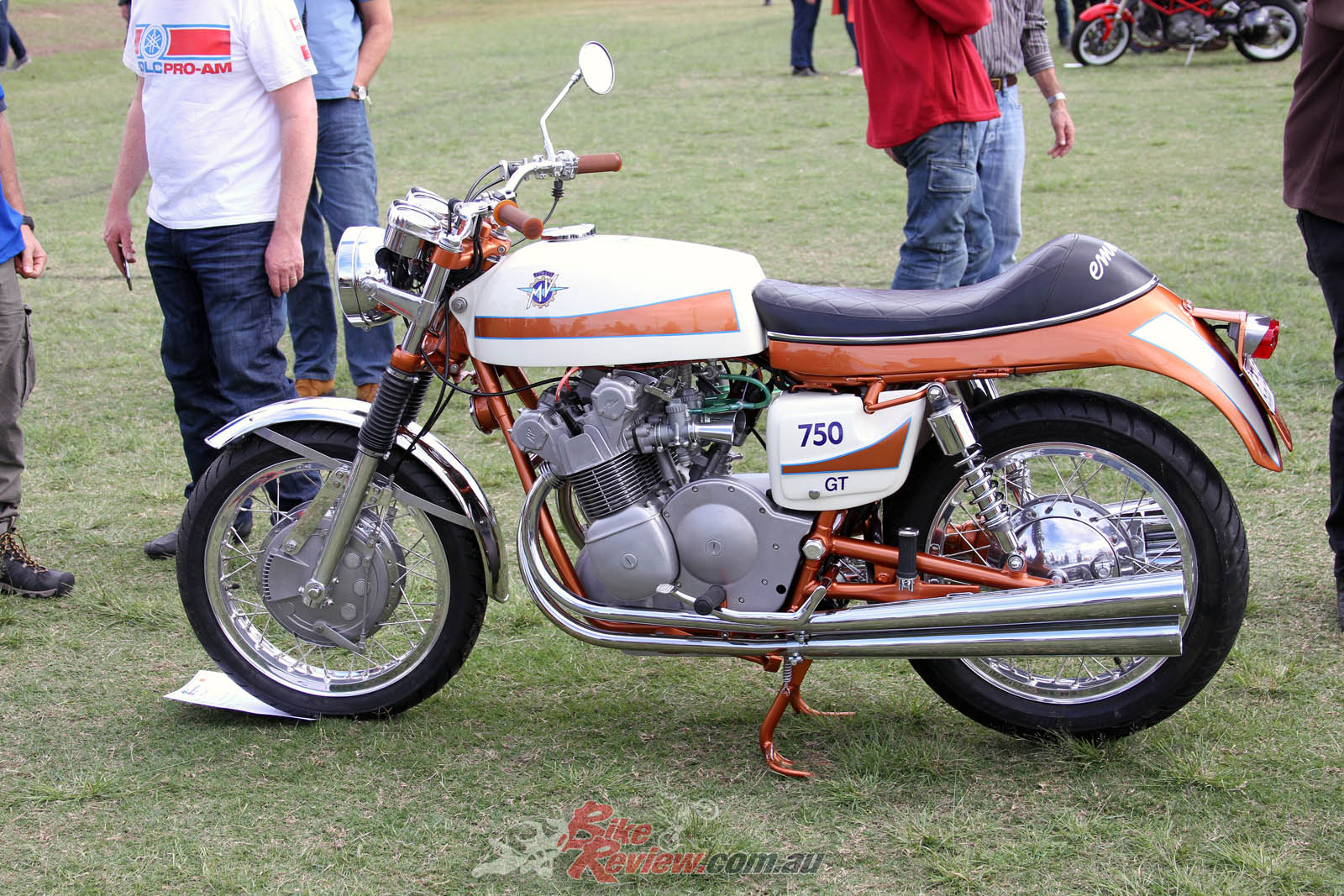
After googling a few piccies, the build of the road 750's and even their GP500's was with built-up cranks as you describe. Think Piet's nailed the description - beautifully executed but archaic. Given their road 750's are actually more or less piles of crap (as a sportsbike) it's the ugly cruiser style ones that appeal to me more. A few years ago at the Cleveland CLQ concourse there was an amazing looking MV with a sort of fastback tail on it. Looked awesome.
 
Hey presto, google found it straight up....

Much cooler than any of the pretend 750 racebikes which were actually terrible.

2016-Laverda-Concours-Bike-Review-158.jpg
 
Hey presto, google found it straight up....

Much cooler than any of the pretend 750 racebikes which were actually terrible.
My favourite as well, Steve!

I've only ever come across one in the wild, very, very rare, even over here.

I also prefer looks of the touring and scrambler 250/350 twins over the wannabe racer Electronica. The later Ipotesi looked daring, but under the squared-off engine cases was the same old grey porridge of yesteryear. Laverda wasn't the only marque living on past glory.

piet
 
Steve and his ugly Ducklings, have you seen the very early 600 road bike they made? This thread reminds me of my time in a Wedding Car. A 1920s Roller, very beautiful and I expected a ride like a Hovercraft. Nope, it was like the rock-hard Horse and Sulky my Grandmother drove between Farms when my Mother was a kid. Bloody Horrible.
 
Steve and his ugly Ducklings, have you seen the very early 600 road bike they made? This thread reminds me of my time in a Wedding Car. A 1920s Roller, very beautiful and I expected a ride like a Hovercraft. Nope, it was like the rock-hard Horse and Sulky my Grandmother drove between Farms when my Mother was a kid. Bloody Horrible.
A truely innovative bike, I think it's called "thinking outside the box" these days! ;) Sadly, it isn't always a (financial) success.

Not many transverse fours were offered before the MV, first proddy bike with front discs, even if still mechanical. The road was paved, but it still took a while for Honda to catch on.

piet
 
Back
Top