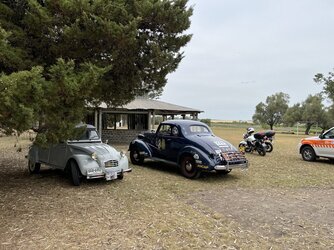
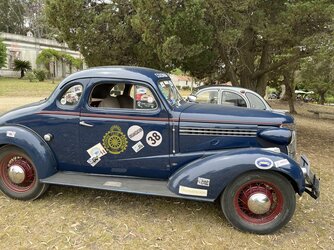
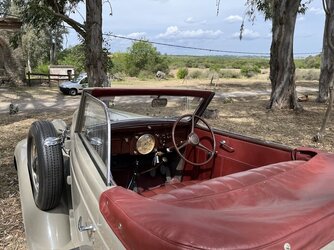
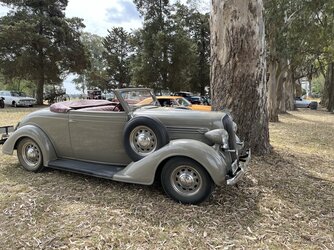
Cars and bikes I’ve come across in my travels

Is that a morse transmitter? Fantastic. I presume it all packed away into a box when travelling!

It looks like an old ignition system. The great-grandfather of the Ignitech box. The magneto with the crank handle near the bottom of the picture is the starter for multi-cylinder engines. I don't know what the morse key is for. Possibly a kill switch.

Starting procedure was to use a hand pump to pressurise the fuel system, then turn the engine over a couple of revolutions (with ignition off) using the crank handle (or propellor ion an aircraft) to prime the cylinders with fuel mixture. Next step is to switch the ignition on and crank the magneto handle as fast as you can. That magneto fires all spark plugs. One of the cylinders will have a gut full and be near enough to the right part of its 4-stroke cycle to fire and start the crank turning. As soon as the engine starts, the engine driven magneto takes over, firing each cylinder at its correct time. It's quite a simple system that eliminates the starter motor. I imagine that starter motors in the early 1900s would have been big heavy things. Weight saving was an important consideration for flimsy WW1 aircraft, so the magneto starter was used extensively in early aviation.

Those big clunky things on top of the box appear to be the ignition coils. I dunno what's inside the box, but perhaps it's the engine driven magneto.

You can see a hand-crank magneto starter in operation at about 23 seconds into this video
 
They're called trembler coils. Basically they produce a stream of sparks, of which some will be at the approximate right time to fire the mixture.

They also have other uses....A friend of mine was serving his apprenticeship at the local Ford dealership. As apprentices do, he and the others got up to tricks. One of which was wiring a trembler coil and battery to the sheet steel backing of the staff pissoir (stand-up male toilet) As it happened it was the foreman who was the first to find out about it.. His comment to me was that he hadn't known a human could make that noise.
They never found out who'd set it up. Luckily.
 
It looks like an old ignition system. The great-grandfather of the Ignitech box. The magneto with the crank handle near the bottom of the picture is the starter for multi-cylinder engines. I don't know what the morse key is for. Possibly a kill switch.

Starting procedure was to use a hand pump to pressurise the fuel system, then turn the engine over a couple of revolutions (with ignition off) using the crank handle (or propellor ion an aircraft) to prime the cylinders with fuel mixture. Next step is to switch the ignition on and crank the magneto handle as fast as you can. That magneto fires all spark plugs. One of the cylinders will have a gut full and be near enough to the right part of its 4-stroke cycle to fire and start the crank turning. As soon as the engine starts, the engine driven magneto takes over, firing each cylinder at its correct time. It's quite a simple system that eliminates the starter motor. I imagine that starter motors in the early 1900s would have been big heavy things. Weight saving was an important consideration for flimsy WW1 aircraft, so the magneto starter was used extensively in early aviation.

Those big clunky things on top of the box appear to be the ignition coils. I dunno what's inside the box, but perhaps it's the engine driven magneto.

You can see a hand-crank magneto starter in operation at about 23 seconds into this video

Really? So an aftermarket accessory?

I had just seen the morse key and made the assumption based on it being described as a Linesman’s car (telegraph linesman presumably).

Also, isn’t that photo of the back of the car? Surely you’d put an ignition system closer to the engine?
 
Dah Dit Dah Dah \\\\ Dit \\\\ Dit Dit Dit ( Yes ) its a basic morse key in the photo! Many the hour behind a key and headphones, send 10wpm and a dismal 5 wpm receive.... another life ago.... Most probable the key is a shunt "off" device ie short out the trembler arrangement ( well done whom called that, add name next time )....mazing... Horseshoe magneto ( as a best guess ) is for initial excitation pre crank start. Must be a sustain circuit with mechanical coupling for continued excitation.... sure a detailed circuit description would be somewhere in vintage car online information..j **** mmmmm then again i may be completely up a pole and no clue.... my actual apprenticed trade qualification is "Telegraph Mechanic" i ought to know what am looking at....a wry smile here....

**** This forum text formatting keeps deleting more than one space character ( ASCII 20 Hex ) if more than one between words, or at Paragraph commencement with a "tab" indent or the use of multiple 20Hex to substitute as paragraph indent. Has a big problem with spell check "Laverda" and other valid spelling for words, the grammar formatting is unrestricted it appears. Know its all free, and glad of that to be so, am not a modernist when it comes to composition and grammer, being tutored by the shallow modern programmer whom avoided English class in favor of C++, Python, Java et al may have got us here, their program is incomplete, it needs to attend English classes, deference to other written languages in my missive, j.
 
Last edited:
My Dad got a start as a Telegraph Operator at the PMG at 15 in 1947, but loved Horses too much and left to Drive a Bread Delivery Cart, Horse Drawn. That was a lifetime and more ago. We found his practice Key when we were kids.
 
It looks like an old ignition system. The great-grandfather of the Ignitech box. The magneto with the crank handle near the bottom of the picture is the starter for multi-cylinder engines. I don't know what the morse key is for. Possibly a kill switch.

Starting procedure was to use a hand pump to pressurise the fuel system, then turn the engine over a couple of revolutions (with ignition off) using the crank handle (or propellor ion an aircraft) to prime the cylinders with fuel mixture. Next step is to switch the ignition on and crank the magneto handle as fast as you can. That magneto fires all spark plugs. One of the cylinders will have a gut full and be near enough to the right part of its 4-stroke cycle to fire and start the crank turning. As soon as the engine starts, the engine driven magneto takes over, firing each cylinder at its correct time. It's quite a simple system that eliminates the starter motor. I imagine that starter motors in the early 1900s would have been big heavy things. Weight saving was an important consideration for flimsy WW1 aircraft, so the magneto starter was used extensively in early aviation.

Those big clunky things on top of the box appear to be the ignition coils. I dunno what's inside the box, but perhaps it's the engine driven magneto.

You can see a hand-crank magneto starter in operation at about 23 seconds into this video
Sorry Cam, somehow missed your description above, when i posted the thoughts of Chairman Jon.... big lever ( or similar ) on the left mid section front panel has me wondering. Then there is the lower lever arm that may well be a mechanical advance/retard of enduring spark process j
 
that is a lovely looking rag top, the windscreen and surround almost makes it look like a home conversion from a tin top, and maybe done 60+ years ago, I am not an expert and I dont know what make the car is either. Just look at the beeeyoootifull aerodynamic head lights! and two spare wheels! I wonder if the boot (trunk) opens or is it accessed throught the inside?
CLEM
 
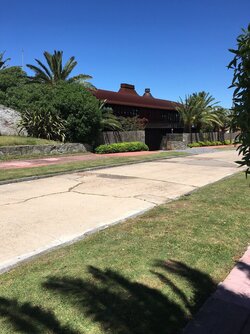
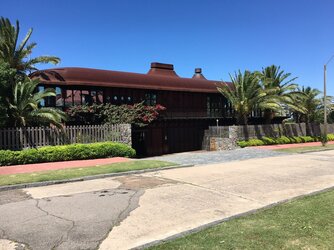
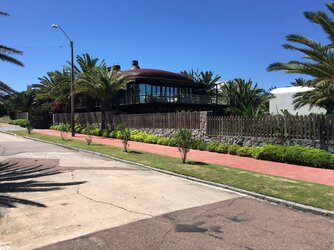
Bonus content: a weird iron house in Punta del Este. It seems to be made of stamped and welded Corten steel which gets a cool red-orange rust coating after exposure. It looks like a rail car, but is far too wide. I tried to find out how old it is, but had no luck.


C94727DD-E313-4F8D-91CF-B21C529CEF9A.jpeg
09261019-9882-4268-8E9E-9D3A9D8921A5.jpeg5139A8E2-C2E4-452B-A428-9CB9CCFB714C.jpeg
 
Last edited:
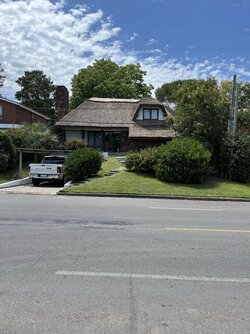
A thatched roof cottage in Uruguay, who knew…….? I was really surprised to see so many thatched traditional homes here, I had stupidly thought it was a strictly European thing.
6388287C-3BC1-4567-A789-9D30498104A5.jpeg
 
A thatched roof cottage in Uruguay, who knew…….? I was really surprised to see so many thatched traditional homes here, I had stupidly thought it was a strictly European thing.
View attachment 68736
Many europeans fled to South America during and after WW2, most prominently Germans Nazis and other european fascists (mostly to Uruguay, Paraguay, Chile and Argentina, perhaps one of the reasons that dictatorships have been so "popular" in S. America). Many have been found and trialled, reckon there were still a few that escaped detection. Now their off-spring are living off the suitcases of cash and gold their parents/grandparents brought with them.

Besides those, probably tens of thousands of others from both sides that were fed up with what was going on in Europe.

piet
 
Apparently they also have ‘thatched’ roofs on many old buildings in Africa, and quite a few new ones when they can’t get hold of corrugated tin. Not just a European thing.
 
Thatched roofs in Asia too. Also Teak leaves are used as well. My mother in law made a bunch of thatch panels for one of my previous houses.
As for the steel house, I have just clad 2 walls of my house with corten steel. I just love the look of that rusty finish and best of all no more maintenance.
 
Sorry Cam, somehow missed your description above, when i posted the thoughts of Chairman Jon.... big lever ( or similar ) on the left mid section front panel has me wondering. Then there is the lower lever arm that may well be a mechanical advance/retard of enduring spark process j
I'm having second thoughts about it being an ignition system. If it is ignition, then for what? Surely a Model A ford has its own ignition system, unless someone thought this was an upgrade. But then as Andy pointed out, what's it doing on the back of the car, and how would it get a crank position input way back there?
It's a mystery. Perhaps it is some kind of communication equipment. The hand crank generator being a telephone ringing device and the morse key being exactly that. But what are all those coils for?
 
Thatched roofs in Asia too. Also Teak leaves are used as well. My mother in law made a bunch of thatch panels for one of my previous houses.
As for the steel house, I have just clad 2 walls of my house with corten steel. I just love the look of that rusty finish and best of all no more maintenance.
Roof with tea leaves. Very practical when it rains.

Paul
 
I'm having second thoughts about it being an ignition system. If it is ignition, then for what? Surely a Model A ford has its own ignition system, unless someone thought this was an upgrade. But then as Andy pointed out, what's it doing on the back of the car, and how would it get a crank position input way back there?
It's a mystery. Perhaps it is some kind of communication equipment. The hand crank generator being a telephone ringing device and the morse key being exactly that. But what are all those coils for?
It's probably a military thing for obtaining information from reticent captives.

Paul
 
Back
Top