Ceriani fork piston clearance

Thanks guys.

Using the 31.96 dia in piston in a 32 bore leg, I did an air damping test.  I put the top cap in the fork leg, turned it upside down and dropped the piston in with a 500 gram weight attached to it. With the damping effect of air leaking past the piston, it took about 15 seconds to fall to the other end of the tube. No idea if that's a sensible test, but I thought it was cool  :D

Perhaps I should try it with the fork full of oil. It might take half an hour!

A more meaningful analysis is to look at the areas available for oil to flow through.

The total area of holes in the damper washers (11 holes x 3mm dia) is 78 mm2.
At .04mm clearance, the gap around the piston has an area of about 2 mm2, around 3% of the damping orifices. That means about 97% of the oil flow will be controlled by the damping device.

If I go to twice the clearance, I end up with 95% of the oil going through the damping device. That means piston clearance is not particularly critical. 2 to 4 thou would be quite OK.

Does that answer your original question Greg?
 
And then when you have bored 3 bloody great holes through the damper rod, the piston action probably makes no difference at all.
 
I've been looking for the Smiley face holding a gun to my head, to save you blokes doing it...

I've rebuilt Ceriani's, Koni's , Showas and Paoli's, even to point of getting Paoli rear shock seals cnc machined.

At least the forks and shocks on the Zanes are well machined...... :D

Greg
 
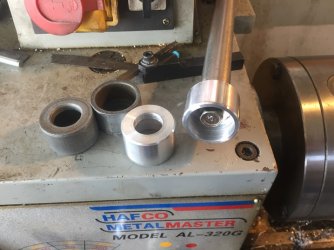
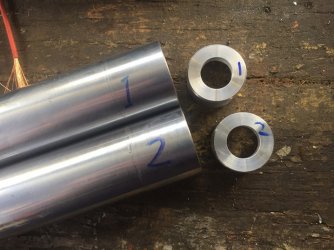
I made some nice new shiny pistons for the Ceriani forks today. The old ones had little hairline cracks all over them and were swollen over-size. I could have re-machined the old ones to fit but I figured new pistons turned from billet alloy would be more dimensionally stable than the originals.

I have a home-grown theory as to why the original ones swell up. They appear to be some kind of crappy cast alloy. Perhaps they have a bit of porosity, allowing any moisture inside the forks to soak into the metal and oxidise them from within. The oxide making them swell and crack. That could be wrong, but there's clearly some change going on in the metal over time.

Unlike Marzocchis, Ceriani pistons don?t have piston rings to seal them. So I made them with as close a clearance as I could so they will slide freely without binding anywhere, and have minimal oil leakage around the sides. Fork leg IDs differ by about 0.1 mm (4 thou) and I did the pistons to 0.05 mm (2 thou) clearance. Given that the clearance is less than the difference in ID of the forks, the pistons aren?t interchangeable. I've marked them 1 and 2 for my own ease of assembly, but it'll be easy enough for anyone to tell if they get them arse about in future. One of them won?t fit!


Attachments

  • pistons 1.jpg
    pistons 1.jpg
    138.6 KB · Views: 34
  • pistons 2.jpg
    pistons 2.jpg
    161.9 KB · Views: 26
Hi Cam what material did you use to machine the new pistons out of and why as I plan to turn some up myself ?

I had planned on using some bronze or maybe experimenting with delrin any thoughts on either of these ?
 
The problem from another point of view:
just lately and a few years ago I purchased new
stanchions. The aftermarket ones have a smaller
diameter than the original ones. ALL the parts
going in from the bottom (except the spring and the small
brass plate) had to be machined down to fit in there.

Ernesto

P.S.: you mustn't rub the pistons, maybe so you can avoid swelling... :D
 
I just used a piece of 33mm aluminium bar that I scrounged from my mate Gerry at a local engineering workshop. I think it's a 6000 series structural alloy.

Bronze would work just as well, and may have a slight friction advantage against the inside of the stanchion tube. I have bronze bar that I bought to make gearbox bushes from, but not of sufficient diameter (32 mm) so in my case the aluminium was the simplest option.

I considered using plastic. I have plenty of bearing grade black plastic bar (nylon? delrin? I dunno) lying around so could easily have used it, and I think it would have worked OK. A couple of things that went through my mind ...  Plastic pistons may need greater clearance because they expand more with heat. Not that forks should be getting very hot anyway, but if the bike is sitting in the sun on a 40 deg day it might be enough to make them bind if using tight clearance. The other thing with plastic is that it may not be strong enough. I'd imagine that the piston is subject to some high forces when the forks hit a sharp bump, so there may be a remote possibility that the retaining circlip will tear through the plastic crown of the piston.

I'd be happy to experiment on my own forks, but these forks are going to someone else so I figured I stick with the usual technology.

 
Back
Top