
You are using an out of date browser. It may not display this or other websites correctly.
You should upgrade or use an alternative browser.
You should upgrade or use an alternative browser.
Circumnavigation of Oz
- Thread starter martymoose
- Start date


 :

piranha-bro2
Hero member
- Location
- Melbourne
Any particular reason for tubeless Marty? In all my riding I only had one flat and that was a large thick piece of metal trim from a car that went straight through the K81. 100km east of Mt Isa. Had the spare tube, tyre levers and little hand pump and did the job. Big plus the sf centre stand!

martymoose
Hero member
- Location
- Sydney, Australia
No centre stand with Sfc pipe and taller suspension. Never had a puncture on the Jota in 100,000km, running tubeless, but talking to club members who have done a trip round, one, Brian Wilson, had 6 punctures. Bought the little mushroom headed plugs from the US that he uses, called stop and go.
Breaking beads and resealing Laverda rims is a pain even with a tyre machine!
Breaking beads and resealing Laverda rims is a pain even with a tyre machine!
I have had a few, maybe 3 in 40 years of on-road. Lots more off-road with low pressures especially on the Radial Trials rear tire running less than 10psi. The center stand doesn't help if the rear flattens as fast as my last time, the rear of the bike was so low I couldn't lift it onto the stand by myself, luckily I had help handy. Seems my spell checker has suddenly gone American.

Dellortoman
Hero member
- Location
- Tasmania, Australia
I thought you were speaking with an American accent Vince. Good impersonation 

Legs
Hero member
- Location
- Adelaide Hills
In days of old it was easy to fix a flat by the side of the road, as long as you had the proper gear, but that was in the days when breaking the bead was easy.
Virtually impossible to break the bead on a modern tyre without all the special gear.
I live in fear of getting a flat out in the middle of Whoop Whoop, reckon tubeless with a good puncture repair kit is the way to go.
Virtually impossible to break the bead on a modern tyre without all the special gear.
I live in fear of getting a flat out in the middle of Whoop Whoop, reckon tubeless with a good puncture repair kit is the way to go.
martymoose
Hero member
- Location
- Sydney, Australia
martymoose
Hero member
- Location
- Sydney, Australia
Followed Chris aka woody into the servo at cooma and noticed the nail hanging out of the rear tyre on his sfc1000. Had it repaired before the others had finished filling up
Dellortoman
Hero member
- Location
- Tasmania, Australia
I think Andy is right to be cautious. It's always a good thing to think these things through.
I watched the video of the bloke sealing his spokes and I had to wonder about the wisdom of putting the rubber band back on over the top of it all. Without a pressurised tube to hold it in place, it may not be tight enough to overcome the G-forces of the spinning wheel. If you do put the rubber band on, it would be interesting to see if it has shifted around the wheel when you next change the tyre. If the valve hole has moved away from the valve, then the band has probably been flapping around inside the wheel. That doesn't seem like a useful thing to me. Especially if it breaks and ends up bunched up on one side of the wheel.
Edit. Some time later ?
OK, rather than wonder about it, I just did the calculation. At 100kph, the rotational acceleration force on that rubber band is about 400G, so I reckon there's a pretty good chance of the rubber band NOT staying in contact with the rim. That figure is approximate because I guessed the rolling diameter of the tyre at 600mm and the diameter of the well in the middle of the rim at 450mm (18" rim) because I don't have one lying around to measure. But it's close enough to show that the centrifugal forces are not insignificant. If it were me, I?d leave the rubber band out. I reckon it'll spend some of its time pressed against the inside of the tyre!
Incidentally, that 400G force also applies to the sealing system, so my advice would be to keep the blobs of sealant as small as possible. The heavier they are, the greater the centrifugal force on each blob.
Let's say you have 2.5 grams of silicone over each spoke hole. At 100kph, that 2.5 grams becomes 1kg of force trying to pull each little blob off the rim (let?s not get into the mass vs force argument ? you know what I mean). You only need one of them to let go enough to leak and you've lost tyre pressure. Note that the force increases with the square of the speed, so if you get bored out in the middle of nowhere and crank the poor old bike up to 200kph, then there's 4kg of force trying to pull those silicone blobs off. How sticky is that tape?
On the other side of the coin, you have pressurised air on the inside of the tape. So that air pressure will help to hold the tape in place. Let?s assume the silicone blobs are 1 cm2 in area and you inflate your tyre to 35 psi, then the tyre pressure will provide a force of 2.5 kg pushing each blob back against the rim. That?s good news because it?s greater than the centrifugal force trying to pull it out at 100 kph.
But remember the square of the speed thing? The centrifugal force increases exponentially the faster you go. Using the assumptions above, it becomes equal to the air pressure force at about 160kph. Beyond that speed the centrifugal force exceeds the air pressure on top of the silicone blob and you?re relying on the adhesive properties of the tape and sealant to hold the sealing system together.
The centrifugal force thing is a whole lot more dangerous if you break a spoke. The busted end of the spoke I going to have a lot more mass than a wee little blob of silicone, so the centrifugal force could be enough to spear it straight through the sealing tape. I suspect an inner tube would be better able to withstand the centrifugal force of a broken spoke because it?s thicker and more pliable than the tape.
Not trying to put you off the tubeless idea Marty. I assume the sealing system has been well tested by others. It's just that I think it pays to know what you're doing when you embark on any modification.
piranha-bro2
Hero member
- Location
- Melbourne
I?m sure you?ll carry one tube with you Marty? So in the event of any dramas you?ll have the contingency plan. FWIW the old Borranis aren?t so tricky to work with.

Reunited Chris
Senior member
- Location
- Sydney
I've just covered over 54,000 K on the Green Lav with spoked wheels converted to tubeless with no issues other than changing tyres.
The RGS front tyre (tubeless) had a tree sticking out of it in Tassie a year ago, no flat tyre.
Better than riding on a flat tyre looking for a servo in the outback.
The RGS front tyre (tubeless) had a tree sticking out of it in Tassie a year ago, no flat tyre.
Better than riding on a flat tyre looking for a servo in the outback.
martymoose
Hero member
- Location
- Sydney, Australia
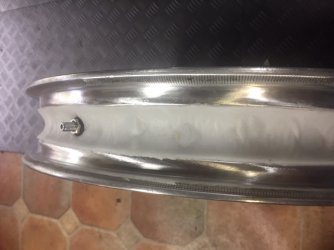
No silicon used, just the sticky tape. Agree that the extra weight of the silicon would be a bad idea. Tape is thicker than the tube. Tubes let go in a hurry, ie, dangerous. Tubeless lets go slowly - safer.
All the new tubes we sell are all made in china, quality is rubbish. Kenda, michelin, dont care what brand you choose, all are crap.
Spokes not the problem, bead will be the issue if there is one.
Agree Q that old borranis are much easier than the mag wheels.
All the new tubes we sell are all made in china, quality is rubbish. Kenda, michelin, dont care what brand you choose, all are crap.
Spokes not the problem, bead will be the issue if there is one.
Agree Q that old borranis are much easier than the mag wheels.

Tippie
Hero member
- Location
- Dr?bak, Norway
Does air pressure hold things against the side of a receptacle, Cam? Unless they are subject to a pressure difference like covering a hole, they are in equilibrium and free to float around? I don't get a few of the things in the video. Why overlap the tape so much? And it seems his overlap is the wrong way for tyre creep to try to unwind it with a driving tyre - which by his method cannot contact the tape anyway as it is clear of the tyre seating surface. A broken spoke will try to push the wide end of the nipple through, not such a big risk, sikaflex is bloody tough. There is no point at all having the rim band there, as Cam says. Tons of classic race guys here run tubeless with just the sealant, no tape, without problems, but they get rid of the texture on the inner lip of the rim which increases the risk of tyre creep. If your tape is really tough Vince it should be enough by itself. The risk of going tubeless with "tube type rim" has been discussed enough for it to be a matter of personal evaluation and choice. Anyone here with experienced a blowout?
martymoose
Hero member
- Location
- Sydney, Australia
No experience of blowout on a bike, but have had a blowout in the 1955 MG, front left went, but car never dived left or right, very lucky...