Clutch 8 vs 7 friction plates

LOS56

New member
Location
Malmö, Sweden
Hi!

I'm to change the clutch plates of my 1200 engine (series 1, 1980) as they are sticking severely and at the same time change the transmission chain. I’m however finding an 8-friction plate clutch mounted in the engine and I’m also having misalignment between the sprockets. First question, what’s the difference between the clutches? There are of course the two inner friction plates with springs in between and the cutouts in the outer clutch housing. The outer housing should be usable for both old and new clutch but are there other differences to take extra space for the 8:th plate? I have a clutch kit with 7+6 plates as I thought that would be correct.

So questions;

What parts are different between the clutches?

Can I use the new clutch kit? Maybe only change 6 friction plates as they are without the cutout for springs.

Does the 8+6 plate clutch create an alignment issue?

I have a 1 mm inner shim and two 0,5 mm outer shims. Is it possible to run without an inner shim for the outer clutch housing? It would improve but not fully solve the alignment issue as it is about 2 mm. I see no wear on the sprockets but small wear on chain side plates.

Thanks for any support!

Lars
 
Should definitely not run without the inner shim. The clutch plate pack has no effect on how the sprockets align. There was a recent discussion regarding this, a search may find it.
 
Thanks for the replies, the earlier discussion was useful. Regarding shiming the crank sprocket, 1 mm may work but 2? Then the nut will not be fully engaged to the threads. A bit strange that the misalignment is so large. Is a 0,5 mm shim too thin to use on the inside?

Regarding the clutch pack, I assume the inner drum or the outer pressure plate are thinner to take the 8:th plate? Or it has just been fitted and a reason for the troublesome disengement? Is there any way to check if the parts are correct for 8+6 clutch pack?

I read that the preload springs for the inner friction plates are not needed, I guess it makes it much easier to assemble the clutch without the specific tool (which I don't have).

Lars
 
In 40 years I've never come across a primary drive that required more than 0.5mm to align. The clutch drum should be centred between two 1mm thrust washers, one on each side of the drum.

Although they are disdained by most, I'm a big fan of the tensioning springs betwen the hindmost plates, they can reduce clutch clatter drastically, their sole purpose. It may be a pita to fit them, but well worth it imho. It is of course a breeze with the correct tools... I've modified my 750 clutch in the same manner to achieve less clatter and noise, works quite well.

The hub is modified to accomodate the extra plate, no more. You could modify one of the new plates accordingly to fit the springs and re-use one of the originals. Or just omit the springs and see how it goes...

piet
 
Thanks, I guess I could change the order of the two existing plates with cut outs, one side must be very little worn, if I keep the springs. I read some old threads and it seems there are no consensus if they make a difference or not ;). I found a tip how to assemble without the special tool.
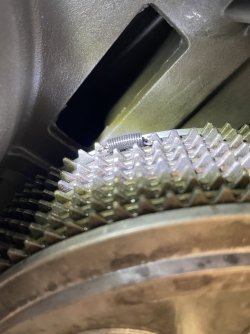
Is there any measurement I can do on the hub to see if it is for the 8+6 pack or it would just not fit on the old hub?

Regarding the alignment there are no shim behind my crank sprocket, the parts list shows 0,5 and 1 mm available from the factory so at least I can use a 1 mm. Don’t know why it’s so badly aligned.

Lars
 
Slide the entire plate pack onto the hub, you will need to have about 4-5mm of the hub splines exposed so they can register with the pressure plate and not over-ride when the clutch is deployed.

piet
 
Thanks Piet

Finally, I got some time to go into the garage... I have disassembled the clutch and took some pictures. It looks marginal that the pack fits but there is no strange wear on the hub or pressure plate. I post some pictures. Do you think it’s the correct hub for 8 friction plates? One strange thing is that when actuating the clutch, the pressure plate is “warping”. Could it be due to too little distance on the hub for the pressure plate? All springs are 46-47mm free length.

Regarding the anti-rattle springs, they look not to be stretched to do any good. The one who assembled cheated, I guess ;). Picture taken before actuating the clutch. No nice look of steel plates after standing for 20 years, guess it's why I couldn't break them loose.

Regarding alignment, I think a 1mm shim on the crank will do it and they should be available.

Regards Lars
 

Attachments

  • 20240619_090737509_iOS.jpg
    20240619_090737509_iOS.jpg
    166.4 KB · Views: 31
  • 20240619_084718349_iOS.jpg
    20240619_084718349_iOS.jpg
    124.7 KB · Views: 31
  • 20240619_090813539_iOS.jpg
    20240619_090813539_iOS.jpg
    161.8 KB · Views: 31
I measured the new clutch pack and I'm now convinced it's an 8+6 plate clutch. Also found an old post by Piet with engine numbers for series 1 where the 8:th plate was introduced and my 1200 is above but my 1000 Jota just below. New learning and a lot of good stuff on those old posts. My hesitation because some other parts as the cylinder head came from a RGS Corsa. Have put together the clutch temporary and will try to keep and find a way to stretch the plate springs (I kept the two inner friction plates), the rest new.
 
The springs will snap closed the second the pressure plate is relieved. The pressure plate rarely turns exactly true when deployed, but no big deal as long as the plates are completely free.

The splines of the hub can give you an indication if you have the correct hub. The Mk I hub has splines reaching to the rear brim, the later Mk II hub has a small plain portion at the end of the splines. The original Mk I hubs had the brim slimmed a bit to make space for the extra plate.

piet
 
Back
Top