Clutch Actuation Rod - 180 S2 Jota

Rocket

Full member
Location
Melbourne
Hi All,
I am in the middle of installing new clutch plates in my 30 year old Jota, a job which is turning out to be bigger than Ben Hur.  ??? My latest issue concerns the actuation rods and the hydraulic slave cylinder.  While bleeding the hydraulic line after installing the plates the slave piston went past the point of no return and caused a large leak of fluid.  After removing the cover I noticed there was not much of the rod sticking out.  Does anyone have a measurement for how much should protrude?

I did inspect the other rod while the clutch was dismantled which looked fine. The ball bearing did not come out with it so I returned the rod and reassembled the everything. I hope that ball bearing is in there and in the right place.  ::)  I'm going fishing.

Cheers,
Rocket
 

Attachments

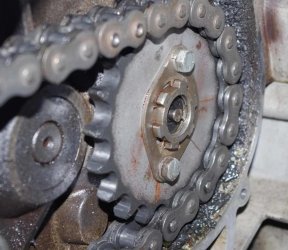
  • Drive Sprocket1.jpg
    Drive Sprocket1.jpg
    149.3 KB · Views: 12
Should have about 15-18mm protruding, depending on clutch plate condition.  New plates-less, old/worn plates-more.  Guess you'd rather start fishing for the bearing. :D

Check rod ends for wear, the indents made by the bearing can be rather deep.  Check the bearing in the slave piston, also often worn to an oval shape.  The cross-piece that works the pressure plate can also wear to the point that several mm go missing...

If everything needed is present and the rod is still too short, either replace the whole caboodle or cut off 1cm from one of them, re-dress the ensuing ends and stick the short bit back in and add another bearing ball before replacing the remainder.  Should then be a bit too long, but gives you something to work with.  You can then gradually remove a little bit by bit till all slots together nicely.

piet
 
yeah - put my money on the ball between the two rods is missing or welded to the right hand rod. Never tried it, but I know at least 2 bikes that used 2 balls in the middle to close the gap between rod and slave cylinder.

Make sure the ball in the slave cylinder piston still turns and grease this one as much as possible! make sure the piston looks OK, the coating isn't damaged to much and you replace the O-ring with one that is capable of the job (oil, grease and brake fluid resistant)...

The construction is very sensitive to keeping the clutch lever pulled while engine is running (f.e. remaining in first gear while standing in front of a red light, waiting for it to turn green to start of right away). The way to weld the ball to the rods easiest is either on a dyno or on highways with pulling clutch lever at high engine speeds and keeping it pulled. This way, the engine side runs slower than the sprocket, which - due to the oil-seal inside - turns (or tries to) the right side rod at sprocket speed. Different speeds + pressure = friction = heat = problem.

So - if the ball is welded to one or both rods and/or the slave piston shows radial wear or the ball sitting it it has welded itself to the slave piston, this is caused by the engine running slower than the sprocket (pulling clutch lever at high speeds). wear on the cross piece that separates the clutch is either due to the engine running faster than the sprocket (e.g. when pulling clutch lever in front of traffic lights) or is a consequence of the already damaged ball-bearings of the actuation system.

So - depending on what you find, this should help to avoid those damages in the future. Had it on 2 different Laverdas - no fun at all... Even had to kind of "roadside repair" it once, which involved finding someone to drill the welded ball out of the piston, make new rods etc., which is not really a road side repair anymore, but re-assembly was really on road side, involving a complete strip of primary drive AND shifter cover... :-[ No fun at that time, but good experience looking back...  ;)
 
The ball-on-ball method should be avoided.  They will not "centre" themselves on one another and chances are high they can damage the mainshaft bore because they are canted.  Always seperate 2 balls with a length of rod (be a bit difficult, biologically :D), even a 6mm roller bearing would do the trick.

piet
 
sfcpiet said:
Always seperate 2 balls with a length of rod (be a bit difficult, biologically :D), piet

not if you wear very tight underwear...  :D :D :LOL: :LOL: :D :D

and yes, its better to have not to balls touching each other. I mean in the clutch actuation system. ;)
 
Laverdalothar said:
Make sure the ball in the slave cylinder piston still turns and grease this one as much as possible! make sure the piston looks OK, the coating isn't damaged to much and you replace the O-ring with one that is capable of the job (oil, grease and brake fluid resistant)...

Not as easy as you think Lothar:
Viton 'O' rings = superb for oils/greases - hates brake fluid though.
EPDM 'O' rings = superb for brake fluid - hates oils and greases.

source: http://www.marcorubber.com/material_chart.htm

You need to look at Kalrez(or equivalent) 'O' rings to do oils and brake fluids (in fact Kalrez can handle just about anything you can throw at it).
Big downside to these Kalrez 'O' ring thingies is the cost is eye-wateringly high.
 
There's not much heat build-up in a clutch's hydraulics, so you don't need brake fluid in a clutch system. If you just use light oil (eg, diesel fuel, kerosine, paraffin) then you don't need brake fluid resistant o-rings.

Cheers,
Cam
 
Thanks guys for your responses. All good info.
I've come back from my fishing trip. No ball.  ::)  I will assume it is in there for the moment and buy/have made up a longer rod to extend it the 15-18mm that Piet suggests.  I will cross check this with measurements of the slave cylinder piston position and travel. The slave piston is only 2 years old (~7,000 km) and installed at the same time I applied Red and Wolfgangs fix for the cover cracking problem. It must be something to do with the increased overall thickness of the plate assembly and will change over time as the kevlar beds in.  As Piet says "You can then gradually remove a little bit by bit till all slots together nicely."
Looks like you have to keep a regular eye on this one and shorten the rod in small steps.

For the record one rod is 123.3 mm long
It is protruding 4.9 mm past the oil seal and only 2.6mm past the seals wire retainer. (a place the piston should not go!)

Cam, that's an interesting point about types of hydraulic fluid you can use in the clutch. Do you run any of these alternate types in you bike?
 
Rocket,
Go back and have a look at your pressure plate alignment on the clutch hub.
Have you lined the pressure plate up so it engages the clutch hub spline ?
you have a choice of 3 positions over the 6 studs where the clutch springs go
not all positions engage the clutch hub spline, your pressure plate may be sitting proud of the hub

 
Hi Red, no doubt that will be the issue.  I was not aware of that alignment requirement. Not in the green book.
So its off with primary chains again.  :-[
Many thanks.
Rocket
 
Dellortoman said:
There's not much heat build-up in a clutch's hydraulics, so you don't need brake fluid in a clutch system. If you just use light oil (eg, diesel fuel, kerosine, paraffin) then you don't need brake fluid resistant o-rings.

Cheers,
Cam
A good cunning plan Cam, but if you are to use Hydrocarbon oils you also will have to get Viton lip seals for the Brembo master cylinder as well.
 
As an aside to the conversation about clutch actuator balls, it is worth pointing out that they are not all the same.
Tungsten Cobalt balls are supposed to be good for extreme load and wear resistance:
http://www.alibaba.com/product-gs/402477596/Alloy_ball.html

Might be worth thinking about? I have used them in steam Safety Valve applications where there is the highest load. Ordinary ball bearings get muellered in no time.

Not sure what the originals are made of though.
 
Many thanks to Red for diagnosing my problem.  I have disassembled the clutch again and indeed the pressure plate and clutch hub spline where not aligned correctly which prevented the pressure plate from going the final 8mm onto the spline.  I had a 1 in 3 chance of getting it right but lucked out this time.  :(

With both the clutch plates out and the RH cover removed I went fishin' again for that elusive 6mm ball bearing. Still no ball!  :o
It was there once but now.  With a new ball and the additional 8mm from the pressure plate I should have that 15-18mm of rod protudence that Piet advised.

Thanks everyone. I Love this Forum.  :-*
Rocket
 
Hi Rod have you got the ball between the two rods?? is that the one your talking about??? you can also turn the square peg that pushes on the pressure plate 90 deg' so there is no wear on the face that meets the rod.
Be careful with this non hydraulic brake fluid if your master cylindr seals are standard any non hydraulic fluid will swell the seals and jamm the master cylinder completely.
M.
 
Hi Maurice, yes that was the ball I was looking for but it wasn't there.  I must have let it lose unknowingly a couple of years ago. That would explain the different feel to the clutch lever after an hour or two on the bike.  Glad you mentioned the square peg as it seemed reasonable to turn it which I did. All fixed now I think. I am yet to fire it up as I am still fitting new cam blocks supplied by Red. Must get them seating correctly! I look forward to catching up with you at Eastern Creek.
Cheers,
Rod
 
Back
Top