Clutch plates

Tippie

Hero member
Location
Dr?bak, Norway
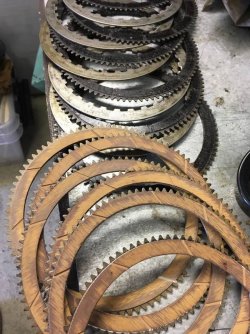
Does anyone recognise this type of clutch plate?
From memory (most unreliable!) I bought them as kevlar but from whom escapes me.
 

Attachments

  • rsz_clutch_plates.jpg
    rsz_clutch_plates.jpg
    96.6 KB · Views: 38
Hi Tippie,
Definitely new style kevlar plates.
I would guess from Keith Nairn in Scotland?
I have had a couple of sets from him, they work very well. With standard springs, they have plenty of bite.
Best to replace the steel plates as well, if they are even slighty warped, the clutch tends to drag, snd the gearshift quality is crap.

Hth
Steve
 
Thanks Steve. I did get some stuff from Keith some time ago. For some reason there were only six when I recently unpacked them, they?ve been sitting in my race spares box since I got them.
 
angonemoto said:
I'm considering overhauling the clutch on my 68 750 GT. Is Keith the best resource for modern plates and springs that will drop into Laverda twins?

You're going to have an iron peg clutch unless previously changed.
Plates are the same as the others.

Paul
 
One sure thing that will Fuck Up your Breganzie Clutch Disc's and Plates's is Synth-Oil. Other words they will last forever with seasonal changes of DINO Oil. (Any 15w40 industrial diesel grade)

Learn to Clean, Burn with a Propane torch or Bake them in your Wife's oven then buff if you contaminate the Clutch Stack.
 
Mobil 1 last time I rode it late 1990s!) and never had a problem with the clutch. New motor will go onto Moto version of Mobil 1 once I've run it in on dinosaur oil. Each to their own when it comes to oil.
 
Yes: Rotella, Mobil 1, AC Delco, Delvac Super 1300(My Fav) - what's another Shell Duramax?... etc 15w40 Diesel DINO.

Kinda think Mobile 1 and Shell Duramax is labeled under Rotella T6.

Basically all Mobil 1 except for AC Delco (Ford) and Delvac.

To clean a dirty cable after 3 or 5 years, I will hang them and drip Varsol and Methyl Hydrate through it for a few days then heat and dry them with heat gun or hair dryer then drip ATF through them and repair any cracks in the skin with heat shrink.
 
Oil for diesel engines has a higher detergent content  which isn't ideal for our unfiltered oil systems as it picks up and carries all the crap around the engine.
 
Grant said:
Oil for diesel engines has a higher detergent content  which isn't ideal for our unfiltered oil systems as it picks up and carries all the crap around the engine.

Lovely on a clean engine.

Paul
 
Dream on.
I see a lot more of them than you, and that's certainly not my experience.
 
My Jota has done something like 75,000 km and the slingers were half full when I split the case a couple of years ago to fix a gearbox bearing. At that rate they'll probably need to be replaced by around 150,000. But with the amount of use the bike gets, I'll be in a nursing home and Red will probably be retired by then! 
 
They only fill up to around "half-full" Cam.

The crap builds up to the edge of the crank pin bore, after that, oil flow washes everything through the big-ends... ::)  If you can actually see the surface of the crap in the slingers by peering past the bearings, it's just about cleaning time.

Many of the cranks I repair have sludge up to the pin bore, these usually have knackered pins and rods as well.  As many cranks have led a life or 3, it is difficult to assess the realistic mileage they have attained before they land on the workbench.  Big-end ovality and small end wear can give an indication of what sort of life the crank has led, twins show nicely polished grooves in the big-end, resulting from roller cage edges paired with dirty oil.

piet
 
Yes, I was aware of that. By "half full" I meant half way up to the crank pin bores. I couldn't see the crap. I checked the level of crap by poking a bit of wire down inside the slingers.
 
Someone said a while back you could tell a lot from reading the layers of sludge,how many oil changes the bike had over its life.
 
Vince said:
Someone said a while back you could tell a lot from reading the layers of sludge,how many oil changes the bike had over its life.

That's going a bit far, Vince.

But, you can tell if any bronze bushes (gearbox, small-ends) have given up during its service life, results in a nice gold circle within the crap.  This can only be seen if the slingers are removed.  When cleaned while fitted, there really is no way to tell what has gone on.  Only how well it was maintained if the true mileage is known.  A well-maintained crank will show considerably less sludge build-up over a given time/mileage than a neglected one.  But then you would need several cranks for comparison...

Anything you may find in the slingers has had to travel through the sump strainer and the oil pump first.  If any big bits are found, you can bet on the oil pump being really knackered.

piet
 
Back
Top