Clutch slave insert

I did some measuring of the Wolfgang hose adapter and the threaded hole in the slave - realised that the adapter wasn't reaching down to the flare/taper at the bottom of the hole, it jammed up in the thread before it reached there. No chance of sealing that crack/hole in the threads if the male and female tapers aren't mated.

I suppose this is why I've read all over the forum that you need a long fitting on the bottom of the clutch hose, so that it reaches down (~13mm) into the hole to mate with the hole's taper. Especially because the taper is in the 30mm cylinder insert, not in the cover metal, so the fitting reaches past the join between cover and insert. Sorry if this is obvious to 95% of people reading this but it's all dawned on me in the past coupla days. :rolleyes:

It felt like the lower section of the hole wasn't tapped at all so I got a set of M10x1.0 taps, most usefully the bottoming tap - used that and the adapter then screwed in about 3mm/3 threads more. See below
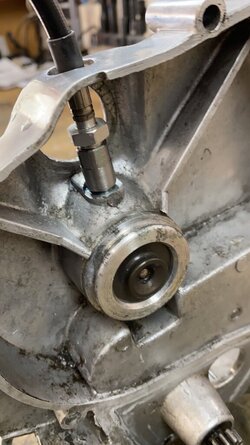
clutch again.JPG
I covered it in blue Loctite and let it harden for a day - tested it and it looks like it works now - no flexing of the cover and lever noticeably less effort - probably because it's not being used to bend 3mm of cast aluminium.

Remaining problems:
- The clutch is dragging pretty badly and the disengagement is right by the bar. With the slave now working properly this problem must be deeper in the clutch. I haven't ridden it on the road yet but it feels like I'm never going to find neutral
- As pictured above, there's a crack/hole in the clutch hose inlet so I don't think it's going to last forever - one day I'm going to need a proper fix from Keith or Clem.

-Richard
 
Glad you found that hole - if it isn’t disengaging until the bar have you got all the air out ? What sort of oil are you using ! Seems some as in the case of my Formula can stick the plates - once changed no longer a issue
 
What type of master cylinder are you using? Original (PS15 Brembo round reservoir) or something else? Anything less than a 14mm piston won't shift enough fluid to fully separate the clutch plates.
As Adam says, any air in the system won't help. Usually the clutch will almost bleed itself, but if you have the usual handlebar arrangement air can collect at the highest point which is the union between m/cyl and line. Try turning the handlebars to full right lock - or better - remove the m/cyl from the bar to ensure it is the highest point. Gentle 5-10mm movement of the lever will chase air bubbles out.
 
...but isn't the objective of Wolfgang's kit to get the adapter down into the insert material and seal on that, hence no hydraulic pressure up there where you've found the hole? That's how it should be at least, the entire problem with these covers is that the hydraulic pressure should be contained to the hose and the insert. If the seal is on the cover, then by definition you have hydraulic pressure between insert and cover - and it will crack sooner or later.
If your cover is flexing, are you sure you have got the adapter sealing directly on the insert and not the cover? If I understand it correctly, it should work with no thread sealant and no sealing washer on the cover. It should seal right down the bottom of the hole - directly on the insert.
HTH
SteveB
 
on my own bike, I am not even going to have the hose connect through the hole in the cover and onto the top of the casting/reducer, I am simply going to have a banjo on the top front face of the (new) reducer where it penetrates the front of the polished cover, this is repairing a totally trashed and badly repaired (several times) cover, some of them by me, when I was less learned, it might not suit others, but basically screwing an long adapter into a parralel thread is still a compromise, the seal is the clamping of the copper washer under the hexagon flange spigot, although I have invested in sme HORRENDOUSLY expensive Loctite thread sealant, which becomes a plastic on contact with non ferrous metals and doesnt even require the thread to be tightened, taper or parallel, just screwed together, then left for 24 hours, my own take is, if it aint there it cant give trouble, and if I have trouble bleeding it (very much dont think so) i can change the banjo bolt for a bleed nipple type. this repair is underqway and I will picture it when done.
CLEM
 
What type of master cylinder are you using? Original (PS15 Brembo round reservoir) or something else? Anything less than a 14mm piston won't shift enough fluid to fully separate the clutch plates.
As Adam says, any air in the system won't help. Usually the clutch will almost bleed itself, but if you have the usual handlebar arrangement air can collect at the highest point which is the union between m/cyl and line. Try turning the handlebars to full right lock - or better - remove the m/cyl from the bar to ensure it is the highest point. Gentle 5-10mm movement of the lever will chase air bubbles out.
Rob, it's the original PS15 M/C, with new piston and seals - I'm pretty sure it's well bled now but I'll see if it's improved overnight ('bars to the right as you said) - maybe have another go bleeding it. I had the whole thing plumbed together on the bench to look for leaks, G-clamp holding the piston pack with some rubber, and the slightest movement at the lever moved the piston so I had it bled there I think.

Anyway, yes I'll keep bleeding it.
 
...but isn't the objective of Wolfgang's kit to get the adapter down into the insert material and seal on that, hence no hydraulic pressure up there where you've found the hole? That's how it should be at least, the entire problem with these covers is that the hydraulic pressure should be contained to the hose and the insert. If the seal is on the cover, then by definition you have hydraulic pressure between insert and cover - and it will crack sooner or later.
If your cover is flexing, are you sure you have got the adapter sealing directly on the insert and not the cover? If I understand it correctly, it should work with no thread sealant and no sealing washer on the cover. It should seal right down the bottom of the hole - directly on the insert.
HTH
Steve
Steve, yes I think that's the point of the Wolfgang kit. Mine wasn't screwing down into the insert material, so was just pumping through that crack. It no doubt got cracked inside from having a short hose-fiting and pumping into the insert/cover joint. Next step would have been cracking the outside of the cover.
My cover isn't flexing any more, so yes I have the adapter sealing directly now, right down in the bottom of the hole, in the insert material. It wasn't getting down there before because there were bad or missing threads in the insert material - now tapped. Wolfgang said to use blue-loctite so I used that - also because of the hole higher up the threads, but that should be irrelevant now as the seal is further down.

It feels pretty good now, easy enough action - it just feels like it should have a longer pushrod to move the lever out from the bar and maybe get a bit more disengagement. But, I've never had the actual clutch apart to see how that works so no idea.

"HTH" - definitely did help, thanks all.
 
All this talk of issues with the hydraulic clutch has me wondering about my own. I installed one of Red's inserts early on and it's served me well in the years since. The only clutch issue I've ever known is the problem of sticky plates when the machine has sat unused for a time. My question addresses the push rod and ball. How is that interface lubricated? Should the tip of the rod be dabbed with a bit of moly from time to time?
 
Rob, it's the original PS15 M/C, with new piston and seals
That's good for providing sufficient travel then. Just one thing - when you fitted the new piston, how hard did you whack the crush washer? Hopefully just sufficient to grip against the spring pressure. It is possible to overdo things and end up with the piston sitting further away from the clutch lever contact point, causing lost travel before it starts pushing the piston. I assume you've got full lever travel back to the handlebar grip with no fouling from light switch block etc?
 
That's good for providing sufficient travel then. Just one thing - when you fitted the new piston, how hard did you whack the crush washer? Hopefully just sufficient to grip against the spring pressure. It is possible to overdo things and end up with the piston sitting further away from the clutch lever contact point, causing lost travel before it starts pushing the piston. I assume you've got full lever travel back to the handlebar grip with no fouling from light switch block etc?
If I remember rightly I whacked it just hard enough to resist the spring - i think it finally got it about 3rd attempt.
Yes I fiddled with the location on the bar yesterday so that it didn't foul the switch block. I wondered whether someone had swapped the lever for one with different leverage - it looks like the normal Brembo lever, but only way to be sure is to get a new one I suppose.
 
All this talk of issues with the hydraulic clutch has me wondering about my own. I installed one of Red's inserts early on and it's served me well in the years since. The only clutch issue I've ever known is the problem of sticky plates when the machine has sat unused for a time. My question addresses the push rod and ball. How is that interface lubricated? Should the tip of the rod be dabbed with a bit of moly from time to time?
I should think that the oily environment is quite sufficient.
Just don't sit on the bike with the clutch pulled in at traffic lights. You shouldn't do that with any vehicle.

Paul
 
Back
Top