Clutch sticking issues on a 3CL 1980.

Charley

Senior member
Location
Europe
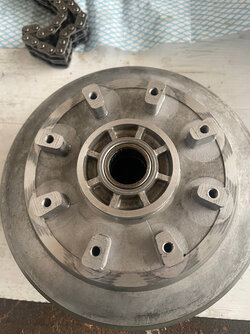
I've stripped out the primary drive system and pulled off the clutch drum to prepare for drilling the drum.
I've got fed up with dealing with a sticking clutch.

Clutch freed at the beginning of a trip, I find after a longer run down the motorway with a warm engine, that the clutch sticks and I get clunky changes or must pre-empt the need to change gear and ensure the clutch is free beforehand.

A more experienced pair of eyes than mine would be able to read the 'witness' marks on drum and chain wheel.
Anything I should be aware of when looking at these components?

I did change the rubbers last summer but did not see the marks that are visible now.
That doesn't mean they were not there, just that I did not see them.

I was surprised at just how dry the inside of the drum was, no sign of oil at all, just clutch dust.
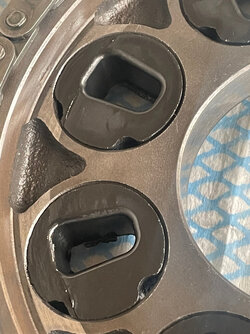
IMG_0452.jpegIMG_0453.jpegIMG_0454.jpegIMG_0455.jpeg
 
Have you got a 2 cm hole on the floor of the primary through the separation to the gearbox? If not, drill one.
The outer plate appears to be split at 5 and 8 o'clock. No big deal.

What oil are you using? Where do the clutch plates come from?

Paul
 
Have you got a 2 cm hole on the floor of the primary through the separation to the gearbox? If not, drill one.
The outer plate appears to be split at 5 and 8 o'clock. No big deal.

What oil are you using? Where do the clutch plates come from?

Paul
Yup! There is a hole for cross transfer of oil.
As to the split plate, I've not pulled the clutch apart. Yet.
I've no idea where the plates are from or their make.
I bought the bike last year and I'm still learning.
Bike was built 20 years ago and has spent most of that time in a garage, very few kilometres on the clock.

Oil.
When bought, Semi synthetic Silkolene 20w50. Clutch stuck.
Changed to Repsol, 20w50 mineral. Clutch stuck.
Then Motul, 20w50 mineral. Clutch stuck.
Then Wagner, 20w50 mineral.Clutch not tested with this yet.

Yes I keep changing it.
 

Attachments

  • IMG_0464.jpeg
    IMG_0464.jpeg
    223.9 KB · Views: 44
Have you soaked the plates in oil a good while before assembling?
Is your clutch lifting enough: rods the right length and balls present and to spac?

Paul
 
Yup! There is a hole for cross transfer of oil.
As to the split plate, I've not pulled the clutch apart. Yet.
I've no idea where the plates are from or their make.
I bought the bike last year and I'm still learning.
Bike was built 20 years ago and has spent most of that time in a garage, very few kilometres on the clock.

Oil.
When bought, Semi synthetic Silkolene 20w50. Clutch stuck.
Changed to Repsol, 20w50 mineral. Clutch stuck.
Then Motul, 20w50 mineral. Clutch stuck.
Then Wagner, 20w50 mineral.Clutch not tested with this yet.

Yes I keep changing it.
It's split on your photos, 5 and 8 o'clock.
Probably from casting.

Paul
 
It's split on your photos, 5 and 8 o'clock.
Probably from casting.

Paul
Thank you for your prompt replies and help.
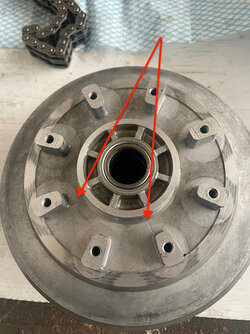
The split or splits I think you refer to (See photo for clarification) are casting faults.
Clutch appears to be lifting correctly.
Before a planned ride I put a ring of inner tube around the clutch lever to keep the clutch lever pulled in over night and then the clutch is free and works well until the end of an extended motorway stint or I leave the bike un ridden for a couple of days without operating the clutch.
During normal everyday riding the clutch operates as I would expect it.
As I did not assemble the bike I did not soak the plates.
They are going to get a soaking before re assembly.
Thanks, C.
 

Attachments

  • Clutch outer splits arrowed..jpeg
    Clutch outer splits arrowed..jpeg
    194.7 KB · Views: 24
Hi Charley. Just a thought....
Your query is worthy of a sepate thread. It would be good for future searches. Good info might get buried in this gereral thread.
 
Can you post pics of the clutch plates, friction and steel, in the order that you take them out.
Close ups will help to determine what's going on.

Gerald
 
Can you post pics of the clutch plates, friction and steel, in the order that you take them out.
Close ups will help to determine what's going on.

Gerald
I wasn't going to strip the clutch but may have to.
Photos will be posted when I've dug deeper.
 
This is a re write of a post I placed in 'What did you do to, for or with your Laverda today?
First some bike details.
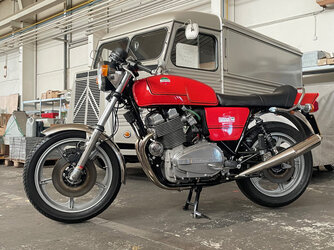
I bought the bike last summer, it's a very low milage very original spec 1980 3CL. Restored back in 2000 as far as I know,
by a Mr. G. Duguid and he appears to have done a very good job. It was then cosmetically refurbished by Made in Italy M/C.
The next twenty years have put very few kilometres on the bike whilst cared for by two different owners.

First thing I did having bought it, was ride it back to where I'm stationed in Germany.

At first all seemed well. Although I did notice a slight hesitation of the clutch to free up in the mornings.
On longer stretches of motorway the same occurred.
Once back I started a refurb as all the external rubber components had lost their elasticity.
After multiple oil changes and setting up of clutch cable and actuator I was still suffering the clutch sticking.

Oil.
When bought, Semi synthetic Silkolene 20w50. Clutch stuck.
Changed to Repsol, 20w50 mineral. Clutch stuck.
Then Motul, 20w50 mineral. Clutch stuck.
Then Wagner, 20w50 mineral.Clutch not tested with this yet.

There is what appears to be a pair of splits in the clutch drum but they are just casting marks.
I've no idea of the type or make of clutch plates used or if they were soaked in oil before assembly.
I can't help but think that given the time scale that they could benefit from a re oiling.

I have just given the clutch drum to a machine shop next to the shed where I'm working for drilling as per details found on this Forum.
12 mm diameter holes at 30 degree intervals.

Now back to the warehouse and working on the bike.
I should be working but there's not a lot of ice to break in Bremerhaven at this time of year.
 

Attachments

  • 3CL.jpeg
    3CL.jpeg
    271.5 KB · Views: 23
  • Clutch outer splits arrowed..jpeg
    Clutch outer splits arrowed..jpeg
    194.7 KB · Views: 23
  • Like
Reactions: Jo
Basic things to check:
The bearing is in good condition (and so helps keep the outer drum from 'rocking' a little bit under chain pull, even though the bearing is central).
The 'teeth' on the inside of the drum are not too worn and notched.
The 'teeth' in the drum-engaging plates are smooth and not burred (which can dig into the drum). Smooth off any manufacturing burrs.
The plates are together in the right order (and the right quantity!)
The steel clutch plate faces are not overly polished.
The sprockets are in line. This is achieved with shimming. For heavens sake don't use a hacksaw blade like in the green book - do it properly.
Check for wear in the whole actuation mechanism. If worn, a full travel at the hand lever can translate to a reduced travel at the clutch.
 
You appear to have a cable clutch which is a good thing.
Measure the rods and balls. Every little fraction of a millimetre helps.
Make sure that the plates are free to slide in the drum. File out any burrs.
I the oil is responsible for your sticking clutch problem, you'll need to soak the plates in solvent, dry and then soak in oil before rebuilding. The plates easily become contaminated.
Or put new Surflex plates in. Not a big expense.

Paul
 
Quick question before I get to far into the clutch.
Are the six clutch bolts done up to a specific torque or to a position?
Is the spring pre load set by the stubs cast in the clutch centre?
Previously, I've assembled diaphragm sprung clutches and
set up British motorcycle clutches where spring length and pressure is adjusted to suit but Laverdas are new to me.
Help appreciated.
 
Quick question before I get to far into the clutch.
Are the six clutch bolts done up to a specific torque or to a position?
Is the spring pre load set by the stubs cast in the clutch centre?
Previously, I've assembled diaphragm sprung clutches and
set up British motorcycle clutches where spring length and pressure is adjusted to suit but Laverdas are new to me.
Help appreciated.
No to all questions.
The only spec is spring length.
Tighten them down evenly until the screws bottom.

Laverda, apart from a few specific points are very straightforward.

Paul
 
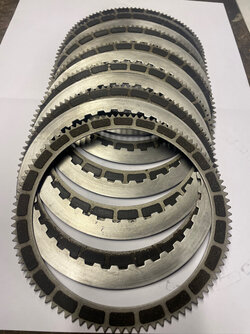
Clutch now stripped.

Just received my first order from Orange Cycle Team and I'm very happy with their rapid response and service.

Clutch springs measured at 46 to 46.5 mm, only one was as short as 46mm so I'm awaiting the my order for new ones.

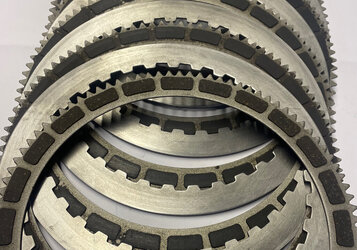
Seven friction plates all measuring 2.90 to 3.00 mm after I'd separated them from their pressure plate neighbour.
Some required the use of a screw drive between teeth to easily prise them apart.
All plates were oily but stuck together with varying levels of gentle persuasion required to separate them.

Pressure plates cleaned up nicely with a new piece of 3M extra fine abrasive material, 'Scotch Brite'.
All pressure plates measure 1.6mm thickness, are flat and have nice smooth tangs/teeth.

Friction plates after cleaning with brake cleaner, 3M extra fine and more brake cleaner all measure in at 3.00mm give or take 0.1mm
I gave them a very light de glazing as nothing else appeared to be required.
Once the new clutch springs arrive, I'll soak the plates in engine oil and refit everything.
As can be seen, there are none of the anti rattle springs to deal with.
Not sure if I should buy new friction plates or not, or from whom as there appears to be a wide variety of potential makes and thicknesses.
Any suggestions?

I have new circles and shims ready and waiting.
Am I one of many or one of the few who always endeavours to use new circlips in a situation such as this?

See attached photos for a look at the clutch plates.
I have no idea as to whom is the manufacturer or when they were fitted, I assume, as I've no information to confirm or deny it,
that they are the ones fitted when the engine was rebuilt twenty odd years ago.

Clutch is cable operated, rods, ball and mechanism appear to be in good serviceable condition.
The square section pin does have witness marks that show it to have been heavily used previously but it has been turned 90 degrees to regain correct tolerances for operational purposes.

Both the clutch cover and hub centre have obvious marks of use but none, to my eye, appear to be detrimental to correct operation of the clutch
A bit of cleaning and tidying is all that is required.
Does anyone or has anyone tried applying a tiny smear of Castrol Molub-Alloy Paste White T on the splines or is this 'over the top' ?
 

Attachments

  • IMG_0466 (1).jpeg
    IMG_0466 (1).jpeg
    200 KB · Views: 40
  • IMG_0466.jpeg
    IMG_0466.jpeg
    175.5 KB · Views: 39
Has been touched on by others, but photograph the teeth inside the clutch drum for us. I have a special triangular file I use to tidy up the teeth inside the drum. I have also come across a warped drum. Only answer was to replace it. If you have a mate with a lathe, set it up and check for runout. The last clutch drum I did on a 1976 jota, there was a good hour of hand filing with the triangular file to get it cleaned up.
 
If you mean, that clutch actuator extended arm, it is a hoax, hate it with a passion, runied many a good outer casting cover. "Fix" one issue and get a bunch of other unwanted consequence. Also been covered before as Marty mentions also as such "hard clutch lever action". Suggest strongly that proper cable, proper routing. will make a noticeable reduction in clutch lever pressure requirement, should that come up as an issue. With some good fortune a dog leg lever can help with high clutch pull lever issue. j
 
Back
Top