Combustion chamber question

Naranja

New member
Location
Sweden
Hi
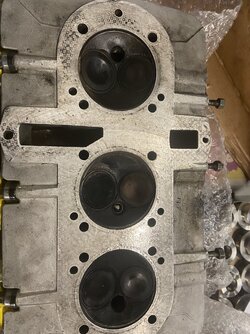
I had to remove the head of my 77 3 CL with 4/C cam as I need to fix one spark plug thread. Thats when I’ve found some things for which I would appreciate advice from all experienced Laverders. The attached picture shows:

A. Around all valves there’s a pearl necklace—like pattern. Does anyone have an idea of what that is?

B. The middle cylinder seem to run dry. The PO had all exhaust valves replaced because one of them was burned ( he doesn’t remember which but I assume it was the middle cylinder). This happened ten years ago but only less than 2000 kms ago. So, although the head was completely renovated at a professional workshop, I’m afraid the root cause was not resolved. So my question is, what is the normal main jet size on a 3CL with 4/C cams? Current size is #120 for all cylinders but when looking at other recommendations (e.g. DAM classic) it should be #145 for a 4/C. That’s a huge difference but could also explain why the valve was burnt previously.
Thanks
Axel
 

Attachments

  • 5878CE2C-86FD-42BB-B66E-0E04B5E6CAF9.jpeg
    5878CE2C-86FD-42BB-B66E-0E04B5E6CAF9.jpeg
    214.3 KB · Views: 158
Looks like someone has used a punch on the alloy round the valve seat, perhaps they thought it was loose.
Colour of the combustion chamber looks OK.
Main jets are much smaller, nowadays, due to changed viscosity of modern fuel.
 
You have one of the all-alloy heads, as opposed to the skulled heads used before and after this debakel. The valve seats are shrunk into the head and the rim of the bore is rolled over the edge of the insert to prevent them from falling out. The edge of the rolling often burns and crumbles, resulting in a "pearl necklace" (first time I've heard it used in this context:LOL:). The factory obviously had no faith in these castings... It does look like somebody has tried to secure the inserts with a series of punches in your case. These heads are notorious for their porosity and tendency to collapse and warp. At some stage, they were also paired with the dreaded short valve springs and shallow spring retainers. These can/should be swapped for the earlier or later items. I truely despise working on these heads, most are a fucking can of worms.

If jetting is overall correct, burnt/stretched valves usually result from incorrect float heights. Your 120 main sounds a tad small, 145 is generally OTT.

piet
 
Good questions, as Piet indicates the history and background, as owner this is better or worse. Bottom line would be your own safety is paramount. Odd for me is the small mains and yet the head indicates an overrich burn, could be wrong there as its a photo on a laptop. Spark plugs removed would tell extra information.

Mostly a post like this would benefit from all the particulars, the misnomered "idle jet" ( 55 a reference value ), mains ( series 1 motor around 132 ), slides ( K1 middle clip and overall condition ) emulsifiers AB265 ( correct me if number sequence wrong ), slides 60/2 was it? Crucial and most important 18m/m float height as per Piet comment. Good condition "choke" assemblies o rings intact, seating correctly. Idle fuel screw adjust, again o ring in good condition, about 1 and 3/4 turns out from cut off position.
Ignition, all bets are off for me if a oem BTZ, cannot help if these are in place. Coils in good working condition, no oem anti start resistors ( hard cranking starts on full fuel enrichment ).... 'Bout it. others will also see any anomalies....j
 
I cannot see what happend to "your" head, anyway it soundslike more after a carb threat.... the manual says 165 main jet for jota, this is way too big, usually they have 145 (never heart about viscosity of fuel anyway...), but be aware that the main jet is only for the 1/3 of high rpm! the jetting depends to many factors, not only the camshaft. without a Lambda you never get a good result, the needle, atomizer, needlejet, and also the idle jet is also important! compression ratio, exhaust of course too......
 
Going by the surface finish it also appears as if the head face may have been machined. Check the overall thickness of the head - top to bottom face. It should be 94.0mm. That should let you know if or by how much the head face/s have been skimmed. It is not uncommon to require this for bottom and/or top face (I gather particularly on this type of head). It is sometimes simply necessary but doing so creates other problems that need to be managed.
 
Thanks all! Very helpful! also, very interesting to have an explanation to the pearl necklace 😊. Anyway, I am a bit worried to have to live with one of the crap cylinderheads. Historically there has been related headaches around this machine. During restoration , by PO, the head has been machined (rectified). Also the block was decked which seem odd to me as the liners were removed. The valve seats were milled (”Mira fräsning” in Swedish). New needle valves were also added to carbs.

What happened before head off was that the spark plug on 1st cyliner popped out ( all the spark threads has been replaced with sockets during restoration but this one did not fit very well, which I knew about and hence the need for head removal). So I had to make a 1km trip back home on 2 cylinders (which Ive done before for the same reason) but then another cylinder was starting to play up so I got home on one cyliner most of the time while another woke up now and then. After all, I’m a single guy having also a Ducati 450 and Yamaha SRX 600 in the garage…Anyhow, while the problem with cylinder 1 is pretty clear - the head is now at Gunnars workshop to have an oversized alloy sparkplug thread inserted - there’s also seem to be a problem with number 2. By my eyes it seems to be running dry (like the whiteish valve and also spark plug). I haven’t look much into the carbs yet but I will definitely look up the float level needle position so thanks very much for the references. The pilot jets are 60, idles jets are 70.

Btw, there’s also a very strange smell (tar?) from the cylinder head which to my not very sensitive human noose seem to come from the cylinder 2 exhaust. The cylinder exhaust opening also has something very sticky residues in it and there’s some black sticky leakage on the outside. My current hypothesis is that the gasket on the EX 2 valve stem is leaking due to overheating and need to be replaced, and this could be caused by overheating due to some carb problems… Anyone felt similar smell from your beloved motor? Whish I could send a sample over the internet…🤥.

Despite the problems I’ve become addicted to the sound of the 180 triple and when spring comes, the music should be back.
 
Get an engineer who knows Laverda to have a look at your head and block. The head has a few must knows.
Might save you throwing the whole lot out.

Paul
 
A "an oversized alloy sparkplug thread inserted" sounds not good to me, since there is allready too little material in between! I did let a good workshop welding the hole to close it and drill a threat for 10 mm plug. Works perfect.
 
I have smelt that smell only once before and it was a Laverda 1200 triple that had run about 200 miles before failure, following an oil change, it was run without new oil being added, quite remarkable given the circumstances and the fact that an international sea crossing was part of those 200 miles, I wont say his name out of respect for him.

My advice is dont use that head, scrap it and obtain another with cast iron skull, which includes, on all of them so fitted a cast iron "nose" for the plugs to screw into, but in all cases an RGS type head is much better and they will fit any triple engine, infortunatley for you the valves are a different size, but if you are lucky (very lucky) you will get one complete with valves, all other parts interchange, springs, collets, cam bearings (assuming 22mm abutment type, not dowelled type) etc even better than that is a Corsa/SFC1000 head, which will also fit, but its going to be hard enough to find a head at all, so you realy cannot be choosey, if you persuade someone to sell you one then great! it might even be possible to buy a new (unused) head, that wil empty all of your bank accounts, and maybe there are none left. There is a very godd set of reasons why Moto Laverda admitted their mistake and ditched the all alloy head, only to return to what was made before.
CLEM
 
I have smelt that smell only once before and it was a Laverda 1200 triple that had run about 200 miles before failure, following an oil change, it was run without new oil being added, quite remarkable given the circumstances and the fact that an international sea crossing was part of those 200 miles, I wont say his name out of respect for him.


CLEM
Haha.
I remember that one. A Sunday evening dash to Calais with the car and trailer.
Paul
 
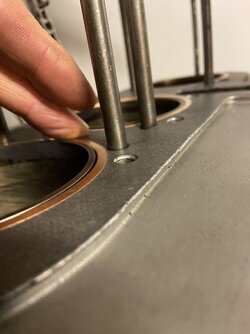
Anyhow, I’m striving further down (or up as I hope 🤞) the road with my all alloy head (is this the only one left?). Gunnar has made and inserted an alloy socket to replace the loose spark plug steel socket. After cleaning up I can only agree that the alloy is full with pores (see picture)>
69CE3554-56E3-4A7C-99AC-05D74085047A.jpeg
 
Then some further questions>
Can someone explain how the gasket works on the 1000 engine as the liners protrude above the thickness of the head gasket? Should I use double gaskets?? Before headlift there was only minor leakage around the exhaust side of the cam chain. 69A98FA8-1AD8-48FF-838C-5D2C51BA0F61.jpeg
 
Finally, do I have high comp or standard pistons on this bike?

9C904727-303F-4EBB-AFA1-018087A3672C.jpeg
sorry for all questions but any response is highly appreciated 🙂
 
Lots going on in this engine, indeed the experienced folk will help a great deal. Love the torque wrench, from an era, j.
 
Haha, forgot to hide that wrench. I only use it for disassembly, promise :rolleyes:.
Even worse, a grin here... were not a bad torque wrench to use for irregular use, gets tiresome when doing it all day, watching a "springy" indicator. Australia made some nice clicking trigger torque wrenches, love my Warren and Brown, precise and reliable.

That head stamping ( numerals ) has me somewhat tricked, been a while since staring at heads, reads to my eye as a 79 ( perhaps covered prior in this topic ) as such it does not match the Laverda year model indicated in the original post? Not uncommon ( love English double negatives... ) to have different heads of course over 40 years of use/maintenance, yet that era head is not something i would endure or use, in an expensive rebuild, your the rider owner of course.

Yet safety has no price, you and other road users, no insult intended or similar. Being blunt i would not build with that head. Is that a roman numeral scratch on the piston crown?? Not something that is conducive to good practice, scoring a working crown deliberately, odds are the other two suffer same, glad to be wrong. Seems most probable, previous to your current work efforts, your standards in this post indicate better skills than that, comments only of personal perspective. j

*** that middle inlet valve seat "compression set" ( outer edge/lip ) has me even more troubled. Had another look at the stamping, most usual month then year in stampings, as such it would read as a November 1976, makes more sense that my ramble above, plus does appear as a cast skull, correct me as required, old blokes are need correcting, a smile here.
 
Last edited:
Back
Top