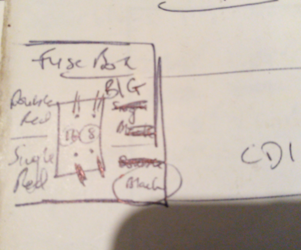
Correct Fuse amperage.

philw

Junior member
Location
lincs
Just been checking and cleaning the connections in my 1977 Jota's fusebox, its the 2 fuse type, i notice they are both the old 8 amp white Torpedo type fuses, and after double checking the wiring diagram in my owners handbook and the Green book it appears to say they should be 30?...can someone advise what they should be please?

Will probably look into converting to spade type fuses sometime in the future.

Thanks Phil.
 
As a guide i would use 25A, as the factory were not electrical engineers at Breganze, would be a simple answer to a complex sizing of fuse devices. Though really if original fuse elements, be lucky to find anything to fit as new. Can refurbish ( love that obscure term ) cleared fuses, ie make a failed fuse into a new fuse, foil and steel replacements aside.... not sure am helping here...perhaps, perhaps not...j
 
As a guide i would use 25A, as the factory were not electrical engineers at Breganze, would be a simple answer to a complex sizing of fuse devices.

Just to delve a bit deeper than John's simple answer and look for the complex fuse sizing he alludes to:

The function of a fuse is to protect the wiring - basically to stop the wiring harness melting into a nasty blob of sticky plastic insulation and emitting clouds of acrid smoke. I don't know what wire sizes your bike has. After 40 years it could have all sorts of bodges wired into it, with alarmingly skinny wires. I hope not.

I think most of the original wires in Laverdas are about 1mm2 in cross sectional area, which you wouldn't want to load much beyond 20A. If anyone has fitted wires smaller than that for any purpose, I'd suggest you replace them with 1mm2. While smaller wires might be fine for whatever job they're doing (LED indicators for example), a 20A fuse won't protect them if you get a short circuit.

1mm2 wire will carry 25A but I reckon the plastic insulation will be getting pretty soft. Not quite in Chernobyl melt-down territory, but you don't wanna get much hotter. As much as it goes against all my personal logic to differ from John's opinion on anything electrical, I think I'd be a little more conservative and opt for 20A fuses in the absence of any other knowledge.

Of course, the other approach is to gain some knowledge. Work out what each fuse does. If I recall correctly, the two fuse system in Laverda triples has one fuse for the charging circuit and one for everything else. The charging circuit wiring is substantially beefier than the rest of the general wiring (perhaps 2.5mm2 or bigger?) so a 25A or even a 30A fuse would be OK there. But bear in mind the current rating of your rectifier/regulator when selecting a fuse for the charging system, and don't exceed that.

For the general wiring system, you could make a guess at the maximum load likely to be applied. Let's consider a worst case scenario when you have the headlight on, you also have the turn signals flashing, and you have cause to beep the horn at the same time.
60W headlight = 5A
2 x 21W indicator globes = 3.5A
Horn? I dunno. Let's say 6A.
Let's not forget the ignition system (assuming it's not self-generating like the old HKZ), say 4A max?
That's a total of 18.5A, so a 20A fuse would do. But the chances are that you won't have all that stuff on at the same time, so you'll likely get away with a smaller fuse.
 
Just been checking and cleaning the connections in my 1977 Jota's fusebox, its the 2 fuse type, i notice they are both the old 8 amp white Torpedo type fuses, and after double checking the wiring diagram in my owners handbook and the Green book it appears to say they should be 30?...can someone advise what they should be please?

Will probably look into converting to spade type fuses sometime in the future.

Thanks Phil.
& dab dielectric grease on the fuse ends!
 
As you say Cam, a power budget will indicate a suitable fuse. Fuse rating is centred on I squared t rating, function of let through current ( magnitude ) versus time, the designated fuse rating printed or indicated is a nominal rating. Covered this previous, i think on the thesis that was about charging system issues, diatribe over Robs issue. Extrapolated does a 20A fuse not clear at 20A and Clears at 20.1Amps, that is where the I squared t rating comes in. Trade off my suggested fuse, had an electrical system ( ignition supply, not ignition ) fail while overtaking at speed on the road, better to run a wiring hard for a moment than clear a fuse on the fly with a marginal rating or i squared t that is short... if that makes sense... j
 
Just been checking and cleaning the connections in my 1977 Jota's fusebox, its the 2 fuse type, i notice they are both the old 8 amp white Torpedo type fuses, and after double checking the wiring diagram in my owners handbook and the Green book it appears to say they should be 30?...can someone advise what they should be please?

Will probably look into converting to spade type fuses sometime in the future.

Thanks Phil.
At least you know you haven't got a short.

Paul
 
Just to delve a bit deeper than John's simple answer and look for the complex fuse sizing he alludes to:

The function of a fuse is to protect the wiring - basically to stop the wiring harness melting into a nasty blob of sticky plastic insulation and emitting clouds of acrid smoke. I don't know what wire sizes your bike has. After 40 years it could have all sorts of bodges wired into it, with alarmingly skinny wires. I hope not.

I think most of the original wires in Laverdas are about 1mm2 in cross sectional area, which you wouldn't want to load much beyond 20A. If anyone has fitted wires smaller than that for any purpose, I'd suggest you replace them with 1mm2. While smaller wires might be fine for whatever job they're doing (LED indicators for example), a 20A fuse won't protect them if you get a short circuit.

1mm2 wire will carry 25A but I reckon the plastic insulation will be getting pretty soft. Not quite in Chernobyl melt-down territory, but you don't wanna get much hotter. As much as it goes against all my personal logic to differ from John's opinion on anything electrical, I think I'd be a little more conservative and opt for 20A fuses in the absence of any other knowledge.

Of course, the other approach is to gain some knowledge. Work out what each fuse does. If I recall correctly, the two fuse system in Laverda triples has one fuse for the charging circuit and one for everything else. The charging circuit wiring is substantially beefier than the rest of the general wiring (perhaps 2.5mm2 or bigger?) so a 25A or even a 30A fuse would be OK there. But bear in mind the current rating of your rectifier/regulator when selecting a fuse for the charging system, and don't exceed that.

For the general wiring system, you could make a guess at the maximum load likely to be applied. Let's consider a worst case scenario when you have the headlight on, you also have the turn signals flashing, and you have cause to beep the horn at the same time.
60W headlight = 5A
2 x 21W indicator globes = 3.5A
Horn? I dunno. Let's say 6A.
Let's not forget the ignition system (assuming it's not self-generating like the old HKZ), say 4A max?
That's a total of 18.5A, so a 20A fuse would do. But the chances are that you won't have all that stuff on at the same time, so you'll likely get away with a smaller fuse.
Thanks for that, my bike has new Ignitech ignition and uprated 280w charging etc, so wiring will not be ancient...and i ride with the lights on all the time, no flashers fitted tho, so looks like the 8amp fuses fitted could do with being a bit bigger.
 
looks like the 8amp fuses fitted could do with being a bit bigger.
Yeah. I'd suggest at least 15 or 20A for the ignition (and other stuff) circuit. And 20 or 25A for the charging circuit. So John was right in the first place. Mea culpa. I should have known better than to question the guru :)

One of the advantages of Ignitech ignitions is that they're not power hungry. The dwell time is intelligently controlled so that at all engine speeds they bring the coils to saturation and no more. No power is wasted in over-saturating the coils, so they tend to draw a lower average current than other systems.
 
Both ( we ) are correct Cam, 20 or 25amp fuse elements will work, how long is a piece of string, or your applicable fuse... grin.... by all means challenge the person whom makes bold statements, good for the inner tube, i mean being....j
 
That 30 shown in the fusebox is nothing to do with amp rating ..... the wiring diagram is scattered with those little numbers hap hazzardly ....... some sort of factory reference I guess .
I always used 16 and 8 ( see below ).... .... never blew one ..... ratings are supposed to be marked on fuse box base , apparently ......2023-02-09 (1).png2023-02-09 (2).png
 
OK. Am I allowed to challenge you on your use of the pronoun "whom"? :)
Scrambling for my Oxford Press Grammar reference. Dont have one, may have me there Cam, would you accept basic Italian Grammar by McCormick in its place until i locate a nice older copy of Oxford Press Grammar?.... no i thought not....pity... "you and me" or "you and i" pass me the subjective and objective pronoun.. please... skip the perpendicular pronoun.... a laugh here...j
 
Found the pages from Oxford Press Sidney GreenBaum.
Dunno Cam, i find the "whom" correct for objective case, then am somewhat a Laverda old wiring harness, my insulation is tired and failing...j

PHRASES AND WORDS 85
E. Relative pronouns The w/z-relative pronouns (cf. 4.43) display distinctions in gender and case.
The gender contrast is between personal who or whom and non-personal
which:
the friends who give me advice
the book which I have just read
The case contrast applies only to subjective who and objective whom, though
whom tends to be restricted to formal style:

the teacher who taught me English
the teacher whom (or who) you met

Relative that does not have distinctions in gender or case:
the friends that give me advice
the book that I have just read
Genitive whose is mainly used for personal reference, but it is also sometimes
used for non-personal reference:
the friend whose daughter you know
the house whose owners you know

F. Interrogative
pronouns
The personal interrogatives who, whom, and whose (cf. 4.43) also display
distinctions in case:
Who taught you English?
Who (or whom) did you interview?
Whose is that book?
3.27
Adjectives and
adverbs
The semantic category of comparison applies to adjectives and adverbs that
are gradable (cf. 4.24). They are gradable when we can view them as on a scale;
for example, for the adjective cold: a bit cold, somewhat cold, rather cold, very
cold, extremely cold. We can also express comparisons for gradable adjectives
or adverbs: as cold (as), less cold (than), more cold (than), (the) most cold.
Comparison is a grammatical category that can be expressed by inflections
in many gradable adjectives and in a few gradable adverbs. The inflectional
forms end (usually) in -erand -est
absolute comparative superlative
tall taller tallest
wealthy wealthier wealthiest
www.IELTS4U.b
 
Possible issue for lower rated fuse element ( relative term, "lower" to what ) is transient surge withstand, an inadvertent shorting of conductors or metal parts attached to conductors, shorting to frame et al. When rewiring the few/many Laverda here over the long past years, omitted the frame return path. Save for the starter motor for obvious reasons, turn indicators and such were supplied a proper return circuit to battery negative ( distribution block ).

There was once upon a time, an iis module that was supplied, a box case return path to frame via the secondary chain... then what good is an ignition unless it cannot sustain an installation method born of misadventure, a smile here....j ** iis case is floating from supply conductors, ie can be used on positive battery to frame, and was installed on a T160.
 
As a guide i would use 25A, as the factory were not electrical engineers at Breganze, would be a simple answer to a complex sizing of fuse devices. Though really if original fuse elements, be lucky to find anything to fit as new. Can refurbish ( love that obscure term ) cleared fuses, ie make a failed fuse into a new fuse, foil and steel replacements aside.... not sure am helping here...perhaps, perhaps not...j
Here is a useful guide to fuses:Makeshift guide to fuse replacement (1).png
 
Back
Top