Correct method for removing cam blocks?

biffom

Junior member
Another newbie question here....

In the laverda 1000 workshop manual it indicates that you need to undo all the cam block and cylinder head bolts (fig 12).  In the Green Book they only undo the cam block bolts.  Which method is correct? 

Also for torque figures green book is 27ft lb inner 20ft lb outer - workshop manual is 4 mkg - 29ftlb (crossed out with a handwritten note that says 30-35nm 23-26 ftlb) - what's the general accepted torque measurements used for both the internal and external bolts?

And for your amusement: First time I removed the cam chain tensioner following the destructions "undo the bolt but watch for the washer" the instructions neglected to tell you that the bloody thing you need to be watching for is the tensioner as you watch it gaily drop down the cavity.  And after about the nth time of successfully replacing the chain link I finally managed to lose the clip plate down the hole despite having a rag....  Fun fishing with the magnet.  All good newbie stuff - hopefully not to be repeated.

Thanks,

Carl.

 
In theory, you just need to undo the cam block bolts however it is a good thing to check the torque for all the cylinder head bolts.

For torque and sequence: http://www.laverdamania.net/cul_torque3.htm
 
CLEMTOG said:
Make sure you have a very good torque wrench that goes to nothing, one that starts at 15 and ends at 150 will be useless.CLEM

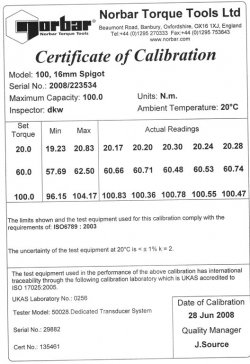
A curse on those misleading calibration certificates...... anybody want to buy a Snap-On 15 to 150 torque wrench? It'll make a very good pry bar... :D :D :D
 
CLEMTOG said:
if you are removing cams for valve shim replacement, I always think its good to only lift one cam at a time, and always retorque all bolts on completion, I use 25ft/lbs for the 9mm and 15ft/lbs for the 8mm.

I really like this approach.  It's way easier and keeps the head under tension.  Also the lighter torque settings help with freeing up the cam for movement at the higher settings it starts to bind.  Unfortunately I still need new blocks as they are showing signs of deformation.

Many thanks guys,

Carl
 
Carl,
A useful tip when retorqueing nuts is to use a Tippex pen and draw a line across the top of the stud and the nut itself, back off the nut , re torque to your chosen setting and then have a look to see if the the Tippex marks line up. This is a good way to check if you're gasket is still compressing.

Simply putting a torque wrench on a nut and seeing if it clicks with a bit of gentle pressure doesn't tell you very much. You would be surprised at how much some of the pattern gaskets compress and you might have to check the torque on the nuts three or four times until you satisfy yourself the nuts aren't moving any more and everything has settled nicely.
 
Not true.Snap-On [Industrial] offer a calibration checking service [?27.50] and issue a calibration certificate regardless of whether the wrench is adjustable or fixed. Presumably they check the accuracy of the wrench across the range of adjustment and if it's within tolerance they issue a calibration certificate. Seems pretty straightforward to me.
 
bob said:
Not true.Snap-On [Industrial] offer a calibration checking service [?27.50] and issue a calibration certificate regardless of whether the wrench is adjustable or fixed. Presumably they check the accuracy of the wrench across the range of adjustment and if it's within tolerance they issue a calibration certificate. Seems pretty straightforward to me.

Agreed: However it's not across the full range.

From their web site: "Guaranteed Accuracy: Within ?4% clockwise and ?6% counterclockwise of any setting from 20% of full scale to full scale."
 
However it's not across the full range.

From their web site: "Guaranteed Accuracy: Within ?4% clockwise and ?6% counterclockwise of any setting from 20% of full scale to full scale."

Blimey - you'd be better off with a Norbar then! Here's a certificate for my adjustable 20-100Nm torque handle.  You'll see it covers the full range

And for the real train spotter, a link to everything you never knew about calibration  :D
http://www.norbar.com/Quality/Calibration-Certificates.aspx

Now, back to them damn cookies and caches....
 

Attachments

  • calibration certificate.jpg
    calibration certificate.jpg
    88.5 KB · Views: 16
:D I think the debate was whether you can calibrate an adjustable torque wrench , not whether you can calibrate the adjustee!
 
Back
Top