
You are using an out of date browser. It may not display this or other websites correctly.
You should upgrade or use an alternative browser.
You should upgrade or use an alternative browser.
Correct throttle cable?
- Thread starter JO55
- Start date


Dellortoman
Hero member
- Location
- Tasmania, Australia
Spring rate can be confusing. While the spring rate (kg per mm of compression) increases in a shortened spring, it doesn't mean the spring is stronger. The shortened portion of the spring is still the same as it was and requires the same force to close its coils together (coil-bind compression). But it now operates over a shorter range. So it's a reduction in mm travel rather than an increase in compression force that makes the rate higher. Does that make sense? Probably not.
Maybe I can represent it graphically.
Let's imagine a hypothetical carby spring (I don't know the specs of a Laverda carb spring)
Free length 150mm
Coil bound length 25mm
Total spring range is 150 - 25 = 125mm
Compression force at coil bind 1kgf
Spring rate is 1kg/120mm or 0.008 kg/mm
Now let's cut 20% (30mm) off its length. The specs become:
Free length 120mm
Coil bound length 20mm
Total spring range is 120 - 20 = 100mm
Compression force at coil bind 1kgf
The spring rate is now 1kg/100mm or 0.01 kg/mm
Let's assume the carby slide travels 40mm between 50 and 90mm spring compression. This operating range applies to both springs because we haven't altered the carby.
Have a look at them on a graph, and the shortened spring has a steeper slope (higher spring rate) but always has less force on it over the entire range.
The left end of the graph is vertical because if the spring is loaded beyond coil bind, the force can go higher with no change in length.
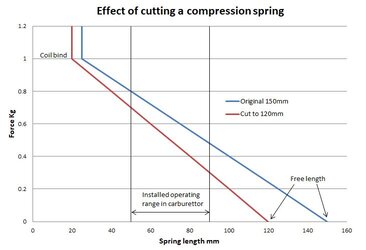
Maybe I can represent it graphically.
Let's imagine a hypothetical carby spring (I don't know the specs of a Laverda carb spring)
Free length 150mm
Coil bound length 25mm
Total spring range is 150 - 25 = 125mm
Compression force at coil bind 1kgf
Spring rate is 1kg/120mm or 0.008 kg/mm
Now let's cut 20% (30mm) off its length. The specs become:
Free length 120mm
Coil bound length 20mm
Total spring range is 120 - 20 = 100mm
Compression force at coil bind 1kgf
The spring rate is now 1kg/100mm or 0.01 kg/mm
Let's assume the carby slide travels 40mm between 50 and 90mm spring compression. This operating range applies to both springs because we haven't altered the carby.
Have a look at them on a graph, and the shortened spring has a steeper slope (higher spring rate) but always has less force on it over the entire range.
The left end of the graph is vertical because if the spring is loaded beyond coil bind, the force can go higher with no change in length.
Last edited:
Spring rate can be confusing. While the spring rate (kg per mm of compression) increases in a shortened spring, it doesn't mean the spring is stronger. The shortened portion of the spring is still the same as it was and requires the same force to close its coils together (coil-bind compression). But it now operates over a shorter range. So it's a reduction in mm travel rather than an increase in compression force that makes the rate higher. Does that make sense? Probably not.
Maybe I can represent it graphically.
Let's imagine a hypothetical carby spring (I don't know the specs of a Laverda carb spring)
Free length 150mm
Coil bound length 25mm
Total spring range is 150 - 25 = 125mm
Compression force at coil bind 1kgf
Spring rate is 1kg/120mm or 0.008 kg/mm
Now let's cut 20% (30mm) off its length. The specs become:
Free length 120mm
Coil bound length 20mm
Total spring range is 120 - 20 = 100mm
Compression force at coil bind 1kgf
The spring rate is now 1kg/100mm or 0.01 kg/mm
Let's assume the carby slide travels 40mm between 50 and 90mm spring compression. This operating range applies to both springs because we haven't altered the carby.
Have a look at them on a graph, and the shortened spring has a steeper slope (higher spring rate) but always has less force on it over the entire range.
The left end of the graph is vertical because if the spring is loaded beyond coil bind, the force can go higher with no change in length.
View attachment 65708

… well, that escalated!
Some detailed explanation there. Yes, my understanding of spring rates is that cutting coils off a linear rate spring will make it proportionally stiffer. However, only if the length removed, is replaced by a spacer.
Anyway, I took mine for a spin yesterday, and must stay, the std throttle (even with the acc pps) is the single biggest improvement to enjoying riding my bike. However - the bloody slow return to idle still remains on shut off and she’s not keen on ticking over. I think a carb rebuild might be beneficial over the winter.
I checked the slide return whilst I had the tank off.
I’m thinking possible air leak, or pilot circuit blockage? Wouldn’t have anything to do with the new ignitech I suppose? It was returning to idle after I installed it initially.
One day, she will be perfect…
Some detailed explanation there. Yes, my understanding of spring rates is that cutting coils off a linear rate spring will make it proportionally stiffer. However, only if the length removed, is replaced by a spacer.
Anyway, I took mine for a spin yesterday, and must stay, the std throttle (even with the acc pps) is the single biggest improvement to enjoying riding my bike. However - the bloody slow return to idle still remains on shut off and she’s not keen on ticking over. I think a carb rebuild might be beneficial over the winter.
I checked the slide return whilst I had the tank off.
I’m thinking possible air leak, or pilot circuit blockage? Wouldn’t have anything to do with the new ignitech I suppose? It was returning to idle after I installed it initially.
One day, she will be perfect…

Alzero
Hero member
- Location
- Slow traveling
A coil spring is just a torsion bar that has been coiled and if you imagine comparing a 10m long bar with a 1m bar in the same diameter stock, the shorter one will be obviously harder to twist.