Corsa Carb Settings

  • Thread starter Thread starter Grant
  • Start date Start date
Steve, as much as I see evidence of Pablo's work on the bike I have reason to believe the carbs are as they left the factory.
It may be a case of whatever was at hand when thry built it (has been known).
Either way it is a moot point as I will put it to where it should be, following the general consensus of experience expressed here from owners with this bike (or SFC 1000).
 
Ok, after a bit of digging I have a set of AB265s that I will fit.

I also found a set of 55 and 60 pilot jets but will start with the 65s as these were standard.

The K1 needles were quite crappy with a coating of fuel mung. After gently cleaning with solvent and a cloth the mung was removed, but on close inspection the surface is all pitted on each needle. There is only light longitudinal scoring caused by them sliding up and down in the bores but I am sure these pits will bugger up the fuel metering. So a new set will be ordered. Ironically I have sets of K14s coming ouit of the woodwork, but they are of no use in this set of carbs.

I also need a set of float needles and also the float needle seats (jets?), not sure exactly how to describe them. They are corroded also, and would chew up a new set of rubber tips in no time.

Now all I need to find is the carb rebuild kits I have somewhere.
 
Steve,

I think the factory thought the performance on hand was quite OK, enough to make for a pleasant, easy to use motor.  And without further mods to the engine, there is no real gain fitting larger carbs.  Exhaust and noise emissions had to be considered at the time too, and they were probably stretching the limits as it was. 

Probably wasn't enough money in the till anyway to commision Dell'Orto to make a special batch of 36mm carbs for them.

piet
 
Grant,

The float needles and their seats should always be replaced as a set, they are delivered that way from Dell'Orto.

piet
 
My first Chott had a very unusual set of carb settings [it came from Spain oddly enough....] and it ran extremely well. For reasons I can't remember I decided to revert to standard settings and the engine became unhappy and no amount of twiddling with the mixture, needle height etc. would resolve it . I went back to the oddball settings and all was well again. Lesson learned.

There's been a lot words written here to solve problems which as yet, don't exist. Given that the bike is reputed to have covered such a low mileage I would have thought that it was probably running quite well when it was put into storage. Surely the thing to do would be to clean and eliminate any obvious signs of aging such as dried seals , rubbers, gaskets etc and then  take it out for a ride on its original base settings regardless of whether they are factory recommended or not and see how it behaves. From there you can develop an objective plan of action. Changing settings and carb specification without first checking to see if the originals work could introduce a set of variables which create problems which weren't there in the first place.
 
Bob, you make the same point as Keith earlier.

Really, the bike was unrideable in as-bought condition, mainly due to the condition inside the tank.
While I am going through it, waiting for the tank to return, I will check and compare against stock settings.
There are a lot of seals perished in the carbs, the fuel taps are clogged with rust, the needles are corroded and the float valves are scored. Some of the screws holding the carbs to the support bars are rounded off (the horrible countersunk allen screws) making it impossible to disassemble properly for cleaning.

I don't intend to fart about with it ad infinitum, but while I am killing time I may as well go through it from stem to stern, starting with the carbs.
 
Hi Grant,
I am pretty sure the data I gave you earlier is bog standard from Laverda. There can be market variations though, taking things like noise, fuelamount/starvation/fumes and others into the equation.
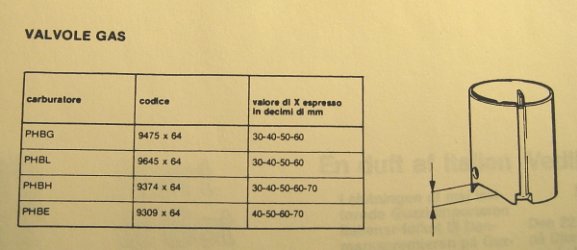
I don't know if you have the Dell'Prto manual (red booklet in A4 size. Unfortunately mine is Italian. I enclose pisc of gasvalves and to what effect. I am sure you can find it on the net or maybe at JLO's page? I am renovating my cd-player with new gears right now, so I will not have a look until later, but will do.

As I think I wrote earlier, I ince had 50/something in mine, and it was to speed up airspeed with the smaller gap. The last number describes the how soon the accelerator comes on, as some of the others have described.
I would for sure do as Piet and others say and revert to normal spec. But it's always worth a try to start it up as is; maybe you have another tank (small for adjustments?) to fit for a start up?

Cheers,
Jacques.
 

Attachments

  • phf1.JPG
    phf1.JPG
    108 KB · Views: 26
  • phf2.JPG
    phf2.JPG
    113 KB · Views: 22
  • phf3.JPG
    phf3.JPG
    67.6 KB · Views: 21
Jacques,
The carbs are now to the spec revealed by various Corsa owners here. I was a little suspicious at first, but now all is well.
The rest of the information I want is purely to learn about how each carb component interacts and affects the fuelling of the bike (with Dellortos)

The only things puzzling me were the 60/6 slides and the AB250 emulsion tubes.
Happy to run with 60/6s and will pop in the AB265s when I rebuild the carbs.
Currently they are disassembled for cleaning the rusted mung from inside them, and to replace all the perished seals. The carbs would have leaked like a sieve if I had just tried to start it up,and if it ever ran (with the clogged fuel taps) it would have pulled more rusty sediment through.

Next step will be to take off some of the parts for rechroming, as I hope they will get back around the same time as the tank, and then I can get it going.
 
Hi Grant,
Here's the English version. Good reading. Should answer your previous q's. Have fun.

-----
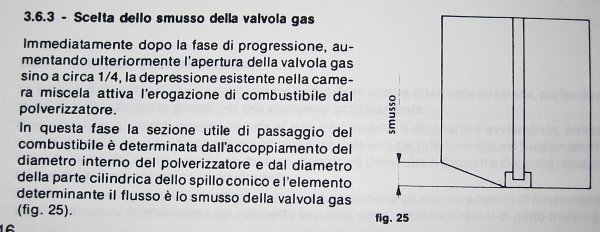
3.6.3. Selection of the throttle valve cutaway.
Following progression and on opening the throttle further up to
approximately one-quarter, the partial vacuum present in the mixture
chamber draws fuel up through the atomiser. In this operating phase the
effective fuel passage area is determined by the atomiser-needlejet
internal diameter and by the varying section of the tapered-needle
moving up and down inside it. The deciding factor which regulates the
air flow in this phase is the throttle valve cutaway (figure 25).
fig. 25
A small cutaway creates a greater vacuum and consequently causes a larger amount of fuel to be drawn
up through the atomiser ; on the other hand, a larger cutaway would lower the vacuum and therefore
reduce the fuel delivered.
Because of this, fitting a lower slide cutaway results in enrichment and vice versa.
-------

Link:
http://www.morinispecial.it/manuali/dellorto_motorcycle_carburetor_tuning_guide.pdf

Cheers,
jacques  ;)
 
My experience with these engines would be that the feeling that they need more fuel at low and mid range, and less at top end, is really more evident than on a 180 engine. This was the case with the Dell'Ortos and also with the Mikunis. Going too lean with the throttle cutaways and idle jets and the first symptom would be problem of transition, a sort of alarm very noticeable on a 120, not so evident on a 180, taken apart the fact that a 120 need smaller main jets anyway.
 
I always found my 120 Jota to be very economical if ridden at or just above speed limits. I regularly returned 50mpg. The best on a 180 was around 40mpg.
Saying that, when I thrashed the 120 it returned 22mpg, but then again so would a 180.

The Corsa settings as standard (which I will retain) are interesting for such a highly tuned triple.
Pilots are way higher than a 981cc 180 (65 vs 55) and mains are way smaller (118 vs 145 as std UK Jota).
The 1200 Mirage spec I had needed 65 pilots to breathe properly at low revs, but a 981cc 180 would be drowning with them.

 
Capacity is not the only criterion to calculate the need in fuel and I think that nobody stays with 145 main jets on a Jota with modern fuel. I'd say also that fuel consumption is not directly related to jet sizes. Lav triple engines are easy to set up regarding main jets but mid range and transition are another affair if you want a good and reliable engine. Difference between 180 and 120 is that the 120 engine (thanks to its better regularity) is more tolerant to bad setting, even if the jets and needles are not perfect the engine still pulls and revs, while it is so evident with a 180 as it looses power immediately. One have only to see the incredibly big difference in power from a Jota to another, just because the set-up is just slightly different! 
 
Accurate cam timing has a big big effect. I recently ran my 180 Jota with the cam timing out (muppet mistake by me) and got down to 110 mains - which were still way too rich. P.
 
Grant,

The reason for the small mains of the 120s is due in a large part to the very efficient stock exhaust system coupled to the evenly spaced gas pulses.  It extracts exhaust gases in such a manner that more of a vacuum is produced during the intake stroke.  Enlargening the collector and replacing the silencers will have a detrimental effect, calling for larger mains, in effect, ruining the efficiency of the motor!

piet
 
I recall a conversation with Van Dijk about exhausts one time and he said that he would like to experiment with a 2:1 system for cylinders 1 and 3, and bringing in cylinder 2 some distance later, like a 180 twin plus a single added abit further down the pipe.

A 180 engine (the prototype big-bang engine?) seems to me to be a technically inefficient way to make good power. The 120 just seems to rev up so easily in comparison. As is said above, easier to design an efficient exhaust system for it, benefits everywhere, but destructive vibes, easily cured these days with balancer shafts.

To a non-engineer like myself I find the precise technical terms escape me but in my view I would think that the power output per litre vs specific fuel consumption must favour the 120, no?
What I mean is that the 180 has to burn more gas to achieve the same power output with the same cylinder size and port/valve/angle architecture.
Or is this a load of bollocks?
Maybe down to the improved scavenging as said above.

Next question:
What is the difference in spec between a 120 Jota (UK model) vs a Corsa motor?
Cams?
Valve sizes?
Ports?
Exhaust system for sure.
I think the pistons were the same compression ratio, around 10:1, no?

My 120 Jota never felt as strong as my Corsa, but it was a S. African import so had softer cams and pistons, but still a hell of a motor.
 
sfcpiet said:
Grant,

The reason for the small mains of the 120s is due in a large part to the very efficient stock exhaust system coupled to the evenly spaced gas pulses.  It extracts exhaust gases in such a manner that more of a vacuum is produced during the intake stroke.  Enlargening the collector and replacing the silencers will have a detrimental effect, calling for larger mains, in effect, ruining the efficiency of the motor!

piet

Correct for the 120 engine only (ie the Witt conical venturi shape collector), quite the contrary on a 180!
 
Grant said:
I recall a conversation with Van Dijk about exhausts one time and he said that he would like to experiment with a 2:1 system for cylinders 1 and 3, and bringing in cylinder 2 some distance later, like a 180 twin plus a single added abit further down the pipe.

To a non-engineer like myself I find the precise technical terms escape me but in my view I would think that the power output per litre vs specific fuel consumption must favour the 120, no?
What I mean is that the 180 has to burn more gas to achieve the same power output with the same cylinder size and port/valve/angle architecture.
Or is this a load of bollocks?

This sort of exhaust was exactly the system imagined by F. Laimboeck for his first prototype of the 1200 nonframe in 1976.

Certainly not a load of bollocks, quite correct actually. This doesn't mean that the 180 is less powerful once well set up  ;)
 
Grant said:
<snip> Next question:
What is the difference in spec between a 120 Jota (UK model) vs a Corsa motor?
Cams?
Valve sizes?
Ports?
Exhaust system for sure.
I think the pistons were the same compression ratio, around 10:1, no?

Hi Grant,

Well, the Corsa's got the CR head, of course - so different valves & ports.  Same cam, tho' - F1.  Pistons are 10.5:1.

(You do know there is a factory-issued, Corsa specific parts list ...?  Which tells you what size main was fitted, for example  ;).  Let me know if you want a copy).

P.s.  So, pray tell: in your pursuit of authenticity, are you going to be fitting Champion N2 plugs  :-* ?

11_15_SparkPlug_main.jpg


Ciao

Craig
 
Craig, I would be interested in that parts list...

After a disastrous move to Champion plugs in my 79 Jota I vowed never again would they darken my doorstep.
I then used NGK B8 or B9EV plugs with no issues whatsoever.

I do have a set of metal-shrouded spark plug caps...  :P
How original will I go?  :D
 
Back
Top