Corsa Carb Settings

  • Thread starter Thread starter Grant
  • Start date Start date
No F1's in a 120 jota. A11, A12 or 4C, I got a 120 jota here with F1's in it but I put them there  ;). The F1 came about with the RGS.


   Keith.

 
I posted the link to the parts-Manual for RGS, RGA, Corsa and SFC some days ago on another thread...:

http://laverdaforum.com/forum/index.php/topic,80802.0.html
 
Grant said:
Craig, I would be interested in that parts list...
Hi Grant,

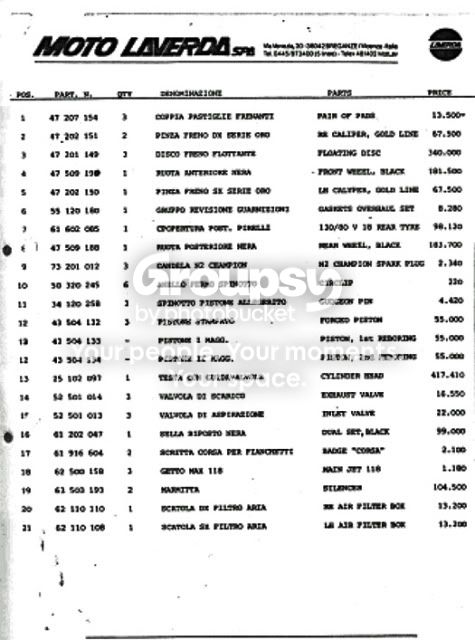
I see that Lothar has already kindly posted a link to the 'Full Thing'; but I also see that the page of descriptions is missing.  So here's that:
(Sorry about the quality - scan of a photocopy of a photocopy of a poorly typed original, I guess.  But just about legible.)

Corsapartslist_edited.jpg


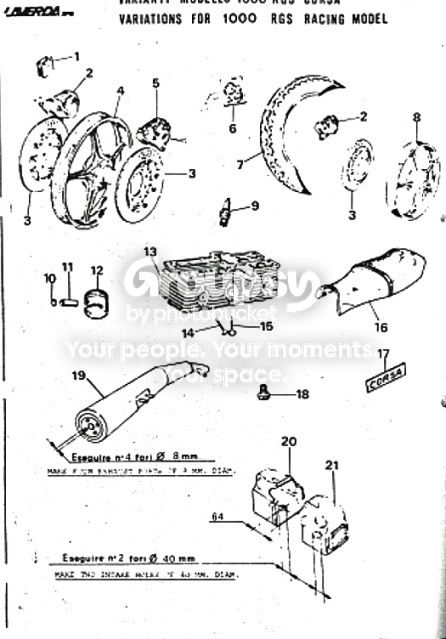
And just in case you only want the drawing that goes with, here's a copy of that too (complete with the special Corsa seat - wooo!  And the main jet, item #18):

Corsapartsdiagram_edited-1.jpg


Grant said:
How original will I go?  :D
Got any Motoplat coils ? :o :D

Ciao

Craig
 
As far as I know, the pistons were not forged in the 120 Jota, but truly so in the Corsa. Maybe someone can tell if the cross pins themselves were slimmer too?
Also, the surface for the insert of the piston crosspin (crank rods) were changed on later RGS onwards.
Note the two holes of 40mm as described earlier. Plus the holes in the muflers, which on the RG Series were quite silent. No more fun of the past. Not to fault Laverda though, as that was Laverda trying to get their bikes legal in the states, prob. California I suppose.

Cheers,
Jacques.
 
The small end of the conrod on 180s has a copper bush, but I think all 120s have no copper bush present. I think that includes the 120 Jota but may be wrong.
 
Grant,

The 180 small end has a bronze bush, copper's too soft for a bush.  Early 120 conrods had a naked steel bearing surface for the gudgeon pin, later (somewehere in the midst of the RGS production run) 120 conrods were copper-plated at the top half, supposedly to offer a bit of lube reserve.... the steel-only rods are quite rough in the small end bores, the copper maybe was meant to fill the cavities.  May also have to do with the hardening process of the big-end, copper plating will effectively shield parts that are not meant to be hardened.

No way a 180 engine will make the same power as a 120 while in exactly the same spec!  A 180 may come close, but a 120 will always stay up front.  Got to delve deep into the box of tricks to get 180 to out-run a 120!  Can always do the same to a 120 to keep it in front though. :D

To my knowledge, the 1000SFC was factory-fitted with forged slugs, not sure about the Corsa engine.

piet
 
Ventodue said:
Grant said:
Craig, I would be interested in that parts list...
Hi Grant,

I see that Lothar has already kindly posted a link to the 'Full Thing'; but I also see that the page of descriptions is missing.
Ciao

Craig

Craig is right, here are the missing parts: Corsa specific parts

My SFC with the Keihins and 3-1 Exhaust, else standard engine: 105 HP Clutch/95HP rearwheel
My Jota with 1116ccm, same spec head, same carbs, same compression has 100 RW HP/110 HP Clutch roughly. That said, it has 11% more ccm while just 4% more power. But if I would limit the SFC to the same maximum Revs as the Jota, the Jota would outbeat the SFC...  :D And the Torque is better on the Jota where the SFC has the more constant HP delivery.

Both bikes btw were tested on the same type of Dyno with the same Software, just different dates.

HTH
 
sfcpiet said:
Grant,

The 180 small end has a bronze bush, copper's too soft for a bush.  Early 120 conrods had a naked steel bearing surface for the gudgeon pin, later (somewehere in the midst of the RGS production run) 120 conrods were copper-plated at the top half, supposedly to offer a bit of lube reserve.... the steel-only rods are quite rough in the small end bores, the copper maybe was meant to fill the cavities.  May also have to do with the hardening process of the big-end, copper plating will effectively shield parts that are not meant to be hardened.

No way a 180 engine will make the same power as a 120 while in exactly the same spec!  A 180 may come close, but a 120 will always stay up front.  Got to delve deep into the box of tricks to get 180 to out-run a 120!  Can always do the same to a 120 to keep it in front though. :D

To my knowledge, the 1000SFC was factory-fitted with forged slugs, not sure about the Corsa engine.

piet
Music to my ears Piet :D

Shaun
 
Laverdalothar said:
My SFC with the Keihins and 3-1 Exhaust, else standard engine: 105 HP Clutch/95HP rearwheel
My Jota with 1116ccm, same spec head, same carbs, same compression has 100 RW HP/110 HP Clutch roughly. That said, it has 11% more ccm while just 4% more power. But if I would limit the SFC to the same maximum Revs as the Jota, the Jota would outbeat the SFC...  :D And the Torque is better on the Jota where the SFC has the more constant HP delivery.

Both bikes btw were tested on the same type of Dyno with the same Software, just different dates.

HTH

I distinctly wrote same spec Lothar.

That includes cams, exhaust, displacement, etc, etc.  Throw the same amount of money/effort at the 120 and it will eat your Jota for breakfast!

Don't compare apples with pears....... :D

piet
 
sfcpiet said:
That includes cams, exhaust, displacement, etc, etc.  Throw the same amount of money/effort at the 120 and it will eat your Jota for breakfast!

Don't compare apples with pears....... :D

piet

Piet, whatever the amount of money/effort/special parts you will put in a 120 engine, even if it gain a bit more power, it will always be a common 120 engine, still missing the character of a 180 or 750 twin real Laverda engines!  :D :D :D
 
laverdakeith said:
No F1's in a 120 jota. A11, A12 or 4C, I got a 120 jota here with F1's in it but I put them there  ;). The F1 came about with the RGS.

   Keith.

Seems that some very rare 120 Jotas had been equipped with F1s. It was the case of the Jota 120 displayed at the same time that the new RGS at the Milano show and also some of the very last 120 Jotas. I never succeeded to know if they were special orders or direct equipment at the factory though.
 
JLO,

I too prefer the feel and character of a 180 over a 120, but there's no denying a 120 works better...... just look at Beezumph triples, they'll give a 180 Lav a jolly good run for its' money, and that's with an antiquated long-stroke pushrod engine with usually a lot less displacement!!

piet
 
sfcpiet said:
I distinctly wrote same spec Lothar.

correct, and that is why I balanced what I said. technically, the engines are not far apart from each other. See:
specs.jpg


Basically, the SFC has the better cam profile, the Jota a bit more ccm. The difference in the Exhaust makes no big difference in the torque or HP figures, as both exhausts have been optimized by specialists for maximum performance on these individual specs.

The SFC head on the Jota is flow-benched, yes, but the result was so minimal (2-3% improvement) that this makes no real difference. The money invested into the Jota was basically to bring it to SFC Standards, just with 1116ccm. F1 cams for the 180? engine were not available 10 years ago for me, else I would have considered them. Not sure the 4/C make such improvement over the F1?!?

So - where do you see the big difference in the Jota engine? I would say the only ones are - basically spoken - displacement and cam (and phasing obviously). Would a 1116ccm SFC engine with else standard specs (F1 Cam, 10:1 compression, everything else left as is) make 10% more HP and Torque? Not sure, as gas-distribution is better in a 1000ccm engine than in a 1116ccm I'd say - no?

Once the SFC engine blows off one day, we will find out... That said, I have my "whish-List" on the table already for that engine. But that will make the engine no way comparable then with the Jota anymore...  :D

That all said, I still do agree with Piet (how could I not...) that the SFC engine is the HP beast while the 180? engine is the torque king, has more punch in low and midrange and is basically the more tempting engine. On the race-track, I think that the SFC gives you better chances to be fast (especially on tracks such as SPA with lots of passages ridden with high revs). On smaller tracks or on the road, the 180? can be the winner due to the better torque.

What great potential the 120? engine has does show my SFC quite clearly: The engine is still in factory specs, just Exhaust and Carbs have been changed and it delivers 10HP more than claimed by the factory. Now - imagine what happens when you start increasing displacement and compression, lighten parts and balance them, reduce friction in the engine by PTFE and carbon coating, optimize the head and cam-timing further than I did etc. etc. etc.  I am pretty sure that you relatively quick end up with an engine that throws out 120 - 125 HP with no big hassle and which will last quite long. Do that same thing on a 180? engine and I think the limit will soon be somewhere in the 115HP range. But my feeling is that the 180? engine will still produce more torque than the 120? engine.
 
I always thought the 120 bikes were quicker accelerating. The quarter mile figures in magazines used to confirm that. I think they even got a 120 Jota dipping into the high 11s, whereas the 180s were usually mid to high 12s.

Seat-of-the-pants dyno used to tell me the 120 had more low down and midrange and that the 180 didn't get into it's stride until midrange onwards.
 
Ok, but who cares about the quarter mile performance? These bikes are old bangers and we love them for their character and feel, not for the fraction of a second that they could gain otherwise we would get a modern Jap rocket. I admit that I still love the 120 models (well, not all...) because they are part of the marque history and maybe because there is a Laverda sticker on the fuel tank but a good 180 or a 750 are the ones who put a smile on my face under the helmet!
 
Not me,but I was just using the point to illustrate what we were discussing about 120 vs 180 power characteristics.

Even comparing (almost) like with like, such as a 120 Jota vs a 180 Jota they are quite different animals to ride.
My heart will always lie with the 180, as that was first with me, but I would rather ride a 120 than a rice burner any day.
 
jlo said:
Ok, but who cares about the quarter mile performance? These bikes are old bangers and we love them for their character and feel, not for the fraction of a second that they could gain otherwise we would get a modern Jap rocket. I admit that I still love the 120 models (well, not all...) because they are part of the marque history and maybe because there is a Laverda sticker on the fuel tank but a good 180 or a 750 are the ones who put a smile on my face under the helmet!

I absolutely agree. The "sick" running of the 180? is something that simply makes you smile, the harsh vibrations rattle your spinal cord - which is the direct link to your brain and maybe the reason why you never forget a ride on such a bike.

Amazing, how much such a non visible change of the engine makes such a big difference between 180? and 120? in terms of vibrations, power and torque output. ;)
 
Laverdalothar said:
I absolutely agree. The "sick" running of the 180? is something that simply makes you smile, the harsh vibrations rattle your spinal cord - which is the direct link to your brain and maybe the reason why you never forget a ride on such a bike.

Lothar, I think your engine really is sick, when was the last time you checked the main bearings?
 
Back
Top