Cush drive rubbers

Ventodue

Hero member
Location
France
Technical question, peeps, if you don't mind.  Not super interesting, I admit.  But you know ... Coronavirus boredom.

How do you assess when a cush drive rubber - clutch or rear sprocket - is past its best?  When the rubber is in your hand, I mean - not when the whole lot is already so far gone that you can feel it when riding  :o.

Obviously, cracking is 'Not Good'.  But apart from that?  Because it ... Well, 'feels' hard?  And what is 'hard' anyway?  Or ...?

All contributions welcome and TIA!

Ciao

Craig

 
Hi Craig. I hope all is well with you.

Clutch - For me they are typically a preventive maintenance items. If I don't know the history then 'While I'm in there', I fit new ones.

Otherwise it's quite subjective. If they are quite difficult to fit (tight in the sprocket), then they are generally OK. If they are a bit shrunken and hard (and so easy to fit) they are on their way out.

For hardness test - bite them  :) Comparing to a new one is good if you can.

Can you feel any sprocket movement by hand? Back and forth motion. The forces are massively more in operation, but this can give a feel for any play.

Rears - is easier as they tend to stay soft - if not completely worn out then shim the rotational slop out with slithers of old credit card. Half joking there - I do it on my Jap Crappers  :D

Someone will be along in a moment with a durometer and a piss take.

Paul


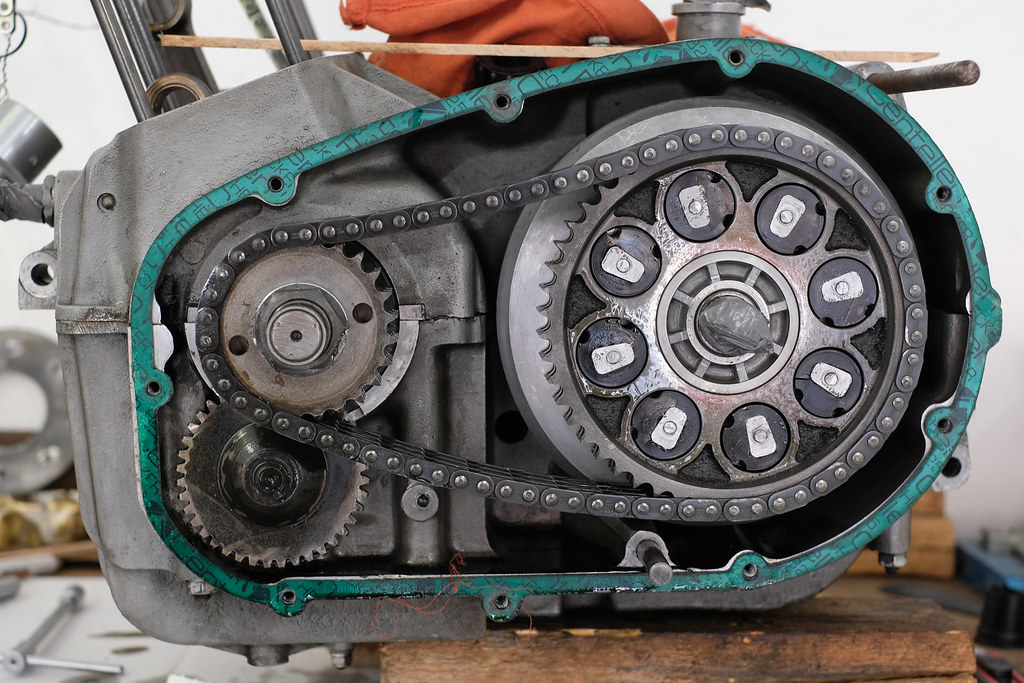
I found my 46 years old rubber dampers partly broken, hard and shrinked:
49859950463_a0587dbfc2_b.jpg


Some say, that they start to disintegrate - but thankfully there weren't any hints for this ...
 
Ta Paul & Jo.

Yeh, that's kind how I assess them, Paul.  Dunno their history?  Change 'em.  Sloppy fit?  Change 'em.  Bite  them?  I'll leave that to you .. :P

Yeh, Jo: falling apart is pretty much a sure sign that something should be done  :o  :D.

Waiting for the 'Durometer Piss Take Boys' now ...
 
Probably something I neglected on my SF motor - changed them once - but that clutch and motor has done way over 200,000km. Will be checked before going back together!
 
Craig,

If you can feel play when twisting the clutch drum and sprocket by hand, they're past their best.  It is this play that will always cause a certain amount of clanking at idle, the remaining clunk is from wear in the clutch drum and hub, which can only be remedied by fitting new parts.

If you can see more than 1-2 mm play between wheel and cush when turning it against an engaged gear by hand, just light to-and-fro without force, the rubbers will have become too soft.  This can add up to about 15-20mm under driving conditions. You can see damage at the sides of the rubbers engaging with the drive dogs, you might find deep tears and worn out cavities.

Fresh rubbers can be felt immediately, the drive train regains a long forgotten tautness, especially when engaging 1st at a standstill.  :D  Having said that, old originals seem to have lasted a lot longer than what is available as spares today.  Either the OE rubber compound hasn't been correctly worked out by todays suppliers, or they deliberately don't and are happy to sell you another set after 2-3 seasons to justify their small production runs...  ::)

piet
 
And don't get excited if you have Mikuni carbs fitted, it's easy to confuse clutch rattle with slide rattle.
 
I recently stripped and inspected the clutch on my RGS. Cush rubbers were the original factory fitted ones, showing a bit of visible slop in a couple, so I replaced them all. OK for 154000km.
Rear wheel cush rubbers are still original, inspected each time the wheel's out.

Alan :)
 
Ta Piet.  So from this I take the following:

1.  Best to assess them in place, i.e. before you pull the clutch or wheel apart, and not in the hand.
2.  It is, indeed, really a question of feel and judgement.

Btw, had never really considered they might in fact become too soft  ::).  Mine always seem hard. (No, no obvious joke there, please boys).

Always learning ... (bigthumb)
 
a14rgs said:
<snip> Rear wheel cush rubbers are still original, inspected each time the wheel's out

That's kind what inspired my question, Alan.

Recently fitted new boots to my Zan? and thought, "Are these cush drive rubbers ok?"  To which my honest reply was, "Ah, and how the hell would I know?!"  :o :D
 
Ventodue said:
That's kind what inspired my question, Alan.

Recently fitted new boots to my Zan? and thought, "Are these cush drive rubbers ok?"  To which my honest reply was, "Ah, and how the hell would I know?!"  :o :D

What do worn out rubbers look like on a Zane, when I took my wheel off yesterday, there is some wear, but they are a snug fit in the wheel, I.e, didn?t fall out with gravity, I needed to pull them out by hand or screwdriver to lever, I would assume this is ok, as you said, how the hell do I know?!

Alistair
 
I definitely go with my friend Piet here, new ones have a life of no more than two to three years regardless of how much used, sorry Alan C, but you will be in there again, no later than 2023.
CLEM
 
CLEMTOG said:
I definitely go with my friend Piet here, new ones have a life of no more than two to three years regardless of how much used, sorry Alan C, but you will be in there again, no later than 2023.
CLEM
New Old Stock, Clem - not new pattern parts - so I'm hoping to prove you wrong! :-*
 
I also have a few sets of NOS, and  they have been kept in the dark, a bit like me! but not fed bullshit
but I also wonder if they have deteriorated on the shelf and I cannot detect?
CLEM
 
I was thinking of looking at my cush rubbers in my clutch, just out of curiosity,not having any issues,bike has less than 4k miles on it,but it is a early 74 3C, but if the availability of decent replacements is not good, I think I'll leave it alone for now.
 
Craig,

The clutch rubbers are affected by oil and usually harden and shrink, leading to slop.  With excessive slop, they can spilt and start to break up.  The wheel cush rubbers are literally pummelled soft, and eventually start to disintergrate.  Just because they "look good" at a casual glance, chances are that even 30-odd year old originals will show damage at closer inspection.  Take 'em out at have a look at all sides...

piet
 
sfcpiet said:
The clutch rubbers are affected by oil and usually harden and shrink, leading to slop.  <snip>

Ta Piet.

Yes, 'hard and split' clutch rubbers, now that rings a bell ;).  Replaced at the time (how long ago, already? :o).  But I confess: I don't intend going look see what they're like now ...  ::).  Whatever I do won't drown out the rattle from my poor old clutch drum  :-[.

Sprocket rubbers going soft ... Hmmm.  Will check at the next tyre change  (thumbup)

Zan? wheel rubbers?  Too late now - tyre's fitted.  And anyways, the thing's such a crazy charging beast, I'm not sure the condition of the cush drive rubbers is likely to makes a lot of perceptible difference  :D

 
Back
Top