Cylinder Honing tools

71Laverda750SF

Hero member
I'm looking for the best honing tools and thought I would ask everybody what they use and how well it lasts. Piet, Red, Phil, Marnix, y'all have to have a better insight than most since you do so many engines. I have been looking at the Flex-Hone from Brush Research Manufacturing http://www.brushresearch.com/product-line.php?line=1 which has a full line of honing brushes of all types and from watching their videos seems to be very good. So what types of honing tools are being used by everybody and which ones work the best and last the longest. I don't look at price as the determining factor in buying tools-qualitity and longevity are the requirements.

Cheers

Clay
 
Clay,

If you're just looking for tools for de-glazing or similar, Flexhones are quite OK.  But for cylinder re-bores, you cannot get past specialist equipement.  A Sunnen hone will set you back several 1000 bucks and you will need to aquire the skills necessary to work with it.  Honing is something of a black art, requires years of experience to get a perfect finish to cylinder bores.  At OCT we use a Sunnen horizontal hone machine for finishing conrod big ends.  We do not have the necessary equipement to do cylinders, so we farm that out to a guy that has been doing my cylinders for the past 30-odd years.  He is absolutely brilliant, his vast experience has helped overcome quite a few problems in the past.

Don't forget, honing tools are worthless without precision measuring equipement...  :D

I only use Flexhones for the final finishing of valve guides and small end bores, to clear out the very last smidgeon required for the perfect fit.

piet
 
I use a Sunnen hone for liners, conrods at both ends, gearbox bushes and everything in between in size under or over
have to hone 100 optical eye surgery focusing lens next week to within 2 micron +/- so hope I get them right for some poor punter with eye issues

use a Sunnen Honall for doing valve guides which is a Sunnen driver in a hand held slow speed drill with flex joint, still adjustable to +/- 5 micron
according to the spiel

only as good as your measuring kit as Piet says, have well over $20k in measuring kit in the workshop now and could easily spend more, good kit is expensive and addictive
wish I had a Coke habit instead, fixing Laverda's is an expensive hobby  :o


I've had a Van Norman boring bar and a Delapena hone for over 30years, used the hone once and never used the boring bar. unless your doing this type of work all the time it's quicker and less hassle to give it to someone that does.
 
Hi Clay -  As has been pointed out there?s a huge difference in ?Honing? and ?Glaze busting?.
  Talking about honing ? I totally agree with Piet that it?s more of a ?black art? than engineering.
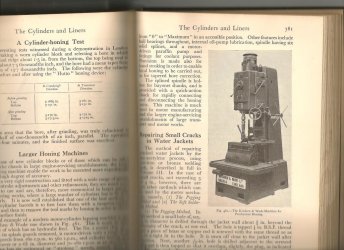
I was reading my  wonderful ?Modern Motor Engineer? books (published in the fifties) and was taken by the very useful looking Kitchen & Wade honing machine (see photo) and spent a couple of years trying to track one down. A local garage supplies rep found one locally for me that the owner was selling as he?d ordered a new machine.  We did the deal at a price that didn?t even cover the adjustable (with clutch) Delapena honing head. As the new machine was delayed for months the seller agreed to let me come and hone the cylinders that I?d bore on my Van Norman boring bar (now with Keith Nairn) ? a massive advantage that money couldn?t buy as the very experienced bloke selling it gave me invaluable advice on how to avoid or correct all problems that I immediately had - such as ?belling? ?barrelling? and tapering. How to adjust and bias the stroke length and how and where and when to ?stone the stones? with a rock hard Borazon stone to target any discrepancies.        Fortunately for me the new machine was delayed for months ? so I got tons of experience and advice!
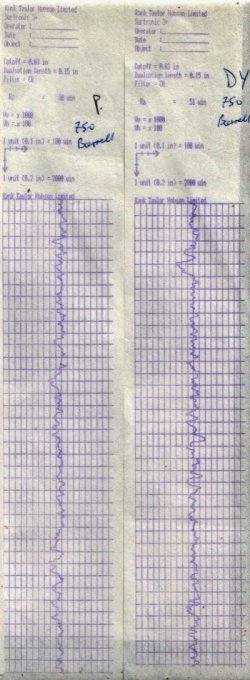
        When I finally got the machine and had to cut each joist in my garage and replace them one by one to get it in ? it was nearly ten feet tall ? I realised that it would be ideal for doing all my boring on as it could take out 1 thou per stroke. There was a double jet of honing fluid that was pumped down the bores - so cooling wasn?t a problem.  I had to make very strong holding jigs for the barrels ? but never used it at full potential ? maybe a tenth of a thou a stroke. I used it for several years doing dozens of barrels. I even had the FER  (Federation of Engine Remanufactures) come and inspect and test the finish ? the tester went into raptures over how good the finish was and said it was difficult to achieve one that good with ?modern? machines. He had a small testing device that measured about a quarter of an inch of the honed surface and it read out onto a sheet about 9? long (see photo)
  I took the machine with me (it weighed about 2 tons) when I moved to Lincolnshire ? but never used it again ? very foolishly I left it when I sold the property and it?s been scrapped.
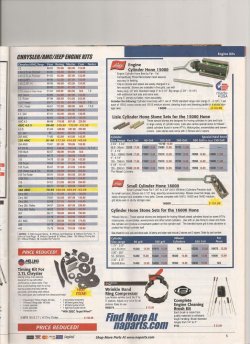
  I?ve now got a  SPS mini- bar to bore with and a ?Lisle? hone kit (see photo) ? these were sold by ?Snap-on? in the UK under the ?Blue point? label ? but now discontinued. With great help from Bob (IAG on this forum) I?ve got one from the USA.
    I plan to use the hone with a slow rotating large drill ? like the old ?Wolf? ones -  Haven?t done a complete bore/hone job yet ? but I know I?ll need all my old skills to do it properly. As has been said already ? much easier and safer to take the job to an expert! ? regards - Phil


Attachments

  • K&W honing machine sm.jpg
    K&W honing machine sm.jpg
    161.1 KB · Views: 23
  • FER tests hone.jpg
    FER tests hone.jpg
    102.4 KB · Views: 23
  • lisle hones - sm.jpg
    lisle hones - sm.jpg
    188.9 KB · Views: 23
Thanks for the advice and info everyone. I should have been more clear on what I plan to do and that is de-glazing the cylinders. Fortunately we have several machine shops that can handle all the real honing and sizing, and if it is an issue I can have them de-glaze them too. What I don't know about is which types of cylinder finishes can be de-glazed and which ones will need the professionals to cut. Regular steel barrels seem straight forward but I have figured out that there is nothing I can do with the nikasil cylinders on my BMW's so they will need to go to a specialized machining/plating shop. In aircraft engines we have chromed and nitride-hardened along with regular steel, so are there more treated types of used besides nikasil that can't be de-glazed like a steel cylinder?

Along with this discussion of honing/de-glazing, what's the best way to assemble the pistons into the cylinders? When I did my R90S years ago the shop that dual proved the heads for me said to put them together dry, and then crank and go straight to 5K and hold it there until is smoothed out. I questioned them about really doing it dry and their answer was "put them together wet and we'll keep selling you rig sets since they won't seat". So I did as they said, engine sounded terrible, coughed, spit and then everything smoothed out. No oil loss, great compression, and a smooth ride afterwards  so no additional ring sets were needed.

So should the cylinders go together wet on the Laverda's? I put them together wet the last time I did the engine and everything seemed to be fine but with all the knowledge you guys have I want to make sure that these will go back together and have great longevity.

Cheers

Clay

 
Opinions vary on wet or dry assembly - my own approach is "dampish". LOL. Just don't use synthetic oil as the assembly lube...

Had a discussion on honing nikasil bores on another forum very recently. I'd thought only diamond honing would work - and if you need to get a major blemish out, yes, that does seem correct.
However a very well known two stroke tuner chipped in and reported using cheap flex hones for deglazing with great success - a couple of world kart champs...
 
Clay-
  A great cylinder hone is the Lisle 15000, Phil Todd (phil37) turned me on to it-readily available on eBay. The brush type hone is something I use for cleaning bores on brake and clutch master cylinders.
HTH, Bob-
 
'71 SF said:
Yes mate, I work in an engine plant on maintenance. It has slowed down a little now but we used to make straight 6, 3 litre  and 3.1 engines for volvo (turbo and n/a), V6  and V8 engines for Jag / Range rover (supercharged and n/a) and 1.25, 1.4, 1.6 (standard and vct) 4 cylinder for Ford. Unfortunately I think the way we mass produce probably would not give you the best info although the basics are the same. Very interesting knocking an engine out approx every 20 seconds though.
 
Back
Top