Daytime light relay

Schurminater

Hero member
Location
Surrey Hills
One for the electrical chaps please.

last year a few had commented on my rear light being very dim so I decided to have a look at it and sure enough it works but its not brilliant, the brake light function works as it should and is very bright.
Voltage check revealed only around 8-9 volts at the bulb holder on the back light side.
My bike (series 1 Jota) is fitted with a daytime running light relay and I wondered if this might be faulty/aged and causing some resistance in the circuit?
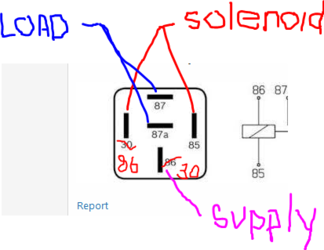
Looking for a replacement to check it seems that the Bosch part number 0332 204 125 (5 blade type) is hard to find and may have been superseded however the replacements seem to have blade 30 and 86 in swapped positions........will this cause a problem or be okay to use?

Picture is the Bosch layout fitted........thanks chaps.

1641294384995.png
 
Start by getting a decent earth from the rear light.
They were never very bright however.
If you have a doubt, junk that relay.

Paul
 
That is odd, changing the position of the terminals. From your schematic it is 85 and 86 that operate the relay, with 30 and 87 connecting the power to the globe. Is there a schematic on the new relay? You can check with a multi-meter what does what. No doubt you had your test meter earthed direct to the battery or as good as. You could also trace back through the connectors to find where the power drop occurs and just fix it, all the meter lamps and park are on that circuit too.
 
The Numbers should make it easy to replace, no matter where the blades are sitting.
Thank you, I agree but If the blades don't line up with the original wiring it might not work as intended.
Start by getting a decent earth from the rear light.
They were never very bright however.
If you have a doubt, junk that relay.

Paul
Thanks Paul,
The earth is good but will check all the wiring and connections in the lighting circuit and have now ordered a new relay to eliminate the old one.
 
That is odd, changing the position of the terminals. From your schematic it is 85 and 86 that operate the relay, with 30 and 87 connecting the power to the globe. Is there a schematic on the new relay? You can check with a multi-meter what does what. No doubt you had your test meter earthed direct to the battery or as good as. You could also trace back through the connectors to find where the power drop occurs and just fix it, all the meter lamps and park are on that circuit too.
Hi Tippie and thanks for your input,

I have checked on the Bosch relay catalogue and ordered the part number given for a replacement of the original, .......Listed as 0986AHO625G I have noticed an error in the schematic drawings they show for it.
There are 2 drawings (which I can't seem to copy) but though the wiring schematic is shown exactly as the original, the blades 30 and 86 positions are shown differently between the two drawings!.......adding some confusion.

Hopefully it is just a draughtsman's error but it will be interesting to see what turns up in the post.

 
Voltage sounds like your problem.
The relay is a standard automotive relay, there are plenty of brands. Follow the numbers or the schematic.
Try bridging the relay contacts (30 to 87 or 87a) and see if that improves voltage, if not then the relay is good- keep looking.
Check voltage at the lampholder, between the earthed sleeve and the taillight connection (not the brake light). Then check each of those directly to the battery. That will tell you if the problem is on the positive side or the earth side.

As always, take the opportunity to check, polish and lightly grease any connections you come across, while you’re at it 👍
 
Just put a 20W "parking bulb" in the headlight and throw that relay away.
Taking one wire and replacing it by a relay and several wires is asking for trouble.

Paul
 
Thank you, I agree but If the blades don't line up with the original wiring it might not work as intended.
Depends - if you have the relay sitting in a socket you would of course have to change the wires going to the socket - if you have blade connectors just switch those around. But I would think an error in their documentation is even more likely….
 
Okay, I'm not an auto electrician nor a qualified bike or car mechanic, but I have fiddled around with a lot of relays over the years. Every one of them with that base pattern have the supply being the central vertical one, the output (load) being the two horizontal ones, and the solenoid being the outside pair. Micro relays follow the same pattern, although condensed.

I'm pretty sure the diagram you have is incorrect and that the numbering would be thus (with apologies for the freehand mouse-work):
1641348216772.png
This would then agree with the scematic to the right, ie the solenoid is activated by the outside pins (85/86) which in this relays case causes output to be switched from 87 to 87a (changeover relay). You can confirm this with a multimeter which should show some number of ohms between 85-86 (the solenoid coil), roughky zero between 30 and 87 and infinite between 30 and 87a.
A standard relay has 87 and 87a bridged together and normally open to pin 30, actuation of the solenoid via pins 85/86 closes 87/87a to pin 30.

Now as for the actual problem, any non-standard wiring is worth a look, ie the relay or more to the point how it's been wired in. I'm not a flat-earther anti-relayer but they're not always very well implemented.
Furthermore the rear light is actually part of the park light circuit and not really part of the headlights. Power comes from the fusebox to the LH switch, then when lights are in PARK or ON, a wire carries power to the ignition key switch (yep), then to the small park globe in the headlight, instruments lights and tail light all via the brown wire circuit.. High and low beam do not actually come into it other than being (originally) powered from the same orange wire coming into the LH switchblock.
As for the suitability of a changeover relay in the first place, that seems a strange choice since you'd need the supply to be switched by the light switch and the entire objective is to take the light switch out of the actual lighting circuit (the switch only actuating the solenoid). So to do it right from where I sit you'd also need another standard relay, supplied direct from fuse box to pin 30, then its output (pin 87) going to pin 30 on your changeover relay. That's not a smart idea because now both relays are in series and a failure of either of them will take out your headlight completely.
Better to have two standard relays, both fed from fuse box to pin 30, both their pin 87's going direct to the headlight globe, both pin 85 grounded and both pin 86 going to original high/low beam output wires respectively. No load through the switch and in the unlikely event of a relay failure, you can swap relays to at least get the low beam working.
Or in deed... no relays at all... :D
 
Okay, I'm not an auto electrician nor a qualified bike or car mechanic, but I have fiddled around with a lot of relays over the years. Every one of them with that base pattern have the supply being the central vertical one, the output (load) being the two horizontal ones, and the solenoid being the outside pair. Micro relays follow the same pattern, although condensed.

I'm pretty sure the diagram you have is incorrect and that the numbering would be thus (with apologies for the freehand mouse-work):
View attachment 61041
Great work Breganzane,
and thank you for going into so much detail, I do agree with the numbering on the diagram and will be checking my original relay to see how it compares. I will be tracing the wiring from the battery through to the rear light to see if there are any issues, nothing else is evident other than a dim (to others) rear light.
As far as I understand the changeover relay may have been used to remove power to the parking light when the main lights are switched on?....might be wrong on this but I will have to see if this happens on mine.
 
If you're referring to the OE arrangement with (metal cased) relay and its plastic holder mounted to the rear mudguard, then yes it's purpose in life is to switch off the 20w pilot light when the headlight is turned on. The higher rated pilot lamp was intended to act as a DRL. This was to avoid using the headlight during the day which (with the OE 140w alternator) results in battery discharge at engine speeds < 4000 rpm.

The relay is supplied through the ignition switch (brown) to terminal 30 with a loop from there direct to the tail light. So the tail light is not fed through the relay contacts. Its feed with ignition on is via the LH handlebar switch block (grey). With the ignition switch in park it's via the fusebox.

If the rear lamp is equally dim in both those ignition switch positions then you can ignore the LH handlebar switch. That would leave poor connection in ignition switch, or its 4 way connector block. If the wiring & spades on relay 30 and rear light are clean and tight (also the lampholder contacts are clean), then try a new rear lamp!
 
Thanks for the information Rob 👍

Okay so the new relay turned up today and makes no difference to the rear light brightness so can illuminate that and in both ignition switch positions the brightness stays the same.
But what I have found is that the parking light stays on with the headlight,which it is not supposed to with the relay fitted so a wiring issue maybe?

Does this suggest that the relay is not being energised?…….any clues as to which wire I should trace?……apart from all of them!

Cheers
 
The parking light is always on with the headlight. There is a diode in the circuit which will stop the headlight coming on with the ignition switch in the park mode.
If I remember, it should be possible to disconnect the park mode feed directly at the ignition switch. It's an independent feed I think.

So back to square one for the rear light.
Have you noticed that it's less brilliant than in the past, because those lights are never very powerful?

Paul
 
Okay thanks Paul,
So I may have misunderstood the reason for the relay? My thoughts were it switched the parking light off when the headlight came on to reduce the draw on the alternator/battery.
parking mode works as it should.

So back to the rear light , funny enough no,it only came about from comments about my rear light from friends on the way back from a late night fish and chip run.
Its probably always been like that and they have no understanding of Italian wiring!,

I will fit a new bulb just for good measure and job done 😁👍
 
Okay thanks Paul,
So I may have misunderstood the reason for the relay? My thoughts were it switched the parking light off when the headlight came on to reduce the draw on the alternator/battery.
parking mode works as it should.

So back to the rear light , funny enough no,it only came about from comments about my rear light from friends on the way back from a late night fish and chip run.
Its probably always been like that and they have no understanding of Italian wiring!,

I will fit a new bulb just for good measure and job done 😁👍
Change friends or ride faster at night.
There is a relay thingy on the rear mudguard however and Rob's explanations are no doubt correct. I'm probably confusing with the post 72 750s where there is a diode for the purpose I mentioned.


Paul
 
Last edited:
The diodes are still used with the daytime relay Paul.
My thoughts were it switched the parking light off when the headlight came on to reduce the draw on the alternator/battery.
Correct.

Can you hear the relay click when you turn the headlight on/off using the left hand switch (from sidelight on to headlight on)?

Do you have a copy of the wiring diagram, and a method to check volts on a wire connection point? If you are an ILOC member then you can access one of Regalia Ted's fantastic coloured diagrams which will make life a lot easier for locating & tracing the wires. This snippet shows wire colours on to the relay
 

Attachments

  • DRL connections.jpg
    DRL connections.jpg
    11.6 KB · Views: 12
Hi Rob,

Yes I have one of Teds excellent wiring diagrams,........and No there is no clicking of the relay when switching......however, I may be chasing a red herring here as my current battery is only reading 10.2 volts and is planned to be replaced imminently as its now 4 years old (in fact I have just ordered the replacement.)

I expect 12 V relays need at least near that to operate???

I've checked all the head light/parking light wiring and it all seems as it should be.

I expect I might even find a brighter rear light with a brand new battery too!
 
Back
Top