
You are using an out of date browser. It may not display this or other websites correctly.
You should upgrade or use an alternative browser.
You should upgrade or use an alternative browser.
Degree wheel 750
- Thread starter Cyriel
- Start date

piranha-bro2
Hero member
- Location
- Melbourne
I had the benefit of a splined Gates belt pulley bolted outside where the V-bely fits (it drives my alternator). It has threaded holes on the outer face that I can bolt the degree wheel onto. I doubt you'd want to (involves modification!) but the best bet is to drill and tap three holes in the outer pulley flange and bolt the deg wheel to that. I'll see if I got any pics when doing mine last week.

Tippie
Hero member
- Location
- Dr?bak, Norway
I just have a cardboard circle with degrees on paper I have printed up from the net. Hole in centre so that it fits snug on the starter pulley, dead simple and I use that to a wire pointer for static. For strobing I have white paint dots on the starter pulley also with a wire pointer as I am not looking for close fractions on strobe but to check it reaches the marks I want. A bit risky with a degree wheel spinning at 5000rpm no matter how you hold it on.

JoePurple73
Full member
- Location
- Gatineau Quebec (Eastern Canada)
I printed mine off the web, then glued it onto a thin piece of plywood (10mm), then drilled three holes into the back into which I inserted three magnets. Works fine.

motoddrob
Hero member
- Location
- S/W Australia
double sided tape


Cheap and cheerful method.... Print a paper degree disc from the Internet. Stick it to cardboard (cornflakes packet type), cut out the necessary hole in the middle and stick it your flywheel face with blu-tac. Perfect concentricity is not important to the degree reading.
piranha-bro2
Hero member
- Location
- Melbourne
You only need the degree wheel if you want to degree cams or check specific advance ignition curves. For the latter you need to secure it very well.I check the TDC marks and then don't need a disc.
Paul

CLEMTOG
Hero member
my degree disc was a freebie from Monty and Ward (Triumph dealers) way back in the 60's, it lasted me until a year or two ago, then I replaced it with a black lazer printed disc organised by a forum member (sorry I forgot who) with A11 timing on one side and C4 timing on the other side, a true work of art that I have on a hook on the wall, and I am still using the now cracked, Wassell freebie from Geof Monty.
"You only need the degree wheel if you want to degree cams or check specific advance ignition curves. For the latter you need to secure it very well.." ??? yes but what about checking the often misplaced TDC and full advnce marks stamped on by Moto laverda? and you cant do that if you dont have a piston stop, again my one is an old spark plug with the centre bashed out, crush washer removed and rod brazed in with a tee bar to tighten, made in college when I was about 17.
CLEM
"You only need the degree wheel if you want to degree cams or check specific advance ignition curves. For the latter you need to secure it very well.." ??? yes but what about checking the often misplaced TDC and full advnce marks stamped on by Moto laverda? and you cant do that if you dont have a piston stop, again my one is an old spark plug with the centre bashed out, crush washer removed and rod brazed in with a tee bar to tighten, made in college when I was about 17.
CLEM
Tippie
Hero member
- Location
- Dr?bak, Norway
Quentin is talking about strobing with a degree wheel. I only use them static for cam, or ignition timing as I don't use tdc for static timing on my engines.

breganzane
Hero member
- Location
- NSW Australia
I made this up for degreeing the cams on a 750, it screws into the thread in the crank pulley and the centre bolt locks it, you can turn the crank with the big hex. I have adapters of that diameter for all the engine types, the bore in the wheel is a snug fit and just locks with a grub screw which makes it super easy to set true TDC. Wind it to your piston stop in one direction, set zero, wind around to the other stop and read the degrees, remove the stop and then go to half way, then loosen the grub screw and rotate the wheel to read zero. To cross check wind the piston away from TDC, put the stop back in, and your stops should be the same number either side of zero.
Worked ok both statically and also with the engine running (done with some caution). It also doubles as a puller if the pulley is stuck too hard on the taper.

Worked ok both statically and also with the engine running (done with some caution). It also doubles as a puller if the pulley is stuck too hard on the taper.

- Location
- Calgary, Alberta, Canada
tried to find a degree wheel for a 750 and failed, sorry
Cam Douglas did up cam timing degree wheels for triples for A11 and 4C cams, downloadable here
 laverdaforum.com
I printed out and glued to a CD Rom disc, worked great.
Cam Douglas did up cam timing degree wheels for triples for A11 and 4C cams, downloadable here
Triples - Degree disc markings - 4C & A11 cams
Baffled by degrees before and/or after top/bottom dead centre and marking out your degree disc for A11 or 4C factory timing? Cam Douglas has prepared a very useful drawing for you!
laverdaforum.com
I printed out and glued to a CD Rom disc, worked great.

Dellortoman
Hero member
- Location
- Tasmania, Australia
I've got a large diameter (about 200mm) aluminium timing wheel that I bought at great expense from Vee Two in Western Australia. It's nice and easy to read, great for checking valve timing or static ignition timing but not good for strobe use. The reason being that it's quite thick and heavy. It would make a half decent brake disk!
The only thing that locks it in place is friction when the centre bolt is tightened. The degree wheel has sufficient rotational inertia to behave like a bloody flywheel. When starting the engine, the first plug to fire will give the crankshaft a sudden increase in speed, which can easily kick the degree wheel a few degrees out of calibration. Too often I've found that a re-check of the degree wheel after strobing an engine has shown that it's shifted a few degrees away from zero at TDC. You have to find some way of locking the crank so you can do the centre bolt up humungously tight to stop it slipping. I'm loath to tighten it up with a rattle gun.
This is issue is especially problematic on my Ducati because the degree wheel bolts to the end of the crankshaft through a small hole in an engine cover that has oil inside it. When the engine is running, it always blows a bit of oil out of the hole onto the hub of the degree wheel, thereby lubricating its propensity to slip out of calibration.
That's why I came up with the paper degree scale to paste onto a CD. Its moment of inertia almost nothing.
The only thing that locks it in place is friction when the centre bolt is tightened. The degree wheel has sufficient rotational inertia to behave like a bloody flywheel. When starting the engine, the first plug to fire will give the crankshaft a sudden increase in speed, which can easily kick the degree wheel a few degrees out of calibration. Too often I've found that a re-check of the degree wheel after strobing an engine has shown that it's shifted a few degrees away from zero at TDC. You have to find some way of locking the crank so you can do the centre bolt up humungously tight to stop it slipping. I'm loath to tighten it up with a rattle gun.
This is issue is especially problematic on my Ducati because the degree wheel bolts to the end of the crankshaft through a small hole in an engine cover that has oil inside it. When the engine is running, it always blows a bit of oil out of the hole onto the hub of the degree wheel, thereby lubricating its propensity to slip out of calibration.
That's why I came up with the paper degree scale to paste onto a CD. Its moment of inertia almost nothing.

Cyriel
Full member
Found this tool on the www.: https://www.blocklayer.com/degree-wheel
Like Cam - I wanted adjustability plus low disc inertia, that's why I came up with the paste-onto-cardboard jobbie. When held on with lots of blobs of blu-tac, it will not move, even with a lurching engine. Here is one on a static motor. As cheap as chips.

Love that 'adjustable events' wheel printer you found Cyriel.
Love that 'adjustable events' wheel printer you found Cyriel.

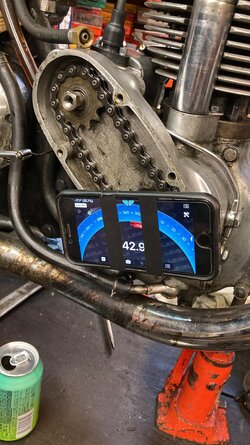

Alan
Senior member
- Location
- Northern Ireland
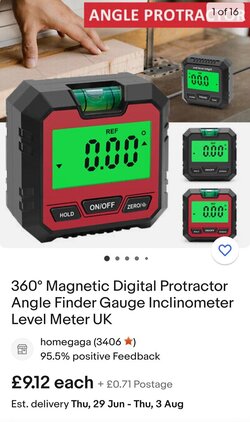
Dellortoman
Hero member
- Location
- Tasmania, Australia
I don't think it would strobe very well.