
You are using an out of date browser. It may not display this or other websites correctly.
You should upgrade or use an alternative browser.
You should upgrade or use an alternative browser.
deleted
- Thread starter twinweb
- Start date


Shajota
Hero member
- Location
- Whitsundays Qld
+1. They also manufacture pattern spokes as required.
Supplied a full replacement set for the front wheel of my '72 xl250 at a very reasonable price when couldn't get pattern sets elsewhere.
Supplied a full replacement set for the front wheel of my '72 xl250 at a very reasonable price when couldn't get pattern sets elsewhere.

hooksey
Hero member
- Location
- Vic , Australia
Good to know+1. They also manufacture pattern spokes as required.
Supplied a full replacement set for the front wheel of my '72 xl250 at a very reasonable price when couldn't get pattern sets elsewhere.


78jotadave
Hero member
What weighs more, a rear spoked wheel complete with brake and sprocket or a Laverda cast wheel with the disc, sprocket, and caliper? Just wondering. Same for the front, does anyone out there know this?

I
I replaced a 3CL cast wheel and Brembo disc brake with a KLR650 wire wheel and KLR disc brake. I measured 5kg savings on the wheels alone. I didn't weigh the calipers and mount but that would certainly be additional weight savings.What weighs more, a rear spoked wheel complete with brake and sprocket or a Laverda cast wheel with the disc, sprocket, and caliper? Just wondering. Same for the front, does anyone out there know this?

Apparently, wire is a lot heavier. I could weigh wire and cast but would involve a lot of moving of bits.What weighs more, a rear spoked wheel complete with brake and sprocket or a Laverda cast wheel with the disc, sprocket, and caliper? Just wondering. Same for the front, does anyone out there know this?
Paul

Dellortoman
Hero member
- Location
- Tasmania, Australia
Hmm ... Looks like a nice wheel build for an original restoration. But if it's a bike that's going to be clocking up lotsa miles, I wouldn't be happy with it.
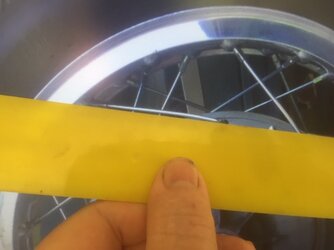
The spokes don't fit the profile of the hub. There's a big gap between the outer spokes and the hub where the bend in the spoke is. You can see quite a bit of daylight under the spokes at that point. The hook in the end of the spokes need to be tighter so the spoke shafts lie flat against the hub flange, then bend around the outer edge of the flange to meet the rim.
The wheel builder has used straight outer spokes whereas they should have two bends, one where it hooks through the hole and another slight bend at the outer edge of the hub flange.
Wheel spokes are cyclically loaded and unloaded as the wheel rotates. That long hook in the hub end will flex a small amount with every loading cycle. In engineering terms, that little hook end is loaded as a cantilever beam. Imagine replacing the spoke with a piece of string and pulling it tight. That's the shape the wire spoke should be so it's loaded in tension rather than bending. If the bike is only ridden occasionally it'll probably be fine. But if you're going to ride it around Australia, I wouldn't be surprised if you get a few fatigue failures of the spokes at that point.
The Laverda factory made the same mistake, which is why the 3C's and SF's regularly break spokes in the rear wheel (haven't seen it happen on drummer front wheels). They nearly always break due to fatigue failure at the hook where it goes through the hub flange. I'm guessing those spokes are reproductions of the originals. Perfect for rivet counter original restorations, but not so good for long term reliability.
The spokes don't fit the profile of the hub. There's a big gap between the outer spokes and the hub where the bend in the spoke is. You can see quite a bit of daylight under the spokes at that point. The hook in the end of the spokes need to be tighter so the spoke shafts lie flat against the hub flange, then bend around the outer edge of the flange to meet the rim.
The wheel builder has used straight outer spokes whereas they should have two bends, one where it hooks through the hole and another slight bend at the outer edge of the hub flange.
Wheel spokes are cyclically loaded and unloaded as the wheel rotates. That long hook in the hub end will flex a small amount with every loading cycle. In engineering terms, that little hook end is loaded as a cantilever beam. Imagine replacing the spoke with a piece of string and pulling it tight. That's the shape the wire spoke should be so it's loaded in tension rather than bending. If the bike is only ridden occasionally it'll probably be fine. But if you're going to ride it around Australia, I wouldn't be surprised if you get a few fatigue failures of the spokes at that point.
The Laverda factory made the same mistake, which is why the 3C's and SF's regularly break spokes in the rear wheel (haven't seen it happen on drummer front wheels). They nearly always break due to fatigue failure at the hook where it goes through the hub flange. I'm guessing those spokes are reproductions of the originals. Perfect for rivet counter original restorations, but not so good for long term reliability.
That sounds like the discussion I had when mine was done, I asked about 2 bends when he made mine and was told he would look at it when he did it and that what was done. There is a long thread written with lots of interesting input when my nightmare happened, BTW I found 12 broken spokes after a fairly high-speed ride with the boys, Petes Ridge sweepers heading to The Old Rd and I was up it a bit, scared me good after finding that. Made much harder by my bigger rim, std is 2.5 and mine is 3.0. My hub had distinct witness marks from where the spokes touched
78jotadave
Hero member
9000+ miles through South America, the original Borrani wire wheel and spokes as per Laverda didn't break any spokes on the front wheel, 3 on the rear, eventually replaced them (I carried spares) with a tire change, spun the bearings in both wheels. The rear wheel was a Borrani WM4 laced up by Hartley Motorcycles in East Perth. The front tire was a Barum purchased in Bolivia so much better for roads in the Andes than the chewed-up Metzler it replaced. When I got to California I replaced the front rim with a non-Borrani alloy rim and new spokes plus got the rear straightened and new spokes by Castro Valley Wheel Works, superb workmanship.
Attachments

Dellortoman
Hero member
- Location
- Tasmania, Australia
I thought it might have been an optical illusion, so I checked with a ruler against the picture on my computer screen. Those outer spokes also have a curve in them where they cross the edge of the hub flange. I'm aware that the bend is forced into the spoke by the way it crosses the edge of the hub at an angle, but I reckon it should have a properly formed bend there, rather than just letting the spoke take up a bow shape. Seems a lazy way to lace a wheel, and it's not as rigid as it could be.
Sorry if I'm pouring cold water on your enthusiasm Paul, but it just doesn't look right to me. What the fuck do I know about lacing wheels though? Maybe I'm just a fusspot. As long as you're happy with the job then it's all good.
Sorry if I'm pouring cold water on your enthusiasm Paul, but it just doesn't look right to me. What the fuck do I know about lacing wheels though? Maybe I'm just a fusspot. As long as you're happy with the job then it's all good.
Attachments

piranha-bro2
Hero member
- Location
- Melbourne
I like spoke threads (not the ones the nipples fit over, the written ones ;-).
It's pretty std practice to 'profile' the spoke across the hub flange as per Cam's description. It's not hard to do. Very common when doing bicycle wheels too, because they have to bend further to lace under-over at the cross. if the J-bend is too wide I will fit washers behind the nipple on assembly.
My experience with bicycle wheels is that (probably repaired, built, trued 500+) is that breakage is directly related to the quality of the spokes. if a customer continually broke spokes, i wold recommend replacing all spokes with known quality items - pay the dough and live happy in the knowledge that the problem had been resolved - never had one come back.
It's pretty std practice to 'profile' the spoke across the hub flange as per Cam's description. It's not hard to do. Very common when doing bicycle wheels too, because they have to bend further to lace under-over at the cross. if the J-bend is too wide I will fit washers behind the nipple on assembly.
My experience with bicycle wheels is that (probably repaired, built, trued 500+) is that breakage is directly related to the quality of the spokes. if a customer continually broke spokes, i wold recommend replacing all spokes with known quality items - pay the dough and live happy in the knowledge that the problem had been resolved - never had one come back.
Dellortoman
Hero member
- Location
- Tasmania, Australia
That's what my brother did with the rear wheel of his 3C after getting fed up with replacing broken (original) spokes at every tyre change. They always broke at the J-bend (thanks for that terminology Q) and for years he kept using a supply of spokes that he bought from a Laverda dealer back when the factory was still a going concern.i wold recommend replacing all spokes with known quality items - pay the dough and live happy in the knowledge that the problem had been resolved - never had one come back.
About 10 years ago he got the wheel re-built with custom made spokes (from the wheel builder) with a nice tight J-bend that leaves no gap between spoke shank and hub flange. The wheel builder also made a pre-formed bend where the spoke crosses the outer edge of of the flange so it's not pulled round into a bow shape. He's had a few tyre changes since then without having to replace broken spokes. He reckons the wheel feels stiffer and has eliminated a high speed wobble that's plagued the bike since it was new.

The Sock
Hero member
- Location
- London, England
I've, as yet, never had a broken spoke, on either of my original 2.15" Borannis or my 3.00" re-laced rear Akront, in forty-five years of spirited riding.
piranha-bro2
Hero member
- Location
- Melbourne
Build 'em right, they don't give probs.I've, as yet, never had a broken spoke, on either of my original 2.15" Borannis or my 3.00" re-laced rear Akront, in forty-five years of spirited riding.
piranha-bro2
Hero member
- Location
- Melbourne
There are many arts and crafts tradespeople disappearing, Vince. How many top quality starter or genny/alt rewinders are there out there these days?