Drilling hexagonal holes ... again

Basketcase

Senior member
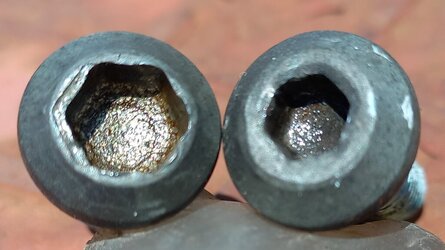
So this time I am presented with a Yamaha hex socket head disc screw that has reamed.

Owner had both over tightened and used copious quantities of ultra high strength loctite which I suspect was super bearing mount.

Their 6mm Unbrako hex key with 18" tube extension reamed the socket.

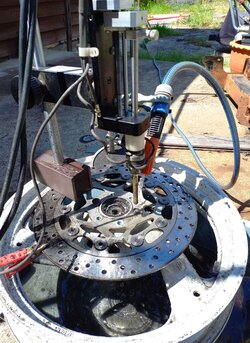
So, got some 5/16" hex brass bar chucked into my EDM and burned an 8mm socket for a larger hex key. The loctite fought me all the way out as it remained intact instead of breaking up into a powder like your usual medium strength thread lock.

Rescued the disc and the slightly stretched wheel threads needed cleaning up with a spiral flute tap ... all good.

Saved an expensive wheel as drilling out the screw thread would not have worked because of the incredibly strong loctite. The glued in debris would not have enabled me to pick out the remains of the screw in the threads. A broken stud extractor (including the hex broach type) would have failed with the incredible torque.
 

Attachments

  • EDM (1).jpg
    EDM (1).jpg
    226.4 KB · Views: 83
  • EDM (4).jpg
    EDM (4).jpg
    90.1 KB · Views: 82
I hate stubborn bolts. That's a novel method you chose. I probably would have welded something to the bolt head. Well done getting them out without busting something.

Next time it might be useful to keep in mind that Loctite will release with a bit of heat. Around 260C will release even the super strength stuff. That could cook the seals in the bearings if you can't concentrate the heat on the bolts, which probably would have given you another job to do.
 
The screw head was already reamed.

I thought about heat but the early FZR600 wheel has a pretty substantial hub that would need warming over a large area instead of point heating and it was obstructed by the large disc.

High tensile aluminium permanently loses strength around 200C, even powder coating causes measurable loss of hardness on most alloys.

Probably not a problem on those soft cheesy old Laverda wheels though.
 
Last edited:
I'm afraid I am not versed in the meaning of "EDM" .......... best I can come up with so far is Electronic Dance Music.

Could you please elaborate a wee bit as to just what you did to to perform this procedure?

Jim

As a non English native I know what you are talking about - there are lots of cases when I'm lost with abreviations.
In this case I can help though: EDM = Electrical discharge machining

Just to please you ...
:cool:
 
As a non English native I know what you are talking about - there are lots of cases when I'm lost with abreviations.
In this case I can help though: EDM = Electrical discharge machining

Just to please you ...
:cool:
Glad you're here to enlighten us, Jo ...;):eek:
 
  • Haha
Reactions: Jo
As a non English native I know what you are talking about - there are lots of cases when I'm lost with abreviations.
In this case I can help though: EDM = Electrical discharge machining

Just to please you ...
:cool:
Otherwise known as spark eroding. Probably the far more common term, something the non-mechanical minded can get their head around.

piet
 
Most Japanese bikes use that red Loctite on their disc carrier bolts, heat gun does the trick. Pretty sure I don't get anywhere near 200 degrees, but interesting to know about the alloy carrier loosing it's hardness, didn't know that.
 
Otherwise known as spark eroding. Probably the far more common term, something the non-mechanical minded can get their head around.

piet
Right, "spark eroding" is the direct translation of the German term "Funkenerosion", so this conceptualization would indeed seem to be much closer.

But for me, the search went the other way round. I read the term EDM here in the forum (a long time ago), didn't know what it meant, and then looked for the translation for this abbreviation. And so the horse was bridled from the other side ...
:cool:
 
With bolts threaded into aluminium, if you want to use heat to release Loctite on a bolt that's going to be replaced, and don't want to heat the entire hub (or whatever) you can heat the bolt electrically. Just zap a welding stick onto the head of the bolt and let the current flow for a second or two. Steel has a much higher resistivity than aluminium, so the bolt will get pretty hot without the surrounding alloy overheating. Don't overdo it though. If the bolt gets red hot, it could melt the alloy thread. At least then the bolt will come out easily :eek:
 
Other way round I think cam, alloy expands faster than steel, my understanding is Loctite let's go at 100c, alloy expands a bit, bolt comes out. This is all unless dpo has fuckulated the head of the bolt....
 
150C is the upper temperature range for standard loctite above which it is permanently weakened. However, strength is reduced while hot around 100C.

200C is the typical upper limit before higher tensile heat resisting alloys such as the 2000 series start to lose their temper.

Spot heating will close up a bolt hole as the cool outer surrounding alloy resists the expansion of the inner warming surrounding alloy surrounding the bolt. So you have to be quick, e.g. tack welding a rod to a broken stud.

Sometimes heating breaks down a corrosion bond enough, or even helps to wick in some release lubricant as it lowers surface tension.
 
I'm afraid I am not versed in the meaning of "EDM" .......... best I can come up with so far is Electronic Dance Music.

Could you please elaborate a wee bit as to just what you did to to perform this procedure?

Jim
Erectile Dysfunction Manipulation ... a technique that has been known to benefit helicopter pilots.
 
When our service technicans can‘t open the M8 hexagon countersunk screws with the 5 mm hex tool they use the torx and drive it in with a hammer.
 
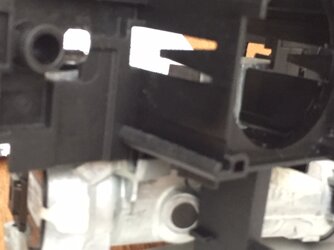
Skoda steering lock thief proof M8 ... try that one on for size ladz (same bolt is blurry top left in 2nd pic). Was tempted to break the plastic shroud that all the stalks and electronics mount to so i could gain access, but that would no doubt have been another $400 to the dealership thieves. Ended up widening the small windows with a file and getting enough purchase with a small cold chisel. Replaced with std M8 capo screws!!
 

Attachments

  • IMG_2590.JPG
    IMG_2590.JPG
    62.6 KB · Views: 25
  • IMG_2591.JPG
    IMG_2591.JPG
    68.5 KB · Views: 25
When our service technicans can‘t open the M8 hexagon countersunk screws with the 5 mm hex tool they use the torx and drive it in with a hammer.

I had a broken stud broach extractor kit (a bit like a torx profile with more small flutes) but the reamed hole was quite shallow. If I wanted to drill down the bolt then I would be limited to a broach diameter much less than the thread root of 6.8mm ... say 5mm or less which is not good for the high torque anyway.

Fortunately this was a button head screw and I had enough material to burn an 8mm hex hole which made sure of the job. Theoretically 2.5 times more strength than a 5mm key.
 
Back
Top