Ducati front axle question, is sort of Laverda related

AndyB_11 said:
I've never seen titanium catch fire and I'd be more likely to blame some other shit in the swarf tray for that happening than the titanium itself. I know you need to be careful regarding which inert gas you use when welding it but I don't think the material itself is a major hazard but is it an oxidising agent that causes issues with other materials?

Believe me once you turn it into fine swarf it will burn white hot, i have had it glowing red under a stream of suds to prove a point to the Boss years ago :)

A quote from wiki
As a powder or in the form of metal shavings, titanium metal poses a significant fire hazard and, when heated in air, an explosion hazard.[87] Water and carbon dioxide?based methods to extinguish fires are ineffective on burning titanium;
 
SimonR501 said:
I turned some Titanium for someone once! I got white hot sparks off it and my tool went blunt.
I believe Titanium is full of rock hard carbides.
That said there must be a way of turning it, but I just changed the tip.

I think the correct technical term is limp rather than blunt. But then again I'm not a doctor. :D

                                                                                      Dave
 
My company used to work in what was then called IMI Titanium in Birmingham and several times I had a wander around the machine shop where the billets went after they came out of the arc furnaces. They used to turn the skin off the billets using high speed steel with the machine running at about 8rpm for a 30" diameter and at that time nobody was allowed to take so called heavy metals (carbide tips etc) onto site because even the smallest piece of carbide would ruin the whole pour of it somehow got into the furnace. 

 
AndyB_11 said:
My company used to work in what was then called IMI Titanium in Birmingham and several times I had a wander around the machine shop where the billets went after they came out of the arc furnaces. They used to turn the skin off the billets using high speed steel with the machine running at about 8rpm for a 30" diameter and at that time nobody was allowed to take so called heavy metals (carbide tips etc) onto site because even the smallest piece of carbide would ruin the whole pour of it somehow got into the furnace.

Was that in Aston or Witton ?

joe
 
Witton and it would have been the late '80s when I worked there.

We used to re-machine the lower sealing face on the arc furnaces to remove pitting and little lumps of titanium that were embedded in there. I always liked working at Witton because there was a belter of a caf? round the corner that sold massive breakfasts dirt cheap  :D

My experience of actually machining titanium was earlier when I worked in the model making team at an aircraft research facility and we used to make quite a few small 2D wing sections for testing in the high speed tunnel. Everything on them was machined with standard HSS cutters and as long as the cutters were kept sharp it cut ok generating normal swarf that in my time never showed any sign of catching fire.

We used to collect the swarf and sell it back to the suppliers because it was top spec stuff and could be melted down and used again for engine components etc so as I previously mentioned; no carbide cutters were allowed anywhere near it. We had to clean the machine down with paraffin before starting the shift then any swarf generated was bagged at the end of and quarantined ready to go back.

 
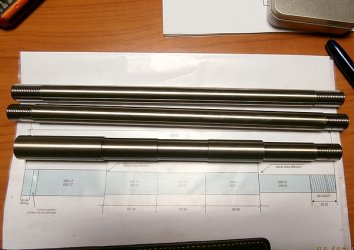
Titanium DO catch fire while being machined, at least this is my experience when I got 2 bars of TA6V titanium to machine the wheels and swingarm axles of my current project. And, added to the price quite high of  the bars themselves, a lot of special cutting tools are needed (at 150 euros each...). All in all, not something that I will do again, I completely underestimated the total cost by lack of experience of this sort of material.


Attachments

  • T1.jpg
    T1.jpg
    67.1 KB · Views: 17
The hollow Duc axle in question seems optimized for lightweight by going closer to the stiffness limits. Titanium has only half the Young's modulus of steel, I'd guess it possibly could cause quite a bit of a wobbly ride with a hollow Titanium axle made to the same dimensions as the Duc steel one.
Even with an undrilled 25mm Titanium rod as axle you will have a 15% lower stiffness compared to the hollow steel one. Not to mention that an undrilled titanium axle would weigh in more than the hollow steel axle. :D For a rather tiny weight savings by use of titanium without sacrifying stability, it would require 30mm axle diameter at least (backside of envelope guess).
Looking at ILO's example probably the same bang for much less bucks could be achieved by drilling out a steel axle (high strenght steel then, of course).
No offense meant, just to highlight that a simple switch from steel to titanium for weight savings without further design changes might not work out as expected in applications where some stiffness/low flex is required.

Regards,
Stefan

 
My mum broke her femur when she was quite elderly and had a titanium rod inserted to fix it. I saw the x-rays after the operation and the bar appeared to be about 250mm long. She was a lively old thing and was up and about within a few days, which says a lot for the strength of that titanium bar. When she died and was cremated, I went to collect her ashes and the funeral bloke asked me if I wanted the titanium rod. At the time I wasn't in a state of mind to properly consider the question, so I said no.  But in hindsight I should have accepted. I could have used the bar for something on my Laverda race bike (a rear-set linkage perhaps?).

Maybe that sounds a bit grim to some people, but to me it would have been nice to have a small contribution from my mother going into the bike. Something to keep her involved in my life. I have very little else of hers. She liked our bikes and would enjoy riding pillion well into her 70s. She was a bit of a nutcase and would have been amused by me recycling her titanium :D
 
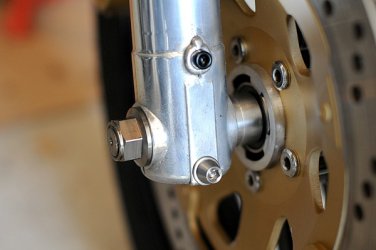
Interesting about the stiffness of titanium as I've got totally different information from a metal specialist in Germany, do you speak about TA6V grade 5 titanium? Some GP bikes had hollowed titanium TA6V wheel axles before they were forbbiden (because they had a tendency to crack not because lack of stiffness). Here is an example of hollowed titanium axles for motorbikes: http://www.ti64.co.uk/honda-rc45-titanium-front-wheel-axle-and-bolt/

I reckon that I'm not an expert myself, just trying to lose weight where it is possible. Axles (undrilled) that you can see on the picture weight between 253 and 275 grams, nut included.


Attachments

  • T2.jpg
    T2.jpg
    109.3 KB · Views: 7
JLO, stiffness is apart from shape and dimensions solely dependent on the youngs modulus, a material property which does not change with alloying. In other words: If you put the same weight at the end of a steel and titanium bar, both of the same dimensions and shape, the titanium bar will flex twice as much as the steel one.

What your expert is talking about is strength, which is a different piece of kettle. strength says how much stress a material can bear without experiencing plastic deformation (yield strength) or rupture (tensile strength). To come back to our example above: Exceeding the yield strength of one of the bars by putting on the weight would result in it remaining bent after taking of the weight. In case you exceed the tensile strength by putting on the weight the bar simply snaps off.

Yield and tensile strength are acutally highly depending on the alloy/heat treatment and your material expert is right here that e.g. TiAl6V4 alloy has more or less the same strength as a quenched and tempered carbon steel.

Have no details available on the broken titanium axles on GP bikes. However, even if the overall stiffness of the titanium axles did not cause handling problems, the low Young's modulus of titanium might have caused large deformations very locally, causing high stresses and early fatigue failure. A lot depends on the design of not only the axles but also the surrounding structures.
 
Many thanks for the very informative reply.
What puzzles me is that some heavily drilled axles in titanium are available for fast sport bikes, see the link above, the thickness is maybe no more than 4 mm, to be compared to mine that are plain.
 
Titanium axles were not banned without reason, I think Stefans' elaborations have explained them quite well.

I'd be very wary of using titanium in load-carrying structures on a road vehicle seeing regular use on normal public roads, rutted and pot-holed as they are in these days of communal financial shortages...

piet
 
(sort of out of date due to other replies written in the mean time but I'll post anyhow)

The difference between stiffness and ultimate strength is often misunderstood and Stefan makes a good point.  The alloy and temper of a metal can change it's ultimate strength by a huge margin but has very little effect on stiffness.

An interesting detail is that in most metals we make bikes from, stiffness scales quite linearly with density.  So for example 4140 steel has a density of ~7.8 and a stiffness ~200Gpa (ratio - 25.6) , Titanium Grade 5 (Ti-6Al-4V) has a density around 4.4 and a stiffness around 114Gpa (25.9) and aluminium 6061 has a density of 2.7 and stiffness of 69Gpa (25.5).  It's a fascinating near-constant that can not be escaped. 
 
JLO, probably it's the "bling factor" that sells those titanium axles for the sports bikes. It depends also on how much reserves re stiffness habe been put in the OEM design by the usual manufacturing/material cost constraints at the bike manufacturers and it would probably take an experienced rider trashing the bike on the track to notice the difference in stiffness. Assumed your 3CL does not exprience any change in handling cababilites by the titanium axles our racers will surely be pleased. They'll know by that moment that they can use hollow steel shafts with half the stiffness of the original shafts, having more weight reduction at probably lower costs compared to the titanium axles.

However, with all this extreme lightweight designs the elephant in the room is fatigue strength, as mentioned by Piet. Even with todays mighty calculation tools you'll finally end out with full scale fatigue testing and/or regular replacements/NDT inspections to ensure a safe ride. Just as they do it in aviation industry.

 
Thanks for all your well documented inputs. I'm always open to discussion and really eager to learn but I'm in a different register, not being an expert in metals and allowing to those who should know to say if such or such metal can be used for such or such application.

When I was thinking to my project, trying to lose weight where it was possible (means everywhere on a Laverda!), I contacted 3 different companies: A well known welding institute in France, in charge of the training session for the welders working at Airbus Industry (special qualification), a big supplier of metals in Germany (where I finally got the titanium) and a significant hi-skilled company specialized in metals and machining that I'm using regularly for my job. After having considered the application, the dimensions and the design, all came to the conclusion that the sole way to lose significant weight while keeping a huge margin in safety would be the grade 5 titanium.

Speaking of safety margin, I can also notice in the same time that titanium axles were used in Moto GP, and that some are available on the market, they are drilled, very thin, and are used on 150 HP bikes and even more, while I'm using plain axles, original design, on a bike that will not be really heavier and would develop less HP.

No offense at all, your points of view are really highly interesting but the difference of argumentation is so big that obviously all that make me think, or at least need an irrefutable scientific demonstration!  :D Who's interested to do that? 8)
 
Can't stand to bore everyone to death by posting lengthy calculations here and the people you've asked are right, surely you'll have still a high marging re ultimate strength with the titanium axles. I'd suppose there is a also sort of smooth transition manufactured at the stepped diameters on the front axle? However, you might keep an eye on those when changing tyres. How about titanium bearing spacers, by the way? :D
 
breganzane said:
(sort of out of date due to other replies written in the mean time but I'll post anyhow)

The difference between stiffness and ultimate strength is often misunderstood and Stefan makes a good point.  The alloy and temper of a metal can change it's ultimate strength by a huge margin but has very little effect on stiffness.

An interesting detail is that in most metals we make bikes from, stiffness scales quite linearly with density.  So for example 4140 steel has a density of ~7.8 and a stiffness ~200Gpa (ratio - 25.6) , Titanium Grade 5 (Ti-6Al-4V) has a density around 4.4 and a stiffness around 114Gpa (25.9) and aluminium 6061 has a density of 2.7 and stiffness of 69Gpa (25.5).  It's a fascinating near-constant that can not be escaped.

Interesting correlation Steve, but beryllium is way off the trend line. According to Wikipedia, it has specific gravity of 1.85 and Youngs modulus of 287 GPa. That makes it lighter than aluminium and stiffer than steel. Maybe we should be making axles out of beryllium alloy.

 
Never liked the toxicity of beryllium.

Never liked the abrasiveness of titanium.

I don't think either will find its way onto my 750GT for some reason.
 
Copper is way out too, which is why I qualified the statement! :)

I think F1 briefly used beryllium alloy engine parts during the first turbo era, banned due to the possibility of pretty carcinogenic exhaust gasses IIRC.
 
Back
Top