Early 750 clutch

Paul Marx

Hero member
Location
France
This is the third time this year, if not the fourth, that I'm dismantling the clutch on my 750 S. I've had the bike since the 90s and the clutch has always had a tendency to drag when hot. It had become very heavy, so last winter, I took it to bits. Since then, problems. It slips and tends to drag as well. Springs are now new though the old ones measured up okay, friction plates are new and the plain plates not warped.
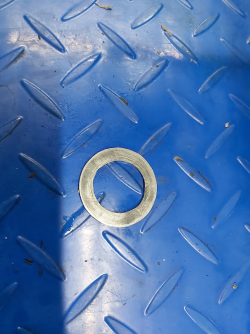
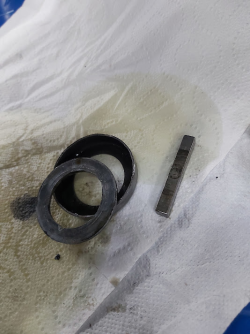
Yesterday, I took ,the clutch to bits again. When I take something to bits, like all of us, I make a note of how things were and rebuild as it was. In this clutch, there's a metal cup whose diameter corresponds with the length of the transverse bar that pushes against the pressure plate. I've always replaced the cup the way that I found it, ie with the bar in the cup and the back of the cup against the pressure plate. Looking at it earlier, I wondered if the cup shouldn't be the other way around, ei before the bar with its back against the clutch hub. Then I asked myself if that cup, ,which is accompanied by an alloy washer, should be there at all and if it's thickness wasn't preventing the plates from seating as they should because that cup figures in no factory parts lists from the time.
In fact, that clutch has been a problem since I bought the machine in the 90s. The clutch was impossibly heavy when I bought the bike. I took it to bits and found washers under the springs which I did away with and got by like that until last year.

So, can some one with experience of these early clutches get me back on track.

Paul
1771436136065.png
1771436152575.png
 
Paul,

The cup restrains the transverse bar from falling out of the mainshaft slot. It needs to be positioned over the bar before installing the pressure plate, as you have done in the past. Don't know where that washer came from, it certainly doesn't belong in there, especially if aluminium alloy. It was possibly fitted to take up excessive slack in the push rod assembly. If there is play at the actuating lever/push rods, the plates should be fully seated. Your description of a dragging clutch points to insufficient lift of the pressure plate or excessive notching of the hub/basket/plates,

I too believe in preserving as much old technology as possible, but the factory didn't replace these clutches because they had nothing better to do... these clutches have mostly been a pita. Some seem to work OK as long as everything is in perfect condition but as soon as a bit of wear and tear sets in they show serious deficits. Easiest work-around is to fit the later clutch.

As to the heavy action, you've probably already attended to the cable and its routing. Optimising the angle of the actuating lever at the gearbox and making sure the handlebar lever fulcrum is in good condition goes a long way to ease lever pressure. I've actually found what I consider lighter springs in some of these early steel clutches, but, as the parts number system at the time was different from that post-1968(?), they cannot be directly translated into the newer system and therefore cannot be exactly defined, ie, I have no idea if they were stock or popular period aftermarket items. The later parts books show the same springs for all models apart from the SFC. I've actually found the earliest clutch set ups controlled by the steel perch/alloy lever Verlicchi hardware to be quite a bit lighter in action than most later combos. Not light to modern standards, but quite OK in regard to Laverda standards.

piet
 
Paul,

The cup restrains the transverse bar from falling out of the mainshaft slot. It needs to be positioned over the bar before installing the pressure plate, as you have done in the past. Don't know where that washer came from, it certainly doesn't belong in there, especially if aluminium alloy. It was possibly fitted to take up excessive slack in the push rod assembly. If there is play at the actuating lever/push rods, the plates should be fully seated. Your description of a dragging clutch points to insufficient lift of the pressure plate or excessive notching of the hub/basket/plates,

I too believe in preserving as much old technology as possible, but the factory didn't replace these clutches because they had nothing better to do... these clutches have mostly been a pita. Some seem to work OK as long as everything is in perfect condition but as soon as a bit of wear and tear sets in they show serious deficits. Easiest work-around is to fit the later clutch.

As to the heavy action, you've probably already attended to the cable and its routing. Optimising the angle of the actuating lever at the gearbox and making sure the handlebar lever fulcrum is in good condition goes a long way to ease lever pressure. I've actually found what I consider lighter springs in some of these early steel clutches, but, as the parts number system at the time was different from that post-1968(?), they cannot be directly translated into the newer system and therefore cannot be exactly defined, ie, I have no idea if they were stock or popular period aftermarket items. The later parts books show the same springs for all models apart from the SFC. I've actually found the earliest clutch set ups controlled by the steel perch/alloy lever Verlicchi hardware to be quite a bit lighter in action than most later combos. Not light to modern standards, but quite OK in regard to Laverda standards.

piet
Thanks Piet. Okay, I'll put the cup back "sans" the washer. The rest checks out okay. I even selected the longest rods in the mainshaft to alleviate drag. I've fitted a DAM arm as well. I'll put it back together and see what happens. If there's still trouble, I'll take the old out and replace with less old.
 
If you're getting drag already, a DAM clutch lever is only going to exacerbate it ... just my contribuito di due lire. We are fortunate that later upgrades transfer easily to older models.
 
Please explain why?
Paul
Physics, Paul.

Law of levers... longer lever = less effort = less travel at the working end in relation to the worked end. You want as much travel at the end of the push rod as you can possibly achieve to fully lift the clutch plates clear of one another. For more travel at the rods you basically need a shorter lever, or optimise the travel through clever cable to lever geometry. Fully deployed, the included angle between cable and actuating lever next to your right foot should only slightly exceed 90°. You are then maximising travel with the least amount of effort.

I have a length of 6mm silver steel rod from which I fabricate rods to the required length in order to achieve optimal geometry. The differences are often only a few 0.1mm and it usually takes a couple of trial fitments to achieve the correct length. The new rod is then removed and the ends flame-hardened before re-assembly. Holds up quite OK, at least until the next dyno run where the whole caboodle welds itself together again. :rolleyes:

piet
 
Understood for the DAM kit. Probably cost me my 3c which I was out testing without the kit when I was hit by a car and the bike burnt.
That said, 3 years later the clutch is still stuck.
I have no problem with the kit on my SF 2. Clutch is easy as is finding neutral.
I managed to cure the drag on my S by choosing the longest rods from my stock. I probably gained 1.5mm lift. But, I was left with a slipping clutch.
I'll get rid of that alloy washer and we'll see.
Paul
 
In another thread, I pointed out the differences in the actuating levers and their fulcrums. These changes cannot be found in the parts books, possibly done at the same time of part number system transitioning. Outwardly, they all look the same...

The earlier type affords less lift, possibly due to the fact the early clutch has fewer plates than the later. Fitting the later-type fulcrum and lever MAY help toward decreasing drag but will undoubtedly increase lever effort.

The entire effort/travel thing is dependant on the type of handlebar lever, condition and routing of the cable and lever geometry at the gearbox end.

piet
 
My Pantah non-hydro clutch was close to as bad as my Laverda one. I tried the local Ducati shops' race Pantah, and it was miles lighter; they used a late model Aprilia purch and dog leg lever that accommodated the bigger cable nipple. Dead cheap fix at $70oz. The way the lower arm fits on Pantahs, there is no way to extend that one at all. Just enough to still get nutral but no ill effects.
 
Piet, by any chance, do you have a "cup" to hand, the one that goes over the clutch bar? If so, can you measure its thickness?
Mine measures around 1.2mm. The alloy spacer is around 2.3mm thick.
Paul
 
Sounds about right, Paul. Can measure one for you tomorrow.

piet
Thanks, have a quick look by all means, but I was on the wrong track, thinking that it's thickness would come into play; but it wont, it will only influence the position of the clutch arm by a gnats whisker.
Paul
 
All closed up.
2 plain discs checked against the rails of my lathe were well and truly warped, so they were changed.
All the discs and the springs are now new.
The alloy washer in the cup that locates the push bar was left out.
Now to put the exhaust back on and some oil in and we'll see.
I'm getting quite good with these peg clutches.
Paul
1771696751087.png
 
Took the S out this morning and all seems well apart from neutral not wanting to appear. No slipping, no dragging.
I may have at last sorted the clutch for the first time since 1996.
:)
What a lovely old motorcycle it is.
Now back to learning the intricacies of Vincent construction and British screw threads.

Paul
 
Took the S out this morning and all seems well apart from neutral not wanting to appear. No slipping, no dragging.
I may have at last sorted the clutch for the first time since 1996.
:)
What a lovely old motorcycle it is.
Now back to learning the intricacies of Vincent construction and British screw threads.

Paul
The Vincent clutch is pretty infamous as well... :ROFLMAO:

piet
 
Back
Top