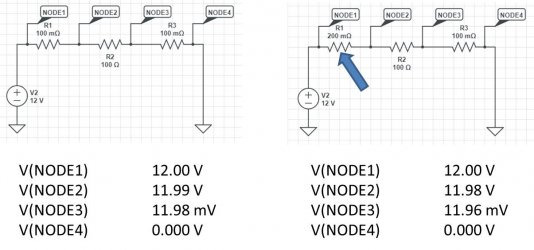
Voltage drop happens over an entire circuit, from battery to the load and back to the battery, wherever you make the electrons travel on any particular circuit. Over the short lengths on a bike the actual value of volt drop caused by cable losses is negligible, maybe 1 volt at most, as long as you use a wire size capable of carrying the current running through it. (connections are another story...)
I have seen overloaded wiring melted within a loom, when the plastic insulation has softened and suddenly all the wires were holding hands... However that was a "too much current" issue, nothing to do with volt drop.
Wiring current ratings are variable depending on installation, so don't take the advertised rating as gospel. If a wire rating is advertised it is likely to be its maximum under perfect circumstances, usually relating to the ability of the insulation to manage the heat which is naturally generated in the copper while current is flowing. Most plastic insulation will stand surprising temperatures and are often rated at 50 - 85?C, enough to burn you, but long before it gets that hot the plastic has softened enough that the slightest pressure will damage it.
So to prevent overheating always use a bigger wire than you need when your wiring is in conditions where it is likely to get hotter, without the ability to loose that heat, like inside a loom or near the motor. Also when it is subject to pressure from cable ties or movement.
Sooooo.... back to the original question...
There is no benefit to using a bigger earth wire than you need, from each accessory, so long as you've allowed for all the current likely to go through that wire, plus a bit.