Exhaust Tuning

evenin gents,

there are so many variables when designing an optimum exhaust system, from the obvious pipe length's, diameter's and sound reduction to pipes missing the sump plug !
On a triple, getting the correct downpipe convergence is very important, the correct gas flow masking from the pipe ends can give huge improvements in mid range torque, getting the position for balancing pipes if required is another important feature.

The more time you have on the dyno the better the result.


Andy - ex Motad exhausts dyno engineer
 
Interesting this topic and have some good first hand knowledge... just before the Snowy Run decided that I would replace the collector on the RGS with the main criterea being to raise the centre stand up some. I had a spare original collector for the Corsa so off with the Stainless one which I noted was cracked near where the centre header goes in.

Since fitting the replacement collector which got the stand to sit a higher ( as the stainless was from a 180 ) have  discovered that the flat spot just off idle that had been chasing for ages had dissappeared, the bike sounded heaps different, a lot more raspy and meaty  :D and as a bonus it went from using a tad over 1 litre per 1000 K's to around 600 ml for the entire Snowy trip which was something a bit over 2000 K's or so.

Say found this link which some might find of interest.

http://www.bukupower.com/animatefast.html
 
Talkin oil consumption correct ... fuel consumption on that bike has never really been an issue was always good maybe it is even marginally better now.. guess around 280 - 300 K's per tank ... with Dellortos !!!!!

At a guess and with a light of hindsight I reckon the oil consumption was more to do with the crack in the collector and as such no back pressure so it was kind of pouring down the guides. When you think about it if you a loose exhaust flange on one of these engines it can leak oil out of there yet when tight you dont see the same oil coming out of the tail pipe. On the RGS I know the guides are nearly shot, was going to replace the head at the last rebuild but that is another story why it didnt happen... the rings however are fine ( new around 15 K ago with hi comp pistons )

 
Brett said:
Interesting this topic and have some good first hand knowledge... just before the Snowy Run decided that I would replace the collector on the RGS with the main criterea being to raise the centre stand up some. I had a spare original collector for the Corsa so off with the Stainless one which I noted was cracked near where the centre header goes in.

Since fitting the replacement collector which got the stand to sit a higher ( as the stainless was from a 180 ) have  discovered that the flat spot just off idle that had been chasing for ages had dissappeared, the bike sounded heaps different, a lot more raspy and meaty  :D and as a bonus it went from using a tad over 1 litre per 1000 K's to around 600 ml for the entire Snowy trip which was something a bit over 2000 K's or so.

Say found this link which some might find of interest.

http://www.bukupower.com/animatefast.html

Thanks for confirming, Brett.

Fitting a big-bore collector to a stock 120 is a load of bollocks... don't see it influencing oil consumption though. :D

piet
 
The Morini engine has Heron heads and vertical valves, not enough back pressure and all the gas runs straight through the head and out the exhaust. Another perculiarity is that the factory also found that because of this the engine did not require as much ignition advance at very high revs so the bike advances as normal then retards a small amount at the top end. Morinis are also noted for having a weakfish spark at low revs which can also aggravate a potential off idle stumble.
 
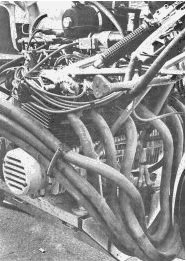
My favourite was the Bol d'Or 1977 Motob?cane Benelli 6 with six five-feet-long pipes wrapped round the engine. It sounded magnificent but, sadly, didn't trouble the leaders.
 

Attachments

  • Bol d'Or '77 Motobecane Benelli 6 Zorsts.jpg
    Bol d'Or '77 Motobecane Benelli 6 Zorsts.jpg
    29.9 KB · Views: 118
Very interested in this thread - I joined the forum after it first appeared so have never seen it. Having just spent the last couple of months piecing together a system for the SFQ, I take everything I can on board about ex sys design.

I'm planning to have a couple of options, one of which is done and ready to weld once lockdown 4.0 finishes in two weeks. I've already posted a pic of the X-pipe I made for version 1. But I'm adamant my decision to go with 35mm ID headers (smaller than stock SF and my factory SFC 2/1) will be used on any variant I end up with. And that's with an increase in capacity from 750 to 880. Basically, it starts to open up just below the front of the motor, then expands gradually from the 35mm to 53 at the end of the whole system. The last 600mm or that expanding taper are through perforated tube for baffling. No idea whatsoever how it will go until dyno time is spent on it.

The other version will be identical but without the X-pipe - and with or without an H-pipe crossover (where to locate that is another enigma!). I theorise that my 270 motor requires a different strategy to a 360 motor ... and I could be wrong! I'll chuck the old 2/1 onto it once it's near a dyno to compare. The old 2/1 is an aftermarket 'copy' of the factory 2/1 but has the smaller 35mm ID headers.

In the pic attached of Lee racing his SF (SFC spec internally with 39mm FCR Keihins) with his home-brewed 2/1. You can clearly see the small collector - same ID as the individual headers. It uses the expanding formula of 1cm/m he was given by expert tuners. His bike punches well above its weight.

Interesting stuff. Certainly tallies with your view on big bore collectors on triples, Piet (then again, very different dynamics in terms of canisters and outlet dias etc).
 

Attachments

PS Notice the small bore headers also. And BTW - I think this pic deserves to be considered for the calendar ... an SF doing what it does best, not shiny or particularly pretty, but going fast!
 
Quentin,

My theory can easily be confirmed with a quick and simple test.

Low pressure air line down one of the headers, a couple of paper snippings fed into one of the other headers.  The difference can be seen in the speed they are picked up by the ensuing vacuum and spat out the back.  Smaller 120? collector is far more efficient than the big-bore, it acts as a real extractor (remember when all 4-1 systems were labeled "extractors"?) using the venturi effect.  Apparently, the even firing intervals of the 120 engine result in an even exhaust flow, with no interference from uneven gas pulses.

Dynamics of the 180? call for a big-bore collector, but the 120? works best with the stock item.

piet
 
Piranha Brother 2 said:
PS Notice the small bore headers also.

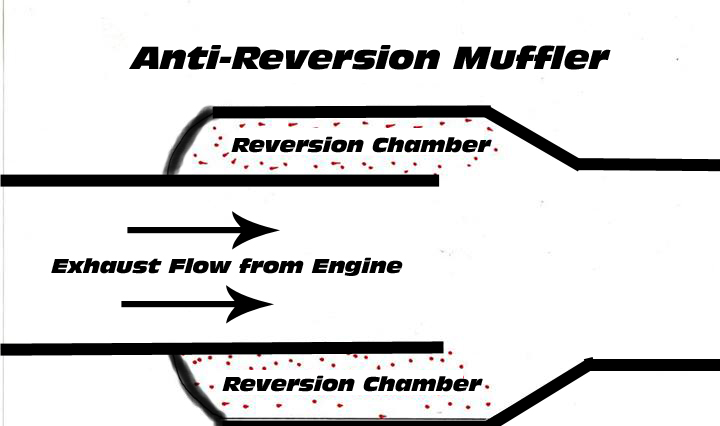
I can't find the correct info or image ..... but I have an exhaust on mt Ducati Monster that uses an interesting header stub attached to the motor that uses a small reversion chamber as it exits the head ........ and this works in concert with a relatively small bore header pipe that increases by about 5 mm about halfway to the collector. I can't say it makes mega power or anything like that but it does make smooth power from 3,000 to 9,000 ....... it cured the emissions stumble at 4,500 even before I remapped the ignition.

If I find better info or photo's I will add them later. This is as close as I can get for now (it is exaggerated as far as the version I have).

Jim

ar-muffler.jpg
 
Nowadays I divide pipe and head development into two categories; Carburettored and injected.

A motor on carbs requires relatively high intake velocity for the carb(s) to function well across a wide range. Too low a gas speed and the fuel doesn't atomise.
When the engine is getting fuel in chunks rather than a burnable mixture it's hard to find the right jets.

A motor with injection can be ported and piped for maximum flow and use a pipe biased toward peak power. The injection pressure looks after fuel atomisation at all gas speeds. Mixture strengths are very easily adjusted too.

The heads that will open your eyes are the latish Ducati 1198 and 1298 twins. The ports are enormous. I'd doubt if they could ever be made to run acceptably on carbs.
 
78jotadave said:
Maybe and it's a big maybe if someone has one of the old 3C single tube (narrow) 3 into one collectors and one of the much more common big bore 3 into 1 's they could do a quick comparison as to changes in performance, rideability. My first 3c had the narrow collector so it was immediately changed for the big bore collector I cannot recall if the narrow collector provided better around town ride as back then everything was about full throttle riding. I modified the narrow collector to big bore as most owners did, doubt there are any narrow collectors about these days.
                                      Cheers Dave
  Dave I have a very early 3C , when I purchased it, it had 1800 original miles on it, it had the original single pipe collector on it, it ran just fine with it, I put a 3CL collector and some Jota  silencers on it and it runs much better,  I might have lost a little under 2000 rpm but pick up a lot everywhere else, it revs much more freely  pulls harder mid top, I put the stock setup  back on and it felt like it had a cork in its ass!      Cheers
 
GregT said:
Nowadays I divide pipe and head development into two categories; Carburettored and injected.

The heads that will open your eyes are the latish Ducati 1198 and 1298 twins. The ports are enormous. I'd doubt if they could ever be made to run acceptably on carbs.

Interesting stuff, Greg. Probably explains the massive headers they seem to use as well. They can also compromise some low and mid simply through huge capacity and high CR, and as you say, the fuel injection deals with it all without drama. Once into high RPM and high HP it's a massive open pump. Impossible to imagine carbs coping with all that!
 
helicopterjim said:
I can't find the correct info or image ..... but I have an exhaust on mt Ducati Monster that uses an interesting header stub attached to the motor that uses a small reversion chamber as it exits the head ........ and this works in concert with a relatively small bore header pipe that increases by about 5 mm about halfway to the collector. I can't say it makes mega power or anything like that but it does make smooth power from 3,000 to 9,000 ....... it cured the emissions stumble at 4,500 even before I remapped the ignition.

If I find better info or photo's I will add them later. This is as close as I can get for now (it is exaggerated as far as the version I have).

Jim

ar-muffler.jpg

Also interesting stuff, Jim. Someone's done a fair amount of research to design a mod like that. Wonder if it's associated with the uneven firing sequence (which is one of my concerns with the 270 motor). I've seen some weird return- and cross-pipe designs on Aprilia performance exhausts that would seem to be dealing with that issue.
 
sfcpiet said:
Quentin,

My theory can easily be confirmed with a quick and simple test.

Low pressure air line down one of the headers, a couple of paper snippings fed into one of the other headers.  The difference can be seen in the speed they are picked up by the ensuing vacuum and spat out the back.  Smaller 120? collector is far more efficient than the big-bore, it acts as a real extractor (remember when all 4-1 systems were labeled "extractors"?) using the venturi effect.  Apparently, the even firing intervals of the 120 engine result in an even exhaust flow, with no interference from uneven gas pulses.

Dynamics of the 180? call for a big-bore collector, but the 120? works best with the stock item.

piet

Firing intervals at play again, Piet. All seems to demonstrate how important it is in ex design - always surprised at how many V-twins have 2/1s. Mine always ran fine on it's 2/1, but I'm interested in what diff a twin or semi-twin (2-1-2) system works.
 
as written before in this thread, both my Jota (180?) and my SFC 1000 (120? obviously) have modified or completely re-designed exhausts. I can confirm what Piet says: the Jota basically has a similar design now to the big-bore collector (wich is basically 2 pipes in parallel, joined together to share the volume). My collector was modified by removing the center piece and welding in 2 pipes that run in parallel back to the mufflers...

The 120? SFC has a 3-2-1 system, where 2 pipes are joined together via a Y-piece, then the end of that Y-piece gets joined together with the 3rd downpipe via another Y-piece. As pulses are going after each other, this makes a veeeery long downpipe for each of them with an underpressure-effect, sucking out the gases of the other cylinders with every pulse. The last Y-joint goes into a conical tube that widens up to the end by roughly 7 or 8? to go into a single, quite large muffler. The headers on the 120? are therewith much longer (almost until the oil drain plug overall) than on the 180? Jota (which has an SFC head, too).

Friend of mine has copied that concept of the SFC 3-2-1 for his race RGS and was very happy with the result.

So - overall, there are lots of aspects that need to go into the calculation of the design. When the 1000 SFC exhaust was shaped, SR-Racing did lots of tests on the dyno to find the right combination. Not the best for the clutch actuation, which I had to repair 3 times, but the result is amazing...
 
Tippie said:
Would that anti reversion system be using the end of the header pipe cut as the tuned length for the return pulse?

Short answer - Yes.

Some years ago David Vizard came out here and gave a talk at a tuning forum. I've still got the very useful handout literature (free ! )
He was keen on a resonator in the tailpipe of joined systems but cautioned specifically not to extend the pipe into the resonator as you then effectively put a stop to wave activity at that point.

Vee twins - My personal rule of thumb is only use a 2:1 on engines under 700cc. Above that I'll always use separate pipes.
I have tried what you could call "H" layouts with a joiner at the length I need to achieve peak torque at the RPM I want.
The spread is probably better - but peak HP down.
For a biggish twisted twin I'd start with separate pipes.
 
Back
Top