flat pack storage option for laverda in UK

just throwing this out there,
does anybody here have any experience, good or bad, with flat pack containers,?
for example https://www.budgetshippingcontainers.co.uk/flat-pack-containers/
I need to buid a new shed/workshop and while that is going on,
I thought I could keep my Laverda plus my tools in a one of these as until my shed is done,
then re use the flat pack to be a garden store, (mowers, ladders that sort of stuff etc)
I like the idea of being able to dismatle and move it,
a standard shipping container is there for good pretty much.
I would appreciate any opinions especially if you have used one?
cheers,
Stuart
 
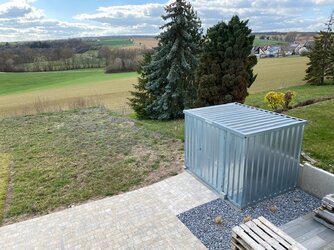
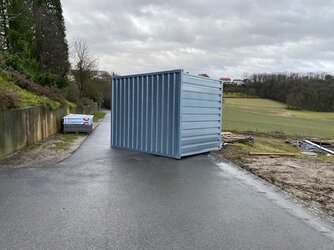
I have one as a garden shed. For the price of an untreated wooden shed of questionable quality you get something that will last forever. Couple of caveats: You will have to isolate the floor from moisture, as it is OSB-board. If you want to put the bikes in, invest in a double door. And if you are exposed to inclement weather - they will fly if not protected....

IMG_2514.jpg

IMG_7990.jpg
 
Yes, it's 2x3. After the tumble it did have a dent in the front where it crashed on the granite curb you see in the foreground. For normal uses it's pretty much indestructible. I have no insulation because I just use it for storing the lawnmower and other garden equipment, I have garages for the bikes. And the silver looks best next to my house AND is the cheapest option.... I didn't dismantle it to move it but used an excavator to lift and move it (if you have access to an excavator and the excavator has access to you). I am going to put another shed (for bicycles and other stuff) in the front where those large pallets are, but that might end up being a metal frame building, because I still have 180m² of surplus aluminum panels lying around.

IMG_2033.jpg
 
Last edited:
Quote:” - they will fly if not protected....

Do you mean that the container blow over? Hmmm That’s no good, ☹️
Where I live it’s extremely flat and therefore really windy, lots of wind farms and all that,
I know a 250kg or whatever bike will hold it done but I hope it will be out and about.

Anyway, another question, how long is an SFC1000 ? Ie what is the smallest
I don’t have my bike with me so that’s why I can’t just go and measure,
I’m guessing 2.5 - 2.6m maybe 2.8.
just be typical of me to order a shed that’s too short.
Could anyone care to check for me? Btw I did do a search!
Stuart
 
You should have checked the RGS workshop manual in the library ;) which will be there or thereabouts....2190mm, give or take the fibreglass rear mudguard vs Bayflex
 
Windspeed was around 110km

OK, you need another solution then.

Whatever type of structure you're building, you need to design it to suit the prevailing conditions. A lightweight tin box sitting on the ground is obviously not going to be up to the task in that kind of wind. It would be foolish to expect it to stay put in all wind conditions. There are many different types of building and anchoring systems that you could consider. Adding weight to the structure is just one way of anchoring a building. I only suggested it because it's simple and portable. Perhaps you need a more permanent structure for your shed.

Your local building authority should be able to provide a wind speed classification for your area. They will also be able to advise you on any special considerations for the exposure of your particular location (if you're on top of a hill for example).

The strongest wind speed I've had to build for was 200mph (320kph). That was for buildings in Antarctica that are subject to katabatic winds. There's a colloquial Australian saying "built like a brick shithouse" meaning something that's very strong and robust. But the Antarctic buildings had to be stronger than that. A brick shithouse would be blown to bits in 300+ kph winds. :)
 
After Cyclone Tracy leveled Darwin they completely changed the Oz building regs to deal with wind loads. I spent a day at a seminar where the locals learned about this. It got very technical very quickly. What was needed was a few rules of thumb but that came after the technical stuff. What I did learn was it gets expensive if you build in open ground and on top of hills or up north where the big winds blow.
 
OK, you need another solution then.

Whatever type of structure you're building, you need to design it to suit the prevailing conditions. A lightweight tin box sitting on the ground is obviously not going to be up to the task in that kind of wind. It would be foolish to expect it to stay put in all wind conditions. There are many different types of building and anchoring systems that you could consider. Adding weight to the structure is just one way of anchoring a building. I only suggested it because it's simple and portable. Perhaps you need a more permanent structure for your shed.

Your local building authority should be able to provide a wind speed classification for your area. They will also be able to advise you on any special considerations for the exposure of your particular location (if you're on top of a hill for example).

The strongest wind speed I've had to build for was 200mph (320kph). That was for buildings in Antarctica that are subject to katabatic winds. There's a colloquial Australian saying "built like a brick shithouse" meaning something that's very strong and robust. But the Antarctic buildings had to be stronger than that. A brick shithouse would be blown to bits in 300+ kph winds. :)
Once upon a time there was three little pigs....
 
Back
Top