Forks again

LUPIS52

New member
Location
North Yorkshire
Hi there
I am a new boy to this ,well not new really just bloody old in fact,so if I make a cock up please excuse.
Lots of details on the forum with regard to fully extended Marzo fork length.
I have a 76 Jota that came with Cerianis ,replaced with Marzo after accident, never thought any thing about it
but I did wonder why it never quite lifted rear wheel of the floor like it use to before rebuild.
Anybody out there got a measurement for fully extended Ceriani axle center to top of stanchion ?.
If the Marzo is slightly too long I will look at dropping the stanchions through the yokes as I will probably end up putting high handlebars on the old thing as wrists are knackered after accident and old age.
On another note Hello Phil good to know you are still out there last met up with you when I picked my cylinder head
up from yourself after you fitted lead free inserts for me.
Hope you are OK
Regards
Chris
 
Were the Marzo forks fitted into the Ceriani yokes?

Is there a difference between Marzo yokes and Ceriani yokes (thinking there is if the variety of headlamp tubes I have is any indicator).

Experts please comment!

h.
 
Harry Lime said:
Were the Marzo forks fitted into the Ceriani yokes?

Is there a difference between Marzo yokes and Ceriani yokes
(thinking there is if the variety of headlamp tubes I have is any indicator).

Experts please comment!

h.

Yes.

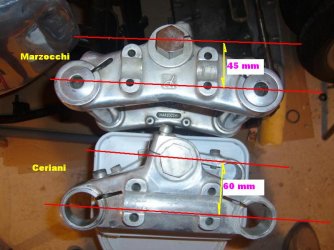
Marzocchi top yokes were flat, Cerianis stepped.  Exception, early Marzocchi-equipped 1200s were fitted with top yokes made to the Ceriani design, later ones had the flat type that was used up to the introduction of the 1000SFC.

The Ceriani yokes had the steering stem at a different angle to the stanchions.  Allowed the use of a shallow steering angle while keeping the wheelbase within desirable limits.  Not sure about the cranked Marzocchi yokes, the flat type definitely had steering tube parallel to the stanchions.

piet
 
Hi Piet, sorry this is an old photo and I don't have the lower yoke immediately on hand.
JLO
 
Hi JLO,

MVma looked somehow familiar, but didn't realise it was you! :D 

Point I was trying to make is, the lower yoke has a lot less off-set, thus illustrating the non-parallelism.  The Ceriani yoke probably offers more trail than the Marzocchi.  Reason why the racers often fitted parallel SFC yokes (before the Marzocchi were available) to reduce trail and enhance handling.

piet
 
Hey Piet, did the 38mm cerianis on the SF2/3 use the offset yokes? My old SF2 had the 35mm forks, never notice if the yokes were offset or not
The Motodd has the offset yokes with Marzo legs. I found the ceranis offer more steering lock than the marzo on the Motodd with the wider spaced downtubes.
I did measure them once, think the offset maybe 5mm comes to mind. Have thought about fitting the yokes from the SFC for a comparison but really can't be fucked.
Can't fault the current setup so leave well alone and I don't really want to remove the front end of the SFC either, so it'll just remain a thought!
 
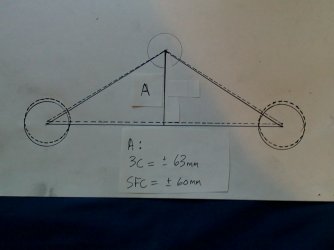
The difference shows up in the top Ceriani Yoke.   

I think that the two versions of the Ceriani bottom yoke have the steering stem in much the same location, but the stem angle is offset on the non-SFC version.  This reflects in a difference in offset on the top yoke.  The non-SFC version of the top yoke has the stanchions further away from the steering stem, and it is the non-SFC version that has the extended trail.  The attached pic shows a crude measurement of the difference in the two top yokes.

I have the SFC version fitted to my 3C.
 

Attachments

  • LaverdaSFC3CTopYokeDims.jpg
    LaverdaSFC3CTopYokeDims.jpg
    154.8 KB · Views: 25
I had the offset removed on the Ceriani yokes on POP.
The steering stem was removed, the holes filled with weld and then rebored parallel to the steering head.

 
motoddrob said:
Have thought about fitting the yokes from the SFC for a comparison but really can't be fucked.

Typical of the lassitude that sets in after spending too long in the colonies!

Going back to the topic, is there a difference in the distance between top and bottom yokes, Marzo vs. Ceriani? Did the Marzo and Ceriani triples have the same headstock?
 
Steering tube length was the same throughout the range, as was the bearing spacing in the frame.

The difference in headlamp tubes stems mainly from the flat or cranked top yoke.

At a guess, the lower Ceriani yoke will have about the same off-set as the Marzocchi, but because the stanchions pass through at an angle, trail will be considerable longer.

Rob, all the 38mm Ceriani forks, except the 750SFC, used the non-parallel stem/stanchion relationship.  The 35mm fork has parallel stem/stanchions.

piet
 
Thanks to all concerned in replying to post.
I dropped my stanchions through the yokes which are Marzos to about the 770mm axle to top of stanchion that Tom measured and the back wheel came off the deck about 10 or 15 mm about the same as I remember with the Ceriani front end.
As the fork were in pieces to fit some emulation valves,  I found that the extra holes in the damper rod have to be be drilled
above the original, although 8mm holes seem big for the diameter of the alloy damper rod.
Anyway one of the stanchions is slightly bent and has some scouring around the bottom so I am going to get them checked and may see about shorting them when I have done some accurate measurements.

Chris
 
Hi Chris

Some notes on installing Gold Valve emulators in Marzocchi forks:

BTW, Marzo damper rods are steel, not aluminium alloy. 

There's a "how to do it" guide by Doug Home on JLO's Laverdamania site here http://www.laverdamania.net/emulatorgb.htm

But if you're talking about drilling 8mm holes I suspect you've already got a copy of the above document and are following it.  However, Doug's instructions re drilling the holes in the damper rod are (in my opinion) incorrect, so I'd suggest you not follow that part of the guide. He says to drill 6 x 8mm holes, only 4 of which are effective anyway (the bottom pair in Doug's design are covered by the alloy mounting spigot at the bottom of the fork leg). Don't worry if you've already drilled the holes to Doug's specs. It will still work, it's just that you've removed a lot more metal than necessary. On the plus side, you will have removed a couple of grams of unsprung weight!

Here's my alternative recommendation:
In the original damper rod, there are two 5mm dia holes (or one hole drilled through both sides) near the bottom end. I open these holes out to 6mm and drill another pair of 6mm holes at right angles to the first hole, about 10mm further up the damper rod. These 4 holes give more than enough open area to allow unrestricted oil flow through the damper rod. Together, they're about 1? times the cross sectional area of the inside diameter of the damper rod, through which the oil also has to flow, so going any bigger than 4 x 6mm is overkill.

You will also be aware that you need to make significant altertions to the top end of the rod, for which you will need a lathe. Doug suggests making a new top end for the rod, which is perfectly OK, but I find it simpler to modify the existing one and plug the rebound damper holes just below the head of the rod. The existing ball valve will fall out when you open up the head of the rod.

Doug also says you need a spacer to go on top of the emulator valve. Put it in if you want, but it's not necessary. It'll work just fine without it.

You will need a spring preload spacer to set the fork sag, but this is more easily fitted above the spring where it doesn't move, wear out or add to un-sprung weight. For 38mm Marzos, I make preload spacers out of 32mm heavy duty (orange) UPVC electrial conduit.

Cheers,
Cam
 
Dellortoman said:
Doug also says you need a spacer to go on top of the emulator valve. Put it in if you want, but it's not necessary. It'll work just fine without it.

Just for clarity, those upper spacers are required if you're using original fork springs.  The ID of the original springs is too small to allow the emulator to operate properly.  But it is highly recommended to replace the springs too, and using typical racetech/eibach/etc springs the upper spacer is not required as the spring has a much larger coil diameter.
 
Hi Steve. I've used both original and aftermarket progressive springs, no problem with either of them interfering with the valve operation. Maybe it depends which valves you use. There seems to be several versions of them from different manufacturers.
 
Back
Top