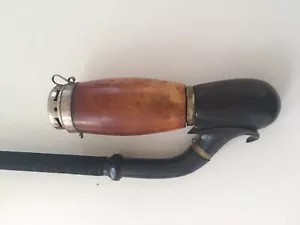
real natural meerschaum
real amber
The rest of the text is the company name and the company headquarters berlin
„Meerschaum“
Meerschaum pipes originally come from Turkey. In all likelihood they were already in use there in the 17th century after the introduction of tobacco. The north Anatolian city of Eskişehir has been a manufacturing center for this type of pipe since 1700; it has been known in Europe since the 18th century. While unsmoked meerschaum pipes are white, they darken with frequent use. This peculiarity distinguishes them from other pipe models.
Meerschaum pipes are made from the clay mineral sepiolite, which was originally called "Lüle stone" after the Turkish name lületaş. This magnesium silicate, which occurs mainly in the region around Eskişehir and is related to magnesite, was extracted as early as 1173 between the fossil calcareous sediments there, which are stored at depths of up to 250 meters. There are also other deposits of the mineral in Tanzania, but also z. B. in Italy at Baldissero Canavese (Piedmont).
The advantages of meerschaum pipes over pipes made of wood include: in that there is no need to smoke them, that they are initially tasteless and that the material (sepiolite = colloquially "meerschaum") is extremely fire-resistant. So they offer little taste absorption. This means that burning such a pipe is theoretically impossible and it is possible to smoke such a pipe while hot. A disadvantage, however, is that meerschaum absorbs tobacco aromas, which are annoying when smoking various types of tobacco. In addition, meerschaum is a very fragile material.
Thomas aus LAU