Harsh Cer Forks.

Are the fork legs straight and parallel,  yokes bent?
Off the bike the forks are still stiff/short stroke or freely moving compared to when on the bike?
Fork brace fitted?
Just trying to think laterally. 
 
Appreciate the thought, legs are brand new.Haven't had them off the bike, they move with the fibreglass guard and wheel attached reasonably easily together given the weight to full, 130mm travel with the caps off. No brace fitted. Anyway its back to the suspension guro on Monday.
 
I thought you were the suspension guru Vince ?????????now I am confused...
If you put one sping in one side what happens.. better still if you put the original springs back in then what ?  as its either the springs or something up with one of the damper rods.

Perhaps your suspension guru flogged you the wrong springs. Better you get him to sort out your leaking rear shocks also but to be ready for the trip or are you taking the Pantah ?? though if it were me would send the shocks to Proven Products even with postage reckon it will be cheaper.
 
He doesn't do twin shocks, BTW the Laverda shocks are ok. Oil came from the head issue. Why this is happening to the Pantah forks makes no logical sense, the springs are softer than std and there appears to be no solid contact internally but something is restricting movement.
Gravity waves maybe?
 
Again if you the stock springs back in do you have the issue and why are we talking Ducrapy on a Laverda forum anyways.
 
Must have missed seeing all those Marzocchi forks fitted to Laverdas. So today after Brett's suggestion, helpful as always, I pull a spring out and tried it with one spring fitted and both caps on. Did this to both sides to see what might happen. Rolling off the centrestand I was concerned the bike might fall to fully bottomed forks but nope. It went down a bit and stopped but with a pushdown and the brake on it will bottom with either spring out pretty easily. Yes a complete waste of time doing this, what could I  learn from this. Seem my problem isn't the springs, or some mechanical resistance but I think its sticktion. There appears to be one hell of a lot of this restricting smooth movement and it gets stronger as the forks compress.
 
Vince said:
Seem my problem isn't the springs, or some mechanical resistance but I think its sticktion. There appears to be one hell of a lot of this restricting smooth movement and it gets stronger as the forks compress.

I think you need to pull the forks off and find out what's really going on ...... you don't want to be damaging them if it is a duff bushing or something like that.
 
As Cam says, it doesn't look like stiction.
Stiction is static friction that resists the initial movement of the item, in this case the fork slider.
After that it is dynamic friction.
Something that resists movement in an increasing manner must be caused by some other source.
 
If I remember rightly you tackled the flow of oil earlier in this thread. My suspension guy had to make a collar to seperate the valve from the bottom of the damper rod because it was sitting right on the end and restricted flow. Works much better now (relative).
 
Even with the forks empty of oil, it doesn't move past 80mm of travel with both springs in, with only one spring in it moves 130mm. And that's with lighter springs than I should have in it.On the road with oil in them even with me hitting speed bumps on the brakes stupidly fast it only used 80mm of travel even if it should have 130mm and is very harsh and its been like that for the 30 years I have known the bike. I used to say to my mate the previous owner, you need to do something about how hard the suspension is. Seem It's down to me.Its going back to the suspension guru on Monday, maybe he can find something
 
Vince said:
Even with the forks empty of oil, it doesn't move past 80mm of travel with both springs in, with only one spring in it moves 130mm. And that's with lighter springs than I should have in it.


Sounds to be that the springs are too long/heavy or both. How do you know the springs are lighter than should be in it and how do you know the intention of the manufacturer was for all the travel to be available? Might it have been set up for racing on a smooth surface?
 
The springs are marked with either 90 or 95 and a serial number.From memory that's the stiffest springs available for 38mm forks.They are 360mm long with no preload, the caps require zero push to get on. I know its sounds exactly like the springs are to stuff but there the same as are in the Ceriarni forks on my 3C and work ok in it. I wouldn't mind some minor bottoming resistance 10 or 15mm where it would need to be ridden into a 150mm concrete gutter to be used but 50mm of resistance isn't reasonable. There, not some oddball forks from what I can see, how much travel do other bikes with 38mm Marzocchi typically use, it's not hard to see with a cable tie fitted. The last long ride I did last year on a 40c day at 600ks down to the Southern Highlands had me beaten to a pulp from the suspansion. I like riding it and would if it wasn't so uncomfortable.
 
Vince, are there venting valves in the fork caps of your Pantah, which could possibly be blocked??? I had more or less the same issues as you describe, with the 35mm Marzo forks on my Morini. It took not many k's for myself being totally beaten up by the harsh fork behaviour, with things getting worse as longer I was into the ride. Changed oil, played with air gap and pretension etc., all to more or less no avail. Finally, I had a closer look on the fork caps, to find out that they include a kind of venting valve. Unlike the Ceriani on the triple, the Marzo on the Morini seemed to be a "vented" fork. Those vent valves are formed by a simple hole in the center of the caps, with a steel ball sitting at the bottom of the hole, followed by a spring, sized similiar like the ones you'll find in ball pens, all held in place by a countersunk slotted screw, sitting at the bottom of the allen key hex of the cap. I wondered how the air could go past the tapered seat of the screw head. Close inspection reveiled, that these countersunk screws are of a special type, having some ridges on the tapered seat of the screw head, to let the vented air pass by. This ridges had simply worn flat, blocking air passage, and taking the vent valves out of work. Slightly releasing the bolts to enable air passing by the bolt head instantly cured the harshness on that forks.


The caps on mine have a Shrader valve, same as a tyre valve. There set at an offset angle on top of the cap with a steel valve cap on top. I depressed them to see if any air pressure had built up, there was a tiny bit released. They look completely sealed, don't know how they might relieve air pressure and not squirt out oil on compression. With them open, it would stop any air compression that usually is used to resist bottoming. I wonder if there should be some form of active air bleeding from them. I will try having them depressed while bouncing the forks hard and see how much travel there is then.
 
Hmm, never seen them with Schrader valves on the fork caps, that might be aftermarket items? You could also remove the valve inserts and put the valve caps back on loosely for a test.

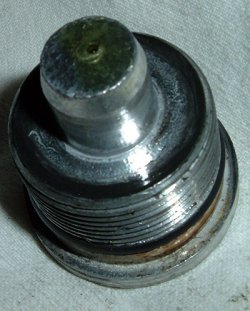
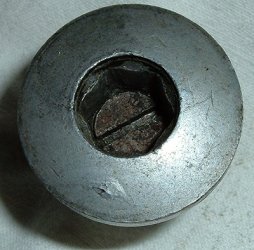
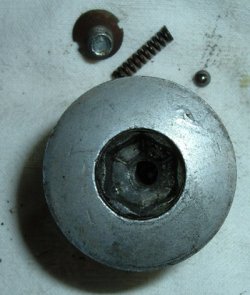
Just went down to the shed to take some photos of the Morini's vented fork caps. See pictures added below.
First picture shows the vent hole at the center of the pin at the inside of the fork cap. Second picture shows the cap from the top with the countersunk slotted screw sitting inside the allen key hex. Third picture then shows the spring and the ball sitting under the screw. Looking closely at the seat of the screw, you can spot the remains of the ridges, intended to allow air passing by the screw head. The slotted countersunk screws are a actually a standard item, my memory had played tricks with me here, so forget what a said about them in my last post.


Attachments

  • Cap1.jpg
    Cap1.jpg
    93.7 KB · Views: 16
  • Cap2.jpg
    Cap2.jpg
    82.8 KB · Views: 18
  • Cap3.jpg
    Cap3.jpg
    74 KB · Views: 21
So I finally got the call from the suspension guru. While I was there I was shown that a few kilos of lateral load on one fork while it was in a vice created huge amounts of friction that took a considerable push to overcome. I was told that without bushes they couldn't fix these forks to make them more compliant. So I asked how much to convert them to top and bottom bushes. They needed to find someone who could line bore or hone them and would get back to me. They said to supply bushes and machine to fit them,$150. Today I hear after calling a few places they found someone to line bore them at $400 a fork, all up $1200 to convert to bushes to reduce friction. So there going back together as they are. I have no idea what to make of all this. All I want is the full 130mm of travel and a nice compliant ride. Seems it's not going to happen. Again these are the 38mm Marzocchi forks wheel axle in line with the fork on my Pantah, the 38mm Cerianis are now great on my 3C.
 
Back
Top