You are using an out of date browser. It may not display this or other websites correctly.
You should upgrade or use an alternative browser.
You should upgrade or use an alternative browser.
Hydraulic brake switch
- Thread starter Paul Marx
- Start date


The Sock
Hero member
- Location
- London, England
It should make a circuit when pressure is applied to the brake lever.

piranha-bro2
Hero member
- Location
- Melbourne
Ha! I'm sure Paul will see the humour in that responseIt should make a circuit when pressure is applied to the brake lever.

Paul, you mean like using a multimeter in some way? Doubtful, because unless you have a closed circuit (like when the brake lever is squeezed) there's nothing to measure - it's just two electrical contacts that touch when hydro pressure brings them together. I tested my aftermarket one off the bike by poking a small rod up it's cloaca and creating that pressure by hand and the multi sounded off to confirm a circuit.
piranha-bro2
Hero member
- Location
- Melbourne
If it's connected and full of fluid and not working ... you'll have to take the f...ing thing off again anyway.Looks like I'm going to have to take the f....ing thing off again.
Paul

Looks like it, only it's one of those jobs with consequences.If it's connected and full of fluid and not working ... you'll have to take the f...ing thing off again anyway.
One of the bleed nipples is about to strip its thread so it means at least one caliper out, a 6mm tap down the bleed hole and if that doesn't do it, a 7mm tap and 7mm bleed screw.
I'm beginning to dream of brake fluid. In the last couple of weeks, I did my wifes 500, then my 3C and then my SF2. New pistons, seals and master cylinder pistons and seals.
I've had quite enough.
Paul

Gerald
Hero member
Paul,
you have a bike to compare, right? the brake light switch works on the SF2, but not on the 3C.
Hook up your multimeter to the SF2, the restistance setting should display some value when the brake lever is pulled.
Repeat the exercise on the 3C and see what you got. If the reading doesn't change, your switch has an issue.
Gerald
you have a bike to compare, right? the brake light switch works on the SF2, but not on the 3C.
Hook up your multimeter to the SF2, the restistance setting should display some value when the brake lever is pulled.
Repeat the exercise on the 3C and see what you got. If the reading doesn't change, your switch has an issue.
Gerald
Thanks Gerald, will give it a try.Paul,
you have a bike to compare, right? the brake light switch works on the SF2, but not on the 3C.
Hook up your multimeter to the SF2, the restistance setting should display some value when the brake lever is pulled.
Repeat the exercise on the 3C and see what you got. If the reading doesn't change, your switch has an issue.
Gerald
Paul
dja982
Full member
- Location
- aberdeen scotland
Why not bridge the two wires if it lights the brake light its the switch if it doesn't its the wiring
There's 3 wires. 2 grey ones from the switches and a black live feed.Why not bridge the two wires if it lights the brake light its the switch if it doesn't its the wiring
The light will come on by bridging black + 1 grey but not black and the other grey.
I'll wait until I have a rear switch wired in before jumping to conclusions.
Paul

Dellortoman
Hero member
- Location
- Tasmania, Australia
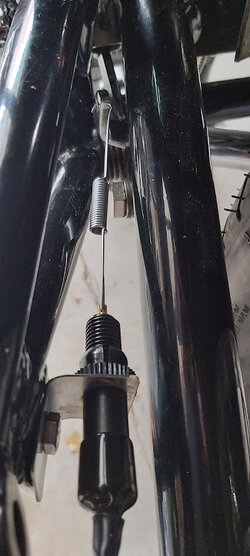
Presuming you have sufficient fluid in the system to develop pressure when you apply the brake lever, then there's no need to remove the switch to test it. It's a simple matter of putting a meter across the spade connectors on the switch. Use the lowest Ohm scale. Some meters have an audible beeper to indicate continuity when the resistance is below a few Ohms, which makes life easier because you don't even have to look at the meter.
Brake not applied - meter reads infinite resistance.
Brake applied - meter reads zero Ohms. Don't worry if it's not exactly zero. Most meters aren't perfectly zeroed.
Brake not applied - meter reads infinite resistance.
Brake applied - meter reads zero Ohms. Don't worry if it's not exactly zero. Most meters aren't perfectly zeroed.
Thanks.Presuming you have sufficient fluid in the system to develop pressure when you apply the brake lever, then there's no need to remove the switch to test it. It's a simple matter of putting a meter across the spade connectors on the switch. Use the lowest Ohm scale. Some meters have an audible beeper to indicate continuity when the resistance is below a few Ohms, which makes life easier because you don't even have to look at the meter.
Brake not applied - meter reads infinite resistance.
Brake applied - meter reads zero Ohms. Don't worry if it's not exactly zero. Most meters aren't perfectly zeroed.
Looks like nothing is going to happen until I wire in a rear brake switch anyway, it's an integral part of the circuit, both switches being on the same circuit.
Paul

Laverda SF
Hero member
Paul: Just quit swearing and FIX the God Dam thing ;o)

Thanks, will do as soon as I have a rear brake switch wired in. I've just ordered a Honda one, €5. Will wire it in next week and see what gives.Connect your multimeter on to the two connectors on the switch and have it on ohms. Push the brake pedal. If its an analogue meter you should have a full scale deflection, if its digital it should be zero (or very low) ohms.
Paul
piranha-bro2
Hero member
- Location
- Melbourne
So ... IIUC you've ascertained that the front brake light switch is good? And you issue was an incomplete circuit through the rear switch?
Dellortoman
Hero member
- Location
- Tasmania, Australia
I don't understand where your thought process is leading you Paul. The front and rear brake switches are wired in parallel so one will still work without the other switch being present. Testing with a meter is best done with the wiring disconnected anyway. So the entire wiring harness can be in another room for all the difference it'll make.Thanks.
Looks like nothing is going to happen until I wire in a rear brake switch anyway, it's an integral part of the circuit, both switches being on the same circuit.
Paul
Ok.I don't understand where your thought process is leading you Paul. The front and rear brake switches are wired in parallel so one will still work without the other switch being present. Testing with a meter is best done with the wiring disconnected anyway. So the entire wiring harness can be in another room for all the difference it'll make.
Paul