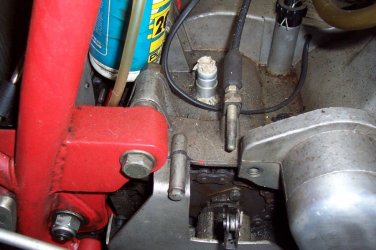
ignition curve sachse ignition

I am trying to manage the mid range flat spot on my 74 sfc. Bike is stock, with stock exhaust ( 2 into "X" into 2), 5C cam, 175 mains and 54 pilots. Just installed Sachse ignition. Stuttering and flat spot at around 4 to 5k. Much better than with stock points, and idles much better, but still a (reduced) flat spot. I know this has been attributed to the stock exhaust, but the two into one is too loud and will likely get me a ticket, so I must manage with the stockexhaust (which is still quite loud). Has anyone settled on the best curve on the Sachse unit with this set up? Currently running curve 4. Instructions do not distinguish between stock SF and SFC.

 
Hey Spud, yep I got a ticket in California with my 2/1!! 
One thing you should watch out for is the breather hose where it comes over the top of the frame and drops down between the carbs. It can get pinched between the frame and the fuel tank. The pressure builds up and blows oil out of the G/box seals and all over the rear tyre with a wooshing sound. It happenned to me on the Pacific hwy in Marin country, first I knew about it was on a right hand bend with the arse hanging out too far for comfort so I headed straight for the bush and drop it in soft dirt not doing any damage apart from some minor scratches on the fairing. Luckly, as the bike had only done a couple of hundred miles I was still running it in so wasn't going as fast as I would normally have been going. Solution is, when fitting the tank, pull it back towards the seat 10-15mm giving the breather alittle more room. If you have a look you'll see what I mean.
Once I get my Motodd finished I might look into a Sache Ign. for the SFC.
The points are well pass their use by date and I don't want to waste my money on replacing them. The SFCs really need the Ign/timing spot on for optimum running, more so than the SFs.
 
Just put two rubbers each side at the back of the tank instead of one. Also stops the tank wearing through on the frame rails.
Ciao
Paul
 
Have you checked the timing of your ignition? I had one last year that didn?t do what it should. The advance did not exceed 20 degrees. It was a fault in the programming and we got a new one instantly.
H.-C.
 
Yep, Rob, that is a sharp bend that breather has to make. The "two rubbers" trick works on the bike I have, it is not collapsed, though the bend is still pretty sharp.

Looked at the curves at Sachse, and note that Curve 9 ends at 39 degrees advanced at about 6K. Supposedly, the stock mechanical unit spooled in 40 degrees at around 3K (similar to some bevel ducatis that had up to 40 degrees). Still, 39 degress is a lot of advance, but bike seems to run best on this curve. I then looked up the advance for my JOTA, and max advance is 32 degrees at around 3K. Got me to thinking why the twins had so much more advance than the triples...You would think at any given RPM the piston speed for a twin or triple is the same, though the twin piston will be firing more times to keep the same rpm up as the triple. This is beyond me, I only install stuff and follow directions, and leave the theory to others, but can anyone enlighten me?
 
Hi Spub,

To understand why pre-advance curves differ, you need to understand why you need pre-advance...  ;) Basically the advance curve is to overcome the fact that fuel does not burn fast enough to maximize the resulting pressure on the piston if you spark at TDC. So - the question is why? Well, a flame needs time to hop from one atom to the next (or basically "expand the flame front"). How much time is needed to do so depends on several factors, which makes up for a need of different pre-advance timings during different running situation... the advance curve depends on:

-compression
-revs
-fuel quality
-piston diameter
-Exhaust resistance/configuration
-some other minor facts such as mixture, temperature etc. etc.

So - the reason why the 750's had so much more advance is simply as they had (mostly) less compression and larger Pistons. I think they were also made for 95 Octane fuel (instead of 98 for the triples) which burns slower (but easier); I might be wrong here though.

HTH
 
Spub, it?d be interesting to get your bike on a dyno to check the effect of different maximum advances. Seat of the pants isn?t always so accurate. On my racing SF with 6C and 10.5 comp etc 28deg gave best power and torque curves, same for a mates race SF. My road SF has inherited my used racing 10.1 setup and is also (un-dynoed) set at 28 and is excellent (even with points!!!).
Lothar, from my experience stock SF are prone to pinging with lower octane fuel when set up to their their standard 9.5:1 compression and standard ign timing. I have measured combustion chamber on numerous standard SF1-3 and found between 8.4 and 9 to one. As you say lower compression does need more advance.
My fading memory tells me that bevel ducs had about 34deg max advance.
Phil, you needed the extra breather when you increased the capacity?
 
Spub,

Ignition timing is mostly dependant on combustion efficiency, which in turn depends to a great deal on engine load, fuel quality and compression ratio.  

The 750 combustion chamber and inlet tracts are far removed from modern designs, valve configuration and plug position add to the disadvantages.  The less efficient a head is, the more advance is needed to get the inhaled gases burning at the right time without creating too much heat.

The combustion process is just that... the atomised fuel burns, it does not explode.  The general idea is to have the mixture burn as quickly and completely as possible, this creates a minimum amount of heat that the engine components need to cope with.  A compact combustion chamber without too many nooks and crannys and a centrally placed spark plug will allow the compressed fuel/air mixture to burn quickly and evenly.  Add a couple of deep valve pockets and a plug placed way off-centre, the mixture will take a lot longer to burn completely.  This is especially evident in large-displacement cylinders, smaller pots will hardly show much difference.  Big bore 2-valve Guzzis e.g., profit greatly from a twin plug set-up, this really speeds up the combustion process.

At full advance, the piston is still on its way to TDC.  When the plug fires, it only initiates the fuel burn process.  Advance is chosen so that the full pressure resulting from combustion, quite a bit later once all the mixture has caught fire, acts on the piston once it has travelled OVER TDC!  Having the combustion pressure acting on the piston before it reaches TDC would result in a massive power loss.

The average Laverda 750 will require something around the factory specified 40?BTDC at WOT under load.  Up the compression a bit and you might get away with 35-36?, getting more of a charge into the combustion chamber via different cams or decent porting might allow even further full advance reduction.

The triple combustion chambers are quite a bit shallower, piston crown flatter with shallower valve pockets, all adding up to a more compact chamber shape.  In the case of a 1000 triple, we also have less piston crown area, ie, a smaller chamber.  This allows the full advance to be reduced to 32?BTDC on a stock engine to around 27-29? on a tuned engine.

The path the ignition curve folows up to full advance, also depends in part on fuel quality, engine state of tune and of course the load the engine is subjected to at any particular revs.  

The procedure for choosing a particular curve should roughly follow the procedure for choosing carb jets.  First look for maximum performance at WOT, then start tuning how to get there....

piet
 
Piet and Lothar, thanks for that, clears the fog somewhat. That is why I was somewhat confused that the curves did not distinguish between an SF and an SFC, which has a higher compression ratio and more lift to the cams. Would seem it should be the case, based on what you stated, that the SFC would need less advance. Curve 9 has a very gradual curve starting out with 2 degress of advance at idle and ending up at 39 degrees at about 6K. Had the bike at WOT and was making power, just worried about holing a piston long term. 6 of the remaining 8 curves start out at 8 degress advance at idle, which for some reason did not agree with the bike as much as the lower advance at idle of curve 9. Curves 1 and 2 also start out at 2 degrees, but end at only 31 and 32 degrees advanced. I suppose I should try these two at WOT also...
 
Hi Tippie - I put the same extra breather on my 750 as well as the 870cc - always like to make sure ther's never any power sapping pressure under the pistons on the downstroke - plus it's "belt &braces" as well in case original breather gets blocked. I use the triple breather hose with a Morini 350 breather baffle in it. - Regards - Phil
 
To avoid welding...: wouldn't it be possible to add a breather instead of the oil dip stick? Especially if you have this nice oil filler in the shifter cover like the SFC's...?
 
Back
Top