Ignitions

  • Thread starter Thread starter jlo
  • Start date Start date
I am. everything so far sounds very good just waiting for some negative comments

DAVE
 
Lothar,
Reason I started making ignitions in the first place was so I could get rid of the original pick ups.
If JW stayed in business I would not have needed to get involved but it was getting so hard trying to buy an IIS I decided to do my own version with Sachse.
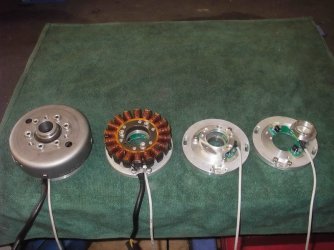
Attached photo shows my system components, in this photo the triggers are optical sensors but new versions are now hall effect.
You throw everything away from the original system.

I'm mystified why the Ignitech needs the standard triggers to work.?
All the triggers do is supply a signal to the control box, why can't they work with hall effect of optical sensors.?

Red
 

Attachments

  • System set up reduced.jpg
    System set up reduced.jpg
    197 KB · Views: 59
Hi Red,

I did not say they can't, I said they can. The only point is that most of us don't have the tools to make up the right signal-disks, mounting plates etc. and Ignitech is offering only basic equipment for that. They can do the signal rotor (which you have to make sure does not turn, they deliver only a flat steel plate, lasered with the right cut-out but with just a central hole) and the hall sensor if you want (but no mounting plate for the Bosch or ND engines). Not that they could not do that, but they see to less requests for them. They would however do everything if you bring the bike there (which is OK for Germans possibly, but no option for you...).

In that regard, the Sachse is a good value for price, especially with your alternator upgrade. So, let me adjust my previous comment...:

on a 120? or Series 2 (ND) 180?, I would go for an ignitech at any time. easy setup, even if you want a hall-sensor to work (you could potentially even use the setup of the 750 Zanes as a basic...). Same is for 750 Breganzes.

on a 180? Tripple Bosch engine, I'd probably would use your system, as it offers a very good value for money together with the alternator upgrade.

Sorry for my bullish wording above, I was just thinking of my recent acquisitions... (which are as you know both 120? ND).  ;)
 
dja981 said:
Cam are you on commission.
                                        Dave

No. I just like the product.

Red's alternator/ignition conversion looks like an excellent product. The high output alternator replacement is a much better solution than putting the extra charging coil in the original Laverda alternator. My preference for Ignitech is purely a personal one because I like to be able to plug a laptop in to see what's going on. Makes set-up and diagnostics very easy.

I'll talk to Ignitech about getting some hall sensors to replace the original Ducati ones at some stage. I dunno what the Ducati pickups are, but they're different to the Laverda variable reluctance type. You can measure the resistance of the Laverda pickups (about 57 Ohms) but the Ducati ones behave as if they're open circuit. Maybe they're some kind of semi-conductor device. The Ducati sensors on my bike seem to have an inherent advance curve that you have to correct for with the advance map in the ignition unit, so a fully programmable ignition is the only real option.

Cheers,
Cam
 
Cam,

Bevel Ducatis have the same pick-ups as the 350/500 twins, MK II 180?, 120? triples, and the '76 750SFC Elettronica..... Bosch, with crumbling isolation.

Someway along the line, Ducati switched to Kokusan....(belt drive?)

piet
 
Thanks Piet

Do you know what sort of device they are - VR, Hall, or some other wierd time-dilation technology from the Tardis?
The pickups on my Duc appear to have a fixed duration time delay built in, so the signal is retarded (a bit like the owner).
The fixed duration means that the spark retardation angle measured at the crank increases with revs. At idle speed, the error negligible, but at max revs I had to program in 40o advance to get 32o measured at the crank with a strobe.

Cheers,
Cam
 
Not sure on the terminology about the pickups but the Kokusan ign. pickups were phased in about 1991.The amplifier boxes controlled the advance curve I guess based on frequency[engine speed].I do know that the Bosch pickups were very sensitive about the air gap to the flywheel trigger and the early belt drive Ducatis used a two stepped bump on the flywheel to effect a timing change.I guess it had to do with the mag. field decay time.The insulation fell off those wires too.
 
This thread makes interesting reading from my side of the world..
The two race 180 deg triples I've built for a customer both use Kawasaki four pickups and backing plate.
This style of twinpickup ignition is pretty common across the 80's Kawa range - 400/550/600 up to 8 valve 1100.
Both are set up as total loss - no alternator so they can be tucked in tight wih a shortened cover.
I use a Kawa twin lead coil on one side and a single lead on the other - the center cylinder obviously.
It's just a question of matching the primary resistances of the two coils. The Kawa 500 twin coils have the same primary
resistance as the fours happily.
There are a range of ignition boxes which will work with these pickups - all seem to have approx 20 deg of advance range.All in by around 2500 rpm which works very well on a race motor.
Currently the boxes in use are 400 four ones - 14000 rev limit....doubt if he'll ever see it cut in - hope not anyway.
The low Kiwi dollar makes this kind of adapting necessary here...
For a road motor the same pickups can work off the outside of an alternator rotor - see the Kawa 500 twin.

What has been said about the sensitivity of pickups to the air gaps rings a bell too - a lot of the Japanese ignitions as they age are starting to show this too. Two that spring to mind are the Kawa KLR600/650 and the Honda GB/TT 500 - both start/run/perform way better with the pickup air gaps closed up to around .015in from the OE .040 or more
 
i would call the Sachse and DMC selectable  rather than programable
you really can't make your own curve or map
i'm not sure about the ignitech but having the ability to tweak with a laptop
suggests tht the curves may be adjusted to ones own design and thus be programable

does anyone know if the ignitech uses 3D mapping?
 
Hi Scott,

no 3D, but 2 D with a TPS influenced 2nd map: you can have a second map that only applies if TPS is activated.

and yes, it is fully programable in terms of ignition advance curves and adjustable in terms of several parameters. For the full description please see:

http://www.ignitech.cz/english/tcip/manual_sparker_tci_p_stps_tps_con_en.doc

have fun

Lothar
 
Anyone know details of Trispark ignitions from NZ friends looking to get one for his Commando?Fully digital I believe.

Shaun
 
i had a Triumph Trident T150 before. Trisparks has a rock solid reputation in that community. The number one thing to do on any of those meriden triples is fitting a trispark. Then look at the rest.
 
jotacorsa said:
i would call the Sachse and DMC selectable  rather than programable
you really can't make your own curve or map

Scott,

The DMC II is at least re-programable... not a DIY affair, but if you have firm ideas of how your advance curve should look, Mr.Witt can program that for you!

He's currently playing around with my RGS ignition, we're up-grading to new low resistance coils that need different dwell timing.  I did my alpine ride a few weeks ago with a completely different programming, very promising.  I'm working on a bracket to fit the new coils which will give a fatter spark.  Better starting, especially with a low battery will be the greatest gain.

piet
 
"The DMC II is at least re-programable... not a DIY affair, but if you have firm ideas of how your advance curve should look, Mr.Witt can program that for you!"

same as the Sachse, Volker has changed a system for me no problem, gave him the curves I wanted, he shipped me the box
he will program any curve you want

Red

 
ltmt7 said:
Hello,
When I put Ignitech ignitions My 3C  became a problem with the power charger.
I bought Chinese elements,  they are be at an affordable price.
The end result was not quite what I was expecting a shark's charging current is 15A,
The result was not quite what I expected to 15A
but it was (140W) 10A. Full capacity will be 2500 already round.
I can run the lights on and the battery voltage is still well.
If Laverda does not begin to reject the Chinese technology.
Here are some pictures of the final outcome.

http://picasaweb.google.com/ltmt43/3cUpdate#

Leo

Hello,
I find Leo's work very interesting, simple, and with the ignitech box it seems to be an economical solution.
But as I don't have skills in electrics, I 'd like to know what you people think about this only one pick up system ?
And how/who's doing it ?
I have the project to restart a 74 triple (HKZ system) i never saw running...
Electrics is a mess on it, so the first step for me will be to rebuilt it from scratch...
By the way does someone know if affordable complete "updated" wiring are availables somewhere ? (I don't have skills in electrics)
Thks
Eric
 
Eric

Ignitech is from the Czech Republic, look at http://www.ignitech.cz/english/aindex.htm (unless your Magyar is better than your English) (:D). There have been several discussions on this forum about them, just search the archives. The consensus seems to be that they are very good value for money, they do work well and are well supported. The down side is that the company has about 3 employees and it wouldn't take much to put them out of business. Also, assuming a Laverda triple crank is completely in phase (all cyilnders being exactly 0 or 180 degrees of rotation) sometimes doesn't happen.
Ken
 
Hi Ken,

but that counts for any ignition, as non of them can adjust to a crank that is out of phase...

Also:
-the Sachse is a one man business
-DMC is a one man business (well - forget Uwe's shop, as it has nothing to do with the DMC business...)
-IIS is/was a one man business

Compared to that, the 3 people at ignitech are 200% improvement, no?  ;)
 
Back
Top