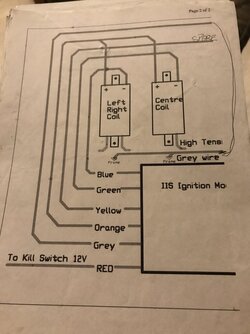
IIS ignition for an 81 Jota...

Nick

Full member
I'm fitting a brand new IIS encoder and harness to my Jota. Back in the day I bought the IIS for my RGA and John sold me the 180 bits as he said I could just swop the black box over between the 120 and 180 configurations. After discussing this at some length with Tony Winterton the conclusion is that to wire this up I need to:

Red to power
Grey to coil mounts
Blue to double coil
Green to single coil
Orange to the 12v side of both coils
Don't use yellow or the mauve wire intended for an electronic tacho

Is this correct?

Secondly I see that on all my standard double Laverda coils 12v is on the green wire but 12v is on the black wire of the single coil. Again am I correct i.e. I join the black and green wires to the orange wire from the IIS?

Many thanks as usual.

Nick :- )
 
Nick - looking at the IIS documents in the Library confirms your/Steve's conclusions. See TA180 kit pdf p6
https://www.laverdaforum.com/xf/resources/29/

Not clear about your coil question - Laverda BTZ / Nippon Denso coil wiring takes +12v from the orange/white wires originally via the redundant resistors to green wire (double coil) and orange (single). In both cases, the black wires go to the BTZ boxes and are the negative side of the coil.
 
As always many thanks for the replies.
I will look again at the coils because it doesn't seem right for the live to be on green and then not orange - I see the legacy flag terminals for the resistors are on the coloured wires.
Be good to hear what you have Stuart.
Nick :- )
PS I did search using IIS but the document didn't come up - I know how frustrating it can be to have the same thread come up again and again. Anyone got advice on which oil to use...
PPS Tony not Steve...
 
oil advice
any 20-50 grade suitable for diesels (or not) classic cars etc, I never buy "motorcycle specific" oil and am not brand loyal. in 50 years I have used oil suitable for stationary air cooled diesels, London buses (both single 30SAE grade) London taxis, cranes ( a lot of the time they run when stationary) and almost any 20-50 that the local factor is selling in multiples at discount, currently Silkolene and previously Fuchs, my 1200 TS is well over the 250,000 kilometre mark and although there have been engine problems and several "rotated" engines there has never been a failure due to the oil type, I have had blown head gaskets, leaking head gaskets (many times until I made my own solid copper ones) melted pistons, broken valve stems but never a seizure of any kind, not even when the piston melted (2x holed under the plug and 1X broken top land all at the same time) sveral times I have had crank rebuilds but none of them ever showed anything terribly bad, just age, except one that was removed due to vibration, and was found to have a web with a lump busted off by the rebuilder (truing) and blocked slingers, one of which had a hole in it and was migwelded up and polished out so i would not notice..

ignition is a very dark art for me but didn't John Willson (IIS) appear here recently, surely he must be the man to ask.
CLEM
 
hi nick sorry for the delay had a look at the paperwork i have and got this hope it’s helpful
 

Attachments

  • image.jpg
    image.jpg
    99.3 KB · Views: 31
Never too late - will download for future reference. IIS now wired up just fiddling about with the mounting position.
Thanks.
Nick :- )
 
Y'hoo Nick am here, your on the correct path with colours and connection diagram from Acelav, well done all. Naughty Cam..have enough to explain, let alone why colours matter, grin here. The Grey wire connection was deleted on later IIS systems. Does no harm to make certain it is connected properly and secured to the coils mounting frame. Most important is the single black wire from module connector to the Battery negative connection direct, not on the frame.
 
Coils, not a simple answer as to the "correct" connection of the primary winding. Pretty much you can try an initial connection, without fear of any damage, resulting. Some coils have isolated primary to secondary windings, some coils have one termination HT secondary side connected back to one side of the primary winding or Y type termination, bottom of the Y was connected to points in the day. You may in certain cases have an "inverted" polarity HT spark, ie postive going to cylinder head, where it is less energy demanding to have the spark plug centre electrode negative going spark, and ongoing ionic current. Though the spark volatage can ring, so polarity changes as the spark endures. Maybe i have given the readers a headache.... mine is present so i share....grin. j
 
You're full of surprises John. I never knew spark voltage could ring. You should write a book on ignition systems.

PS: I just sent you a question by PM on an entirely different electrical issue.
 
Last edited:
Tah Cam, though knowledge here is garnered mostly from others in the fields of expertise. As you are in many fields. The ringing was "tuned" by careful selection of the condensor ( love the old terms ), or capacitor, series resonance with primary winding inductance on Kettering systems, ie sort of important to have a matching coil/capy values, sort of. One strange aspect of spark current i did uncover, not written elsewhere ( that i could ascertain ), is spark impedance curve during flame front initiation and burn cycle. Was able to test that on the IIS long box, with grunty HV DC to DC convertor. Goes from very high to very low, near short circuit, reflected back into the coil primary and by convention the coil driver devices and power supply have to cope with short circuit condition, recover in time for the next spark initiation cycle.... done well Laverda mob to read this far, without eyes dropping...j...
 
You're full of surprises John. I never knew spark voltage could ring. You should write a book on ignition systems.

PS: I just sent you a question by PM on an entirely different electrical issue.
Hi Cam, here's a document on ignitions for Citroen 2CVs, may help regarding what JW has mentioned.
Cheers,
bazzee
 

Attachments

Interesting Baz, so if you're running resistor caps, and resistor plugs, you can damage coils?
The article is specific to Citroen 2CVs, I don't know if all details are common to all ignition systems. But normal use appears to require either resistive leads, resistive plug caps, or resistive plugs, but never a combination of any of those. The principle is that the resistance slows the risetime of the ignition pulse and increases the duration of the spark, to help ensure successful ignition. TBH I am unaware of potential damage to coils or other components due to excessive resistance in the secondary circuit. But i can think of some possibilities.

cheers,
bazzee
 
As is the way of the world, the simple is not so simple. Good man Bazzee on sharing the ignition system information. Had a read, and as a guide it has merit, though the theory has aspects different to my own, books and on the bench alike. Resistance in the HT circuit, will not damage a coil, apart from a gross open circuit, which can take out the electronic ignition systems. Basic math is Di/Dt change of current over change in time, has to be managed in ignition systems. Too high a Di/Dt will lead to cross firing in fast rise time "CDI" circuits, adding 5K resistive ( or inductive suppression, my first choice ) to the HT path cures most of the issues. There are many ignition coils, there are many low cost coils, the dreaded Bosch GT40 in can and open frame, a notable for destroying ignition systems, high leakage inductance primary to secondary windings, ensures any unmatched to load HT voltage wave forms are coupled back in to the driver transistor, punch through on the transistor and short on the ignition system, if your lucky will burn out the GT40, there is justice sometimes.

Good quality ignition coil is just that, well made and fit for purpose, industry standard winding techniques, proper silicon steel laminations, low interwinding capacitance and most of all, very low leakage inductance. Not just sparks for the humble coil, its reliability also. BTW GT40 on points are workable, much better coils to be had at the wreckers, all the same. HTH j.
 
Back
Top