
You are using an out of date browser. It may not display this or other websites correctly.
You should upgrade or use an alternative browser.
You should upgrade or use an alternative browser.
Interesting cam video
- Thread starter drikko
- Start date


Simonr501
Hero member
- Location
- Lympne, Kent. UK
Very interesting, them poor springs get a hard life.
I think the smoke is burning oil on a hot surface, if the valve stem is being wiped of most oil every rotation then the thin residue wouldn't need much excuse to smoke off the way this guy is revving - valve temperatures must be very high.
Of course I have been wrong before!
Could be mist, but the right one has more of it, so could that be the exhaust (i.e. much hotter than the other one).

LaverdaIan
Hero member
That is amazing Drikko.. can see the rotation of the springs, retainers etc.. and how fast is it all working...??!! No wonder top end failures can be so catastrophic...  remind me never to poke my finger in there...

8)
remind me never to poke my finger in there... 8)

Dellortoman
Hero member
- Location
- Tasmania, Australia
Good one Drikko
This video is interesting too.
Taken t 10,000RPM with a high speed strobe, it shows how much the nvalve spring vibrates
Cheers,
Cam
This video is interesting too.
Cheers,
Cam
Simonr501
Hero member
- Location
- Lympne, Kent. UK
Cam, I have tried the strobe trick a few times to see what is going on with a machine.
I had a look at the Spin Tron stuff quoted in the video and it looks like they use a high-speed camera @ 4000 frames per second to analyse the spring behaviour. I bet that's not cheap!
While we are on this theme I noticed this little gem:
[youtube]http://www.youtube.com/watch?v=cy_yaAOKjA8&feature=related[/youtube]

Laverdalothar
Hero member
- Location
- Germany
drikko said:Didn't realise the springs/cam followers rotate so quickly,
and now think of that: they only rotate 1/2 the speed the crank does...
Laverdalothar
Hero member
- Location
- Germany
ah - yes..., only read "cam"... :-[ sorry... still: if you look at the video, at the high revs you almost can't see the cams are moving still. Now think of how fast the crank does, how fast the pistons go up and down - just under your chest when riding...

Rob
Hero member
- Location
- Midlands, UK
drikko said:Indeed, imagine the inside of an F1 engine which is limited to 19,000rpm! I believe they have solenoid driven valves though, ie no cams?
Apparently not - Renault started to develop the idea but the current implementation is to use pneumatics for closing the valve and a cam to open it
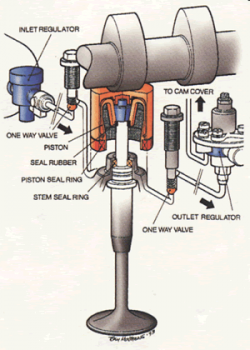
On the end of the valve is the cam follower that doubles as a small piston. This runs in a cylinder mounted on the cylinder head. Air is trapped in the cylinder and as the cam opens the valve, the air is compressed. When the valve is released, the air in the cylinder acts like a spring expanding to close the valve again. In the real world, a full cylinder of air at atmospheric pressure does not have enough force to close the valve again so the cylinders are pressurised to around 100psi. Obviously no seal is perfect and the teams expect some leakage so the cars carry a reservoir of nitrogen compressed to more 2500psi. This is regulated and fed to each of the valve spring cylinders via a ring main and keeps them all topped up to the required pressure. Nitrogen is used because of its stability, however, with the changing temperatures of an engine, pressures would also vary wildly. To combat this each cylinder also has its own bleed valve to release excess pressures. This has the added advantage of bleeding off any oil that collects in the cylinders.
Attachments
Simonr501
Hero member
- Location
- Lympne, Kent. UK
I will have a stab.
Nitrogen bottle (at 2500psi that could be lively if it blows up between your legs), inlet gas regulator, outlet gas regulator, non-return valve, gas lines - perhaps there is not enough room on a bike? Or is it too heavy?
Nitrogen bottle (at 2500psi that could be lively if it blows up between your legs), inlet gas regulator, outlet gas regulator, non-return valve, gas lines - perhaps there is not enough room on a bike? Or is it too heavy?

MickeyMoto
Full member
Laverdalothar said:ah - yes..., only read "cam"... :-[ sorry... still: if you look at the video, at the high revs you almost can't see the cams are moving still. Now think of how fast the crank does, how fast the pistons go up and down - just under your chest when riding...
and that the pistons have to stop at the end of each stroke, then accellerate and decellerate?
Didn't Honda have a 50cc twin that revved to 22k in the 60s?
SimonR501 said:I will have a stab.
Nitrogen bottle (at 2500psi that could be lively if it blows up between your legs), inlet gas regulator, outlet gas regulator, non-return valve, gas lines - perhaps there is not enough room on a bike? Or is it too heavy?
Isn't that why Ducati have the Desmo to close the valves, so that you don't lose your testicles with an exploding Nitrogen bottle?
Mick....
Dellortoman
Hero member
- Location
- Tasmania, Australia
The Yamaha M1 (MotoGP bike) has pneumatic valves. Maybe some others too. I'm guessing it has a compressor somewhere in the donk rather than using bottled gas.

Jotally
Hero member
- Location
- Coventry , UK
Please correct me if I am wrong but I seem to recall that the Aprilia Cube L3 configuration engine used air operated valves a la F1 ?
Ally
Ally