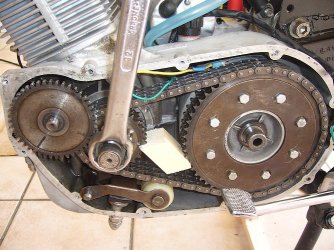
Jesus nut locking tool

Cam, the nuts are just to hold everything in place for storage, you don't need them when you're using the tool.

I haven't had to undo a crank nut on a Laverda for a while, but I think if the chock between the sprockets is the right length then the chains are not loaded, but as I say, it's been a while.

Probably the best tool would be a long handle with pegs to locate in the holes on the front sprocket.  It needs to be made so that the tool can locate accurately at 90 degrees to the axis of the shaft so perhaps a ring with two pegs set in it and a welded on handle, possibly cranked inwards to leave rom to swing the breaker bar on the nut.  As I said, the Wagner one (which doesn't have the ring) has to be used with great care if the chains are on, which they normally would be.

Reggie
 
G'day Reggie

Sure, a long handled (hand-held) sprocket gripping tool would be a good option for removing all forces from other parts of the bike. The only problem I have with that is that it occupies one of your hands to hold it in place - not a serious objection though. If, like most of us, you have two functioning hands, go for it!

Cheers,
Cam
 
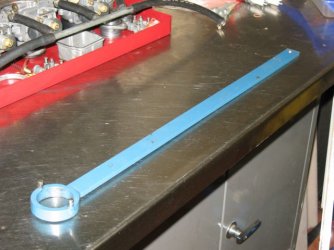
Here's mine, the bore has to be big enough to clear your 32mm deep socket. Works perfectly for tightening, chock it on the floor or just hold with one hand and the torque wrench with the other.  For overcoming static friction when loosening, these days I always use a rattle gun, least stress on everything including the operator.  :D
 

Attachments

  • IMG_4393.JPG
    IMG_4393.JPG
    58.3 KB · Views: 52
A chock between the sprockets will ALWAYS load the chain. If you don't believe me, try doing it without the chain and see how much torque you can get on the nut :).
I agree that the longer the chock the better, but there's a maximum practical chock length that will engage the teeth. My earlier comments were based on the assumption that the maximum practical chock length would be used. There's no escaping the geometry of the sprocket/chock/chain system. Not only will it load the chain, but it will load it to the point where it exceeds the specified maximum tensile loading for any type of chain you choose.
Obviously the specified maximum tensile load has a generous safety factor, so the chain probably won't break, but loading it that much certainly won't do it any good. It probably feels OK while you're doing it because there's no obvious stretching, creaking or groaning going on. But you wouldn't want to have your finger between the chock and sprocket!

People on this forum have said that they've brocken sprocket teeth with the chock method. That should be a clue that stresses are getting beyond reasonable.

Cheers,
Cam
 
Fair enough. Steve's holder (wasn't going to say 15" tool...) looks effective, have to get something similar made at some stage.  This is going to cost me two tins of biscuits...
 
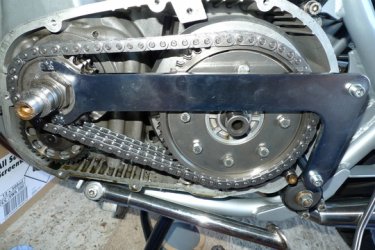
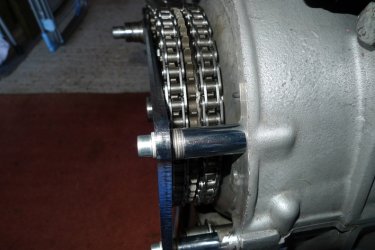
I have done a dry run with the Andy Wagner Tool today (Laverdakeith will hopefully be converting the clutch to Kevlar plates soon).
I had to insert 6 washers in front of the spacers with the primary chain on to get the right clearance.
100Nm didn't phase the tool at all and no deformation of the engine case resulted.

The nuts are on the bolts to prevent the spacers falling off when in storage.

I think Cam has got his sums spot on.


Attachments

  • 64525.jpg
    64525.jpg
    212.5 KB · Views: 38
  • 83840.jpg
    83840.jpg
    254.2 KB · Views: 32
Well being the dunce I am I used the green book method and snapped the teeth off the clutch sprocket without too much effort. Expensive lesson!
 
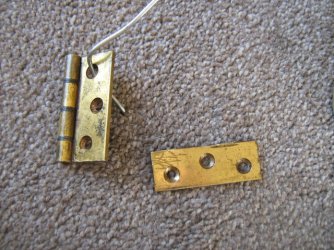
This is my method. I know that I'm probably quite rustic but it always worked ok and never broke anything. ;)


Attachments

  • tool.jpg
    tool.jpg
    155.2 KB · Views: 60
Piece of wood, not Italian... Soft enough to not break anything, hard enough to block the transmission securely.
 
Back
Top