Jota Crank Rebuild

Jota1981

New member
I'm refreshing my 1981 Jota. The head is with Red for a make over. New valves , seats , guides. I'm wondering if I should go ahead with a crank rebuild. I'm the original owner so know the bikes history. The engine has never been mistreated, always fresh high quality oil. Its done 146,000ks and was running nicely when stripped. I have the crank assembly out and it feels OK but the inner and big end bearings have never been replaced. I did replace the outer bearings at 80,000ks since they're easy to pull off but the inner ones need the crank disassembled.
Any thoughts on whether it needs a full rebuild?? How long do the inner bearings/ conrods typically last ??
Cheers Steve
 
I'm refreshing my 1981 Jota. The head is with Red for a make over. New valves , seats , guides. I'm wondering if I should go ahead with a crank rebuild. I'm the original owner so know the bikes history. The engine has never been mistreated, always fresh high quality oil. Its done 146,000ks and was running nicely when stripped. I have the crank assembly out and it feels OK but the inner and big end bearings have never been replaced. I did replace the outer bearings at 80,000ks since they're easy to pull off but the inner ones need the crank disassembled.
Any thoughts on whether it needs a full rebuild?? How long do the inner bearings/ conrods typically last ??
Cheers Steve
Well here is a controversial topic..
Firstly apart from bearings on the crankshaft Laverda conrods can and do fail, some will never fail.
But ask yourself this question would you ever forgive yourself if you put the crank back in as is and a rod did snap and blew a hole in your now unobtainable series 2 crankcases, sometimes it can be a case of insurance.
If its of any comfort I am also a one owner 81 Jota with nearly twice your 146,000 kms on her original crankshaft and bearings.
 
At 140-odd thousand, the inner mains will be worn, no matter how well the bike has been treated. The oil slingers will also be well filled by then too. That's the facts...

The rod issue is a personal thing. I've never had a rod let go on any of my road Laverdas in over 300000km in total. Others have chucked a couple in the same time. A possible/probable cause for rod failure can be prior damage brought on by hydraulic lock caused by carb flooding. Maurice has a valid point, your chances are 50-50. ;)

piet
 
The other thing to consider is the crank's centrifugal shit catchers. At 145k they're probably more than 3/4 full of compacted black mud. It's generally made up of metal filings, carbon particles and any other crap that's found its way into the engine. Only way to clean them out is to press the crankshaft apart and prise the pressed steel lids off each flywheel. Red fits new ones.

I kinda regret not doing it when I split the cases on my Jota to replace a knackered gearbox bearing. But I was keen to get the bike back on the road asap. The bike had done about 100,000 km and they were full to about half the depth of the slinger cavity, so I figured it would do another 100,000. But when I thought about it some more after putting the bike back together, it dawned on me they were way more than half full because the volume is proportional to the square of the radius. The remaining volume wasn't half, but more like 1/4 capacity.

Piet beat me to it about the slingers, but I'd already typed my diatribe so figured I may as well hit the "post reply" button anyway.
 
Do it for all the above good reasons.

My SF2 has about 140 000 km. Nothing wrong with it though I suspect the head would benefit from an overhaul.
Now I have other Lavs to ride, I'm considering doing the engine soon, crank included before I'm incapable of riding and before they're all legislated off the road.

Paul
 
With over 300,000 kays on the clock I suspect the engine on my RGS is way overdue for a strip and rebuild. The problem is, at 72 years old, I may never get around to putting it back together again.
Glad I've got my little Monster 695 to get around on.
 
I had about 3 or more crank issues in approx 10 years with Red sorting the last couple, I was reluctant to do the Rod change in by then it was like posterity taping me on the shoulder and to Reds surprise the last time the engine came apart fully I asked for Carellos, wrong spelling but I couldn't be fucked looking. I did sleep better after they were changed.
 
I agree, having done a top end rebuild on my Jota only to have number three main fail a few thousand k’s later. Bloody annoying to have to pull the engine out again🙁
Tom
 
OK thanks. I'll probably go ahead with the rebuild once I get the rebuilt head back. The Arrow rods do look the business. Cheers
 
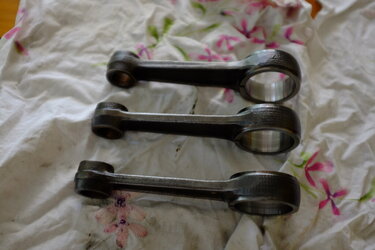
Today's quiz .... spot the bent rod.
So glad I went ahead with Red's crank rebuild. Seems these rods are a weak point.
Cheers Steve

Oh .... its the one on the right. Not clear in the pic but quite visible with the naked eye.
 

Attachments

  • DSCF4578.JPG
    DSCF4578.JPG
    88 KB · Views: 63
  • DSCF4579.JPG
    DSCF4579.JPG
    88.7 KB · Views: 60
  • Wow
Reactions: Jo
It's worth it for peace of mind. You'll be able to give it full throttle without worrying about opening up a window in the crankcase. Something that's always in the back of my mind with my old Jota that still has its original rods. Must be one of the few remaining Laverdas in Australia that Red hasn't rebuilt.
Red does a proper job. It'll be much better than when the factory built it. You'll also get new centrifugal slingers and be rid of all the crud that had accumulated in the old ones.

I sometimes wonder how long it takes those slinger cavities take to fill up. My bike has done about 100,000km and the slingers are filled to about half way between the outer and inner edges. But I don't think that means it'll do another hundred thou. Being an annular shape that fills from the outer edge towards the middle, the diameter decreases as it fills. As the circle of black shit in there gets closer to the centre of the crank, the last mm of slinger depth will fill up a lot quicker than the first mm. So I'd I guess the volume I have left in the cavity is only about half of what's already filled up. That would mean I might have another 50,000km left before they're full to the brim. I guess when that happens, the black carbonaceous muck in the oil will stay in circulation rather than getting collected in the centrifugal shit catchers. Maybe that's an argument for more frequent oil changes in high mileage bikes.

I'm rubbish at documenting oil changes on my bikes. I always intend to keep a record. Sometimes I'll write it down, but then lose the bit of paper or forget where I put it. So don't change the oil at any particular km interval anyway (because I don't know when I last did it). I change it when it starts to look dirty. I seem to go through a lot of oil though.
 
Last edited:
I hear about Laverda rods being a weak point in the triple engine, but in 30 years of riding Laverda's, I don't know anyone who has had one fail?

Also in the case of a bent rod, no one seems to attempt to straighten them? As it's a steel forging, bending it back straight should not cause any issues if done cold. On other bikes, (British, Italian, Japanese) bending a steel rod back straight is commonly done assuming the rod is not bent badly. I have done this to many bikes over the years, some with the crank still in the cases. If your worried about possible cracks in the rod, this can be easily checked for.

On some bikes, the piston sticking is enough to bend the rod a little bit.

It is surprising on an expensive bike like a Laverda, they did not polish the rods at all to eliminate stress risers. Lots of old British bikes, even cheap ones, it is not uncommon to see some polishing. The SFC 750 has polished rods, I think?
 
Last edited:
Back
Top