Jota problem - got me stumped

Paddy said:
Cheers DoC

Now you mention it i do remember people saying there was a big jump in the advance curve on Bosch Lavs and the witt systems smoothed that out ?

I've watched it in shocked amazement on my 74 3C using a strobe.. have used a degree wheel too. With the original Bosch box it went straight to 29 deg at 3000rpm (right where you use it most in town or 80km/hr zones): falls back to 12deg below that. Another unit I tried recently also jolts straight to 29 deg but then seems to stretch with increasing revs to 32 deg.. i dont see how the unit is doing it so i expect it's the crank twisting or something :o :o . Alas this particular unit doesnt seem to retard at idle: back to the drawing board...

AndyW
 
DoC! said:
It's massive......

Modern day electronica sorts all that out quite smoothly.

The Bosch system in it's day in the 80's was superb, but a modern electronic ignition system will transform your bike.

I was totally gobsmacked when I rode my 120 Jota for the first time with the Sasche ignition and the 530 chain set. I do think I wet myself according to wifey! I disagree, but there again, she does the washing lol!

Cheers

DoC!

  More to do with the camshafts not being bar tight, the valve clearances being correct, the valve timing not being 14 degrees out and the carbs being properly set up.... The smoothed out ignition advance is just the icing on the cake.


  Keith
 
AndyW said:
I've watched it in shocked amazement on my 74 3C using a strobe.. have used a degree wheel too. With the original Bosch box it went straight to 29 deg at 3000rpm (right where you use it most in town or 80km/hr zones): falls back to 12deg below that. Another unit I tried recently also jolts straight to 29 deg but then seems to stretch with increasing revs to 32 deg.. i dont see how the unit is doing it so i expect it's the crank twisting or something :o :o . Alas this particular unit doesnt seem to retard at idle: back to the drawing board...

AndyW

Completely normal behaviour.

The original Bosch system is a very early type of "digital" pointless ignition.  Other CDIs of the time still relied on mechanical advance/retard devices, the Bosch was probably one of the first to do away with these.  At pre-set rpm, the advance kicks in, this can be influenced somewhat by inducer/pick-up gap, may shift the point when it happens, but still a simple jump in timing.  State-of-the-art in its' time, more than just crude nowadays.  '70s Ducatis used much the same system, same problems, eh Paddy? 

Any of the aftermarket digital ignition systems will offer a huge improvement in engine characteristics.

piet
 
Cam,
Wipe your current advance map from the Ignitech box, just load some other crap curve, even a flat one say, then reload the advance curve map that you wish to use.
Has not happened to me yet but I have seen on other forums where they say it is possible for the advance map to become corrupted but once you do a clean install all is good

Most likely will make no difference but worth trying.

 
Thanks for the suggestions guys. I'm making a list of things to check.

For starters, here's a few things I've already checked ...
1. Plugs are OK. I've tried swapping them for new ones to no effect.
2. The only gearbox bush I replaced is the 5th gear sleeve. I was wondering if I'd made the clearance a bit tight, but the rear wheel turns over easily by hand. But more more importantly, the problem still exists in top gear, which eliminates the sleeve gear bush as a cause (bush doesn't rotate on the shaft in 5th gear - they're locked together).
3. Bike wheels around easily, so no dragging brakes.
4. All throttle slides are opening fully.
5. Fuel system seems to be flowing freely enough. With a fuel hose disconnected, fuel will piss out of the fuel tap way faster than the engine could possibly use it (with filler cap closed). I let it run for a few minutes to collect a litre or so. There was no drop off in fuel flow, so the tank breather works OK.
6. I haven't put on weight (Thanks Keith  :D)
7. Engine oil level is OK.
8. Crankcase breather is not blocked.

Things I haven't checked are ...
HT leads, coil earthing or the coils themselves. I don't have a scope to check the operation of the HT system, but I could swap the coils and leads for another set. I have no reason to suspect that they're dodgy though, because there's no misfire.

The engine is not missing, coughing, spluttering, or backfiring. It runs smoothly, but is only making about 40 HP at a guess (about the same power as my 350cc Honda). It's actually quite rideable up to about 5000 rpm and I've done a few hundred km since the rebuild. So it's had fresh fuel through it.

Fuel consumption is poor, so I suspect that fuel is getting in there normally (so carbs and fuel system OK), but the engine is not making good use of the fuel available. That seems to point to ignition or valve timing issues. I'm 100% satisfied that the valve timing is OK. I even printed out the old factory drawings of 4C cam sprockets to onfirm that my timing marks were in the right place. That pretty much leaves me with an ignition timing problem.

I'll try Red's idea of wiping the Ignitech program and reloading it. I'll also try to get a better idea of exactly where it's advancing to with the strobe. Last time I strobed it, I was having problems with my Snap-On strobe light, so I only got brief glimpses when the light chose to work. Just enough to confirm that it was actually advancing, but not steady enough to quantify. The strobe might have a loose connection somewhere.

Hmm ... a thought just occurred. I wonder if the intermittent operation of the strobe light could be due to the ignition system not working as it should. I'll test the strobe on another bike.

Thanks for the ideas.
Cam
 
Cam, how fat/blue are the sparks? Mine on the 3C were very weak verging on nonexistent (Red didn't seem too impressed  :-X); power was well down and  continuing to deteriorate. Insulation on the pickups had degraded away so the wires were starting to earth out. When I swapped the pickup plate for a slightly fresher one I got my sparks back along with the missing 40 hp that had been hiding away in the crankcase...

just my 2c..
 
sfcpiet said:
'70s Ducatis used much the same system, same problems, eh Paddy? 

Any of the aftermarket digital ignition systems will offer a huge improvement in engine characteristics.

piet

strangely piet the Ducati didnt have anything like the problems Laverda had. I would not recommend you change a bosch system on a bevel engine unless you tune it and want to alter its advance curve , in stock form i would leave well alone. this was the reason i mentioned over complicated for Sachse initially but i can see now the Bosch system is not up to the job on Lavs.
 
OK, just been tinkering in the shed. The strobe worked perfectly this time (no idea why it was misbehaving before).

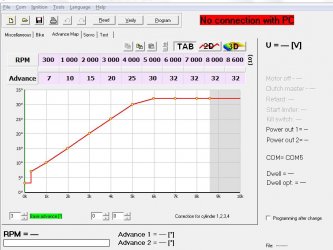
Advance is advancing exactly as it's programmed to. Present advance map is shown below, and strobe confirms that's what the ignition is doing.

I sat there gawking at the ignitech software for a while and couldn't work out how to wipe the program. All you can do is overwrite it with different info.
I tried re-setting everything to zero then re-loaded the 32? program, but it made no difference.

Spark is not overwhelmingly fat and blue, but it's a bright sunny day here and the shed is well lit with natural light (spark might look more encouraging at night). Evidently the spark is good enough to ignite the mixture because it doesn't misfire at all.

FFF - I'm out of ideas.
 

Attachments

  • 32 adv.JPG
    32 adv.JPG
    86.3 KB · Views: 30
Dellortoman said:
Spark is not overwhelmingly fat and blue, but it's a bright sunny day here and the shed is well lit with natural light (spark might look more encouraging at night). Evidently the spark is good enough to ignite the mixture because it doesn't misfire at all.

Mine wasn't misfiring either, Cam, I eventually figured the very weak sparks were causing the initiation of the burn and subsequent flamefront propagation to be slow: effectively retarding the ignition. Tickover was poor too... All good now apart from the fully advanced condition at tick over and low motor speeds :o
 
ghwallice said:
Mungo57. How do I set up an oscilloscope to look at HV output? My apprentice stuck mine on 240v and I've still got to get it fixed...
Thanks, Greg

Sorry should have been clearer, use an automotive "Tunescope " or equivalent. They have a inductive pickup which will give you a clear picture of the output of your coils.Test  the three HT leads under various throttle openings, can show open circuit in leads/caps/plugs, different firing voltages between cylinders.
Most old school auto mechanics would have one kicking around the back,not used as much on the modern shit,but a handy tool for diagnostics.
Hope this helps rather than confusing the issue further .
Cheers Peter.
 
OK Andy. I can try to make the spark better, but I'm not sure how. I have Sachse Hall effect pickups that are only a couple of years old, so there shouldn't be any problems with the insulation on the pickup wires, and the ignitech software doesn't give any error messages in relation to pickups.
I'll re-check the wiring to make sure I haven't pinched the insulation somewhere, and that all is wired in accordance with the instructions. I dunno whether Hall pickups can run with reverse polarity or whether it makes any difference if they can, but I'll check that too.
 
  Going a bit against the trend - but the Sasche systems fitted to both Austin Kear's Barcelona and Robin Webster's too gave some problems - intermittent ones so might be worth trying a spare set of PK's or magnets. My favourite system is the old CDI - it gives a far more powerful spark and lets motor run with more retard to give more power. Of course it has its drawbacks with age and the massive advance step at very low rpm - but my racing motors would behave like pussy cats - pulling from very low rpm making them great road bikes too.  I agree with Paddy that a lot of fiddling with so many adjustments - without the skills or measuring equipment leads to so many self induced problems. Not, of course, saying that anyone on this forum would be guilty of this :D :D.  Over many years I've found that a lot of owners love spending a fortune on tuning parts and, as Keith has already pointed out, miss the real goal of setting the motor up correctly for maximum performance and reliability. - Just my opinion - Regards - Phil
 
Slightly off topic but i had a guy with a bevel, he had read a few books and had an engine built with high comp pistons, high flow pump, Sachse
ignition and lightened crank flywheel and primaries..After a lot of emails i finally gave in and made a house call, something i just don't do. This bike would start after ten minutes of kicking and once started was a bit better once it was warm. He had tried lots of different setting on his ignition to no avail. When i got there he demo'd the starting issue, it eventually started !! I said to him its only running on one ? It cuts in on two if you rev it he said. You have balanced the carbs haven't you ???? No he says...I wanted to get it running properly first.  :o
Some people dont appreciate that another level of adjustment adds a multitude of variations to a set up all of which are inter dependant.  :D Bevels simply don't need a adjustable ignition, the CDi is great in my opinion. Had he kept his CDi his only variable would have been his carbs really. As it was it was actually slower than a well set up std bevel anyway also proving that these things are not plug and play, mix and match  :D
 
Dellortoman said:
The bad news is that the power starts to taper off at about 5000 rpm, just where it used to come on strong and pull like a train right through to about 8000. It used to get well past 200 kph before I'd chicken out and back off.  Now it struggles to do 120kph on a flat road.

You can see that I'm running out of ideas. If anyone has any suggestion, I'd be glad to hear it.

Cheers,
Cam

Going back to perhaps the obvious faults, you didn't happen to leave a rag in the air box during reassembly?
Wayne
 
I know very little but I would personally take it on to a quiet  road , get the bike up to normal operating temperature and replicate the problem. As soon as she started to falter I would switch off the fuel taps and stop the engine.

Then I would examine the fuel level in the float bowls.


If this is not the problem I would again repeat the exercise and as soon as the engine power falters, switch off the ignition and have a look at the plugs and see what colour they are..The diagnosis of plug condition is well documented.

My money is on a very simple issue and I have experienced similar with my airhead beemer when problems with fuel admittance to the float bowls has caused a distinct lack of fuel in the carbs becoming most noticable when running at higher speed for longer periods.
A lay off period can cause fuel admittance valves to become "sticky"

Again, considering a lay off and looking at the simple stuff first, I'd check battery condition , with drop test and alternator voltage output check at tickover, 1000, 2000, 3000,4000, 5000 rpm etc and see what results.

Best of luck to you !
 
Hi Cam have you checked the rev limiter setting?

                                                      Dave
 
dja981 said:
Hi Cam have you checked the rev limiter setting?

                                                      Dave

Are you suggesting he's got a limp wrist? :o  :D :D
 
Back
Top