Just followed me home.

1200ts

Hero member
A 3C motor. Serial number is 1578 so I would think it is a 1974? No oil cooler? Where is the rest of the bike, who knows. The person I got the motor from did not know the history of the bike and this is all he had.

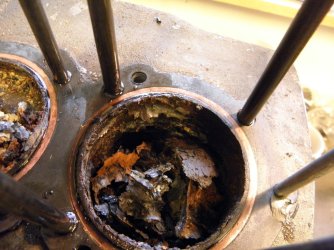
The pistons and cams are in a box. So the head and cylinder have been removed and then put back on. The pistons have some rust on top but look remarkably good. Zero wear on the piston skirt like they had just been put in ten miles ago. Not much carbon on top at all.

The person I got it from suspects the bike was crashed and they pulled the motor out. But why partially take it apart and then give up?

Anyway, what surprises are inside the motor? I will find out soon. I brought it home so I could finally look at a triple crank and make the tooling for the hydraulic press to take one apart. No one in the US will rebuild one so I guess it is up to me.

I hope I did not buy a piece of scrap.
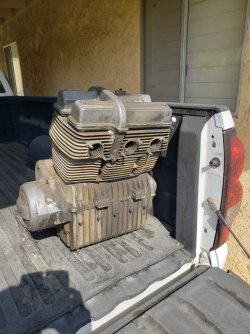
3C motor.jpg
 
Last edited:
Can't be rust ... unless they're iron pistons!! Might just be brownish carbon deposits. Good luck with the stripdown. If you become proficient in pulling down and successfully reassembling triple cranks i think you'll find your Inbox loading up with requests!! Redax has been a major source of this specialist work but that is coming to an end, if Red hasn't actually already accepted his last crank.
 
Can't be rust ... unless they're iron pistons!! Might just be brownish carbon deposits. Good luck with the stripdown. If you become proficient in pulling down and successfully reassembling triple cranks i think you'll find your Inbox loading up with requests!! Redax has been a major source of this specialist work but that is coming to an end, if Red hasn't actually already accepted his last crank.
Yes I know aluminum pistons don't rust but there is definitely rust on the top of them. So it appears water got in the cylinders. But there is no evidence of the pistons being stuck in the bore as they look good. Just rust on top of them. The pistons as they look, I would not hesitate to reuse them as they look close to new.

Now what bad things am I gonna see when I take the head off? I better stock up on beer first!
 
Be of interest to read of whom has actually pressed a series 1 crank, number of practical aspects to be addressed Bruce. Your background will be of much use, in a significant endeavour. Pressing frame a major hurdle, next the various spacer blocks ( Red was more than kind to me there, supplying critical tolerance big end spacer blocks ). Align scribe the crank before you start as there is no indexing on the journals. ( A ) Tricky hurdle is end to end aligning of the crank to meet factory tolerance. Used a 125 year old compound geared 7 ton press and V blocks at intervals.

Lift onto the lathe, between centres, with two dial gauges and see what the crank web/journals run out measured and reducing, nothing to lift that crank between 30-50 times for one crank. Exact number i did am uncertain around 5 would be the minimum. Correct C3 bearings may be of more availability in the States than here, was some 20 odd years ago.

Lot of satisfaction, a lot of respect for others whom do many more than i did. HTH j. **** oh i estimated around 12 Ton pressing force required, both disassemble and assemble. Not a two web is it, special inlet casting and sleeved bucket liners?
 
be aware that there (might) be differences between the very early crank ends (ignition side) since early systems had the iron spinning flail retained by a spring under the rotor, later ones had the same push on device but with a grub screw to retain, not sure if the crank ends differ, and then series 11 cranks are definately different, the ignition is on the other side! and have a Nippon altyernator instead of a Bosch, plus the 120 cranks are well just that, different, as in crank throws, It is also possible and proven in many cases that the indexing 180 or 120 can also be out by a degree or three ex factory
CLEM
 
A 3C motor. Serial number is 1578 so I would think it is a 1974? No oil cooler? Where is the rest of the bike, who knows. The person I got the motor from did not know the history of the bike and this is all he had.

The pistons and cams are in a box. So the head and cylinder have been removed and then put back on. The pistons have some rust on top but look remarkably good. Zero wear on the piston skirt like they had just been put in ten miles ago. Not much carbon on top at all.

The person I got it from suspects the bike was crashed and they pulled the motor out. But why partially take it apart and then give up?

Anyway, what surprises are inside the motor? I will find out soon. I brought it home so I could finally look at a triple crank and make the tooling for the hydraulic press to take one apart. No one in the US will rebuild one so I guess it is up to me.

I hope I did not buy a piece of scrap.

View attachment 96643


Looks exciting, it doesn't look worse than any of the engines I've bought, but Laverdas are easy engines to renovate:
see here: my Laverda 1390 projekt
 

Attachments

  • 1390 foring.JPG
    1390 foring.JPG
    170.2 KB · Views: 41
180 cranks press apart at around 8-10 ton, later 120 cranks around 10-12 ton
it seems Laverda decided to increase the press fit on the later cranks, which is understandable

if you are serious about doing triple cranks, send me an email and I will gladly send you all the info you need to do it
and wish you all the best
 
Can't be rust ... unless they're iron pistons!! Might just be brownish carbon deposits. Good luck with the stripdown. If you become proficient in pulling down and successfully reassembling triple cranks i think you'll find your Inbox loading up with requests!! Redax has been a major source of this specialist work but that is coming to an end, if Red hasn't actually already accepted his last crank.
If you pour water down the inlets or exhaust tracts, you'll find rust on top of the pistons.
Paul
 
180 cranks press apart at around 8-10 ton, later 120 cranks around 10-12 ton
it seems Laverda decided to increase the press fit on the later cranks, which is understandable

if you are serious about doing triple cranks, send me an email and I will gladly send you all the info you need to do it
and wish you all the best
Thank you Red for the kind offer of sharing your knowledge. I will contact you.

I have been looking for years for a triple crank to take apart but could never find one at a reasonable price. All six of my Laverda's have good cranks so I never had one to rebuild. I have lost count the number of times over the years of being asked if I ever made the tooling for the press to take one apart. If offered a bad crank by someone I say no as I don't want to be on a schedule and have your crank done next week. I am retired and have over 30 motorcycles to take care of and am not looking to start a Laverda business but it appears no one else in the US can do it.

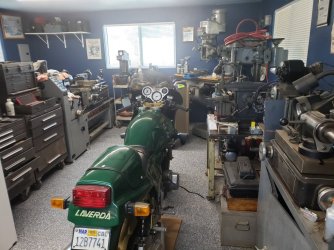
I have experiance rebuilding roller bearing cranks, but mostly British bikes. I have never done a Laverda. I have a full machine shop at home so can make pretty much anything required for the job.

shop.jpg
 
!!!! Holly smoke Batman.... wat a bat cave... knew you were good Bruce, a gifted man, no mistake. Deeds/workshop count....j
 
!!!! Holly smoke Batman.... wat a bat cave... knew you were good Bruce, a gifted man, no mistake. Deeds/workshop count....j
Hi John,

You are only seeing half the shop in the picture. Behind me is more equipment, horizontal mill, surface grinder, cylindrical grinder, heat treat oven and then electronic test equipment (almost all old, some with tubes) and equipment for rebuilding and testing magnetos and dynamos.

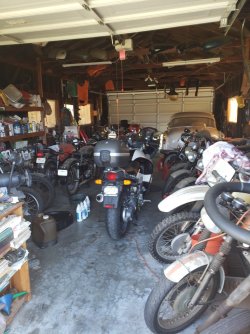
Then I have another much bigger building with more machinery and motorcycles and a 40' shipping container with more parts, bikes and tools.

My wife said it started out as a hobby and turned in to a disease. She made me get all the bikes out of the house as she had a problem with some of them leaking oil on the floor. The things I have to put up with!

The car in the picture in the front right is a 1953 Chevrolet which I took out the straight six motor and put a V8 in it. All hidden no one can tell it can go fast. But it can't stop. Need to put disc brakes on it.

Trying to get the energy now to get the 3C motor out of the back of the truck by myself.shop2.jpg
 
Last edited:
I did it only once, lifted a 1200 motor up onto a bench on my own, madness personified. 90Kg dead lift.... i weigh 62Kg. Think Paul L dropped a 1200 some many years ago... ways and means Bruce, not that you need advice from the recent photos...

Have a radio ham whom is assisting to regain my top licence, his "shack" has more radio and test equipment than any place i have witnessed, including a national standards lab... hard to believe what i was seeing..... yours in that class.... as Quinton remarks.... whom to inherit.... no matter, how good is it to have the tools and the skill to use them.

Just realised recently that the gen behind us baby boomers will have assets and wealth beyond all imagination. Not that concerned of the generations in home purchase hurdles overall, some sympathy though many of them will be well rewarded when the old folk become gone to maker folk..... tried to give away some of my 40+ basses... viewed with suspicion, mores the pity.... j
 
a top tip by me (often repeated) for lifting engines, is to insert a pair of rods through the front and back engine mounts, 10mm studding is ideal as it is "grippy", leave about 150mm sticking out each side and then in four places (you dont need any nuts or washers, friction does it but see later for 120's) andyou have ready made handles in just the right postion, easy two man lift. with 120's its a bit harder since the rubber mount hardware complicates the issue, but can still be done, by using shorter pieces of studding (and more of them) with nuts and washers to give you the handles just where you want them left and right.
CLEM
 
Looks exciting, it doesn't look worse than any of the engines I've bought, but Laverdas are easy engines to renovate:
see here: my Laverda 1390 projekt
Laverda 1390 project 😳

That’s a lot of piston width in a small space, either that, or, so stroked that it won’t go back in the frame!

I’m making a bad cc joke of course 🤭
 
a top tip by me (often repeated) for lifting engines, is to insert a pair of rods through the front and back engine mounts, 10mm studding is ideal as it is "grippy", leave about 150mm sticking out each side and then in four places (you dont need any nuts or washers, friction does it but see later for 120's) andyou have ready made handles in just the right postion, easy two man lift. with 120's its a bit harder since the rubber mount hardware complicates the issue, but can still be done, by using shorter pieces of studding (and more of them) with nuts and washers to give you the handles just where you want them left and right.
CLEM
Thanks Clem
I should be putting the engine in the 120's frame so any tips are appreciated. Just trying to sus out where engine mounts go.
Stephen
 
Back
Top