
I've noticed on some topics that some of you have mounted a socket for lambda sensor on collector. That is obviously for Dyno purposes. I was wondering would it make any sense to fix lambda sensor permanently? It would not adjust anything, but there could be a lambda meter connected to it. That way you could monitor the air/fuel ratio during riding. Due to location, I guess the lambda itself would have to be 3 or 4 wire heated model. There might be just enough space on top of the collector, behind the gear box, just prior to silencer tubes. Any thoughts?

You are using an out of date browser. It may not display this or other websites correctly.
You should upgrade or use an alternative browser.
You should upgrade or use an alternative browser.
Lambda sensor
- Thread starter cape
- Start date

here is a shot of where we mount our Lamba sensor in the collector
we use it when we tune bikes with the Innovate system as it allows us to record AFR for up to 40 mins
when we run engines on the Dyno we run a separate Lamba sensor in each header plus a EGT in each header
have a set of headers set up with ports for the different probes
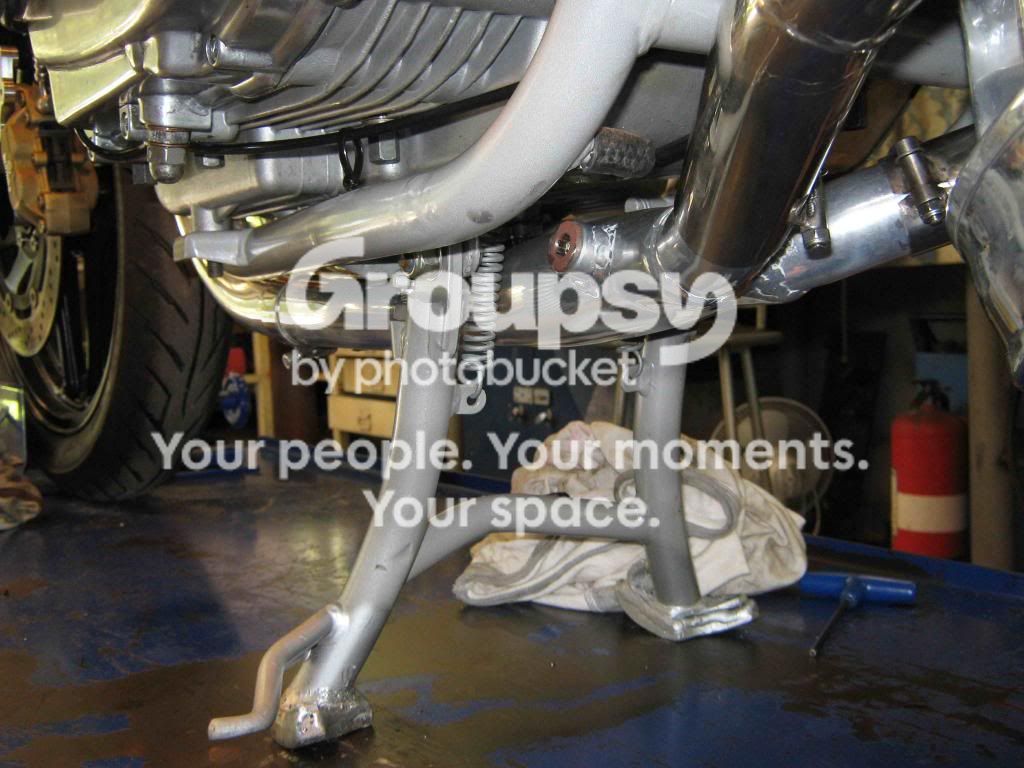
we use it when we tune bikes with the Innovate system as it allows us to record AFR for up to 40 mins
when we run engines on the Dyno we run a separate Lamba sensor in each header plus a EGT in each header
have a set of headers set up with ports for the different probes


hkraanen@xs4all.nl
Junior member
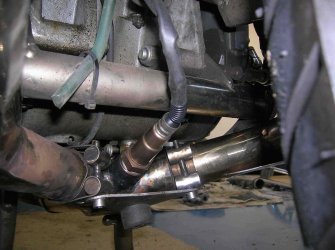
Cape, vertical won't fit, it will touch your lower crankcase. I fitted the sensor, that came with my WideBandCommander according to instructions by Dynojet; at least a 10-15 degree up from horizontal. That's to prevent water/damp entering the sensor. You should use a heated version (mine has 5 wires), it's a Bosch LSU 4.
I liked the idea off being able to monitor AFR continuously, you can adjust the WBC to give warning signals like for instance 3/4 throttle and AFR > 14.
Although mounted correctly, sensors on a bike are much more prone to collecting damp, then on a car's header (rain entering through the uplifted Jota pipes, while parked). I am on my 4th sensor in 6 years and they are expensive (over ? 150,- here in Holland).
I will change the switching of the heated sensor therefore from permanent (ignition on) to seperate, so the system is heated and dryed by exhaust gasses, before switched into operation.
Fouling of a damp sensor only occurs when it is in 'working mode'. So switching it on once it is dry will give a better lifespan (at least I hope so)
Good luck, Hein
Attachments

beauchemin
Senior member
- Location
- Victoria, British Columbia
I was under the impression that WB02 (wideband oxygen) tuning with a lambda sensor is for very rough tuning. You would then need dyno time for fine-tuning. Wouldn't it be better to have an EGT unit at your garage?

- Location
- Calgary, Alberta, Canada
I use a Power COmmander 5 and an auto tuner on my fuel injected Kawasaki ZX 14. The auto tuner records the air fuel ratio tied to throttle position and rpm, and makes a lovely map that allows you to see what is going on, then you can use that map to adjust your actual fuel injection map. Better than a dyno by far, gives actual real world information. On the ZX 14 I had to disable the fresh air injection into the exhaust to have meaningful results.
http://www.powercommander.com/powercommander/Products/AutoTune/powercommander_autotune.aspx
I have my O2 sensor mounted on the ZX 14 in a similar position to Red's photo, in the side of the collector, it definitely does not need to be vertical.
On a Laverda, for a full time O2 sensor to be of any value I would think you would also have to install a Throttle Position Sensor and tap into the coil for rpm info, then use something like the Innovate data logger to gather the information to allow you to then decide how you would set up the carbs for idle, off idle, 1/4 - 1/3 throttle, mid range, 3/4 throttle, full throttle. You absolutely need to have the throttle position information together with the air/fuel ratio at a bare minimum and the rpm info is also crucial, to be able to use the air/fuel info for any tuning. I bet with Red's current ignition you might be able to tie into ignition advance info as well, I control ignition timing as well on my ZX 14 in addition to the fuel injection, makes a huge difference to tuning results.
Steve B must have dealt with all of this on his RGA fuel injection install, maybe check his website, I seem to remember he had a bunch of detail on there re his Laverda fuel injection setup. http://www.breganzane.com/
Paul LeClair
Hein5960 said:vertical won't fit, it will touch your lower crankcase.
It would have to be slightly tilted backwards...
Yours looks nice, but would require too much work.
On side of the collector, the lambda would hit central stand.
cape said:On side of the collector, the lambda would hit central stand.
sensor clears the center stand easily
we use our Innovate system as mentioned in my first post with the sensor installed and center stand up
take the bike for a 30-40 minute ride and come back to the workshop and download the data to the laptop and then we can see how the tune up is
wouldn't be able to do that if the center stand wouldn't retract
there is no issue with the side mounted sensor, all you have to be careful of is that you get the angle right when welding in the threaded boss, our cable exit goes between the engine case and the top of the frame rail, there are no clearance issues involved
you can shove them into your headers if you want but is going to look pretty stupid on a street bike

redax5 said:sensor clears the center stand easily
Ok, thanks. I?ll have to get all the parts and measure things properly.
beauchemin
Senior member
- Location
- Victoria, British Columbia
WOW - Red, I love your stationary testing rig!
