

You are using an out of date browser. It may not display this or other websites correctly.
You should upgrade or use an alternative browser.
You should upgrade or use an alternative browser.
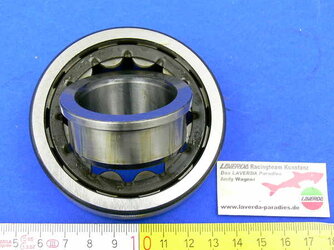
Laverda 1000 : Bearing roller, crankshaft LHS
- Thread starter sfc vintage
- Start date

piranha-bro2
Hero member
- Location
- Melbourne
Think I have a new one in my spares but am in Australia - big bad shipping distance away.
sfc vintage
Hero member
Hi Piranha.
Yes, but thanks for info
Br
Peder
Yes, but thanks for info
Br
Peder
I don't think there is anything special about this bearing. I purchased a similar bearing a few months ago for the crankshaft of a Gilera Saturno.
The only unusual part about it is that it is a roller bearing vs the much more common ball bearing. The odd thing is that on the Gilera, the left bearing is roller and the right bearing is ball. Sounds like Laverda did the same thing? I don't really understand the why behind the two different types on the same crankshaft but it's interesting to find out they were not the only ones that did it!
I purchased an SKF NU 305 ECP which is 25mm x 62mm x 17mm with no shields. I don't have the dimensions for the Laverda bearing but a quick check with a vernier and a google search should get you what you need.
The only unusual part about it is that it is a roller bearing vs the much more common ball bearing. The odd thing is that on the Gilera, the left bearing is roller and the right bearing is ball. Sounds like Laverda did the same thing? I don't really understand the why behind the two different types on the same crankshaft but it's interesting to find out they were not the only ones that did it!
I purchased an SKF NU 305 ECP which is 25mm x 62mm x 17mm with no shields. I don't have the dimensions for the Laverda bearing but a quick check with a vernier and a google search should get you what you need.
alan james
Senior member
Hi
I have one I am in the U.K contact me if wanted.
Alan.
I have one I am in the U.K contact me if wanted.
Alan.

Rollers are usually used on the primary drive side, balls not being up to the extra strain.I don't think there is anything special about this bearing. I purchased a similar bearing a few months ago for the crankshaft of a Gilera Saturno.
The only unusual part about it is that it is a roller bearing vs the much more common ball bearing. The odd thing is that on the Gilera, the left bearing is roller and the right bearing is ball. Sounds like Laverda did the same thing? I don't really understand the why behind the two different types on the same crankshaft but it's interesting to find out they were not the only ones that did it!
I purchased an SKF NU 305 ECP which is 25mm x 62mm x 17mm with no shields. I don't have the dimensions for the Laverda bearing but a quick check with a vernier and a google search should get you what you need.
Paul


laverdaparts.se
Senior member
Got one location Sweden.

Tippie
Hero member
- Location
- Dr?bak, Norway
Would it be that a ball prevents side movement? A crankshaft only on roller bearings will have uncontrolled end float.The odd thing is that on the Gilera, the left bearing is roller and the right bearing is ball. Sounds like Laverda did the same thing? I don't really understand the why behind the two different types on the same crankshaft but it's interesting to find out they were not the only ones that did it!
Tippie
Hero member
- Location
- Dr?bak, Norway
Except for the special 12 ball ones that have graced the primary drive side of my race SF for decades of road and race work. They ain't all the same.Rollers are usually used on the primary drive side, balls not being up to the extra strain.
Paul
Tippie, Interesting. Is there a cage?
Do you have a part number by any chance? I suspected the original engineers may have been using rollers on the primary side because they saw it somewhere before and just copied it but after rooting aroound on the internet it looks like Honda does the same thing on the CRF 450. Honda didn't just copy an idea like that. On my Gilera, side play is set by shims so I don 't think side play is an issue. I spent some of time locating the different bearings in the crankcase (crank and transmission) but all the balls had cages. I never noticed any uncaged bearings. Just curious.
Tim
Do you have a part number by any chance? I suspected the original engineers may have been using rollers on the primary side because they saw it somewhere before and just copied it but after rooting aroound on the internet it looks like Honda does the same thing on the CRF 450. Honda didn't just copy an idea like that. On my Gilera, side play is set by shims so I don 't think side play is an issue. I spent some of time locating the different bearings in the crankcase (crank and transmission) but all the balls had cages. I never noticed any uncaged bearings. Just curious.
Tim
piranha-bro2
Hero member
- Location
- Melbourne
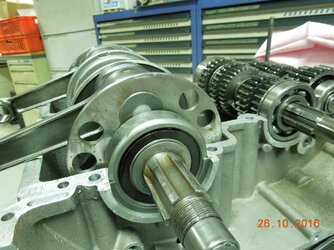
They're the same as an 8-ball caged bearing, just 11-ball with a cage and have a higher load rating. A roller would almost definitely be stronger (engineers chime in here), with a much larger load-bearing area, but the 11-ball is definitely up to it - have also run one for many years in my SF. Now has bronze-caged roller. The crank MUST have something to prevent lateral movement, which is the function of the RH caged ball. Shim washers are more to do with positioning the outer race of the roller or getting the crank positioned correctly in the cases than to prevent lateral play.


GregT
Hero member
- Location
- Christchurch NZ
Are they angular contact bearings ? If you've got a situation where there's a ballrace taking heavy end thrust - like a gearbox mainshaft bearing taking clutch thrust - angular contact are the answer. Readily available too.
piranha-bro2
Hero member
- Location
- Melbourne
No, Piet. I actually have a brand new pair of those that came off the SFC crank Lee bought (he gave me the 'old' one - lucky bruvva me!). Original RIV. The thing that worried me about them was shimming to eliminate sideplay - exactly the same bearings used in Ducati bevel twins, but they have vertically split cases and full dia shimming capability - the drive side of SFC cases only have ring grooves in the lower one. Probably fine, but std bearings cope very well with racing, bronze caged ones even moreso.
Tippie
Hero member
- Location
- Dr?bak, Norway
I had the original SFC shouldered ball ones inspected by bearing engineers after they had been in use. They said that there was clear evidence of hammering as that type of bearing must be shimmed up to prevent that, they said they were not suitable to the application the way they sit in the crank case, and pointed to the 11 ball ones (not 12 as I said) which I have used ever since.
The other issue with my first SFC crank was all of the big end rollers breaking. Analysis of those rollers was also part of the analysis by the same engineers. The rollers were sharp square ended and this was given as the cause of the failure. I know that Piet has seen many cranks with these squared off rollers that haven't given trouble, but mine certainly did, but the with the uber-hard crankpin on the SFC crank there was no damage at all to either it or the rod. I had only done one season of racing on that crank. My new SFC crank (lucky to work for the importers!) was dismantled and the big end rollers had chamfered ends, as they "should" be.
This is all irrelevant to the discussion of the triple crankshaft though. Maybe if those crankshaft centre ball bearings been of the type I use, the factory would have avoided all of that drama.
The other issue with my first SFC crank was all of the big end rollers breaking. Analysis of those rollers was also part of the analysis by the same engineers. The rollers were sharp square ended and this was given as the cause of the failure. I know that Piet has seen many cranks with these squared off rollers that haven't given trouble, but mine certainly did, but the with the uber-hard crankpin on the SFC crank there was no damage at all to either it or the rod. I had only done one season of racing on that crank. My new SFC crank (lucky to work for the importers!) was dismantled and the big end rollers had chamfered ends, as they "should" be.
This is all irrelevant to the discussion of the triple crankshaft though. Maybe if those crankshaft centre ball bearings been of the type I use, the factory would have avoided all of that drama.
Thanks Greg, that was the term I was looking for...Are they angular contact bearings ? If you've got a situation where there's a ballrace taking heavy end thrust - like a gearbox mainshaft bearing taking clutch thrust - angular contact are the answer. Readily available too.
 I do have problems with technical english at times, my German is far better these days!
I never really understood why Laverda opted for these in the SFCs due to the lack of shimming possibilities. Given the case castings as they are, there is no way these bearings could be exactly shimmed. But I've yet to find a damaged one! Ideally, there should be no end thrust on the crank at all. It seems in this case the bearings find their sweet spot and stay there.
The mains in the works 750SFC engine were perfect when I tore it down, as was the entire crank, so it was all re-used. Due to the cost, and un-availability at times, I have converted 2 SFC engines to deep-groove ball/roller bearings in the past, all without issues.
piet

Just thinking about why the angular contact were specified for the harder working motors...
I wonder if the angular contact bearings were installed so that when the motor is up to temperature (and thermal expansion of dissimilar metals has occurred) then the balls would sit nicely into the angled cups. Whereas a deep groove ball would load up the sides of the race's groove ?
As well as dissimilar metals, the case would run a lot cooler than the spinny-bits.
I wonder if the angular contact bearings were installed so that when the motor is up to temperature (and thermal expansion of dissimilar metals has occurred) then the balls would sit nicely into the angled cups. Whereas a deep groove ball would load up the sides of the race's groove ?
As well as dissimilar metals, the case would run a lot cooler than the spinny-bits.
Last edited: