Laverda 1000 cylinder head cracking up.

Zakredridge

Junior member
Location
United Kingdom
Hello
I've read various articles on here regarding repair of the cracks regarding the cam chain area which was a weak spot on the earlier non radius heads.
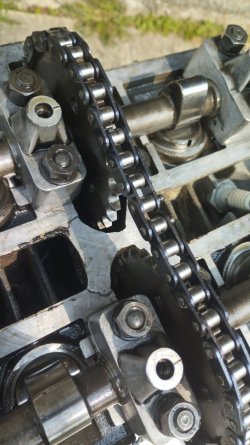
I include a picture of my cylinder head which has been repaired previously.
My question concerns the cutting of the bridge that joins across the cam chain void.
Does the separation partially separate or completely separate?
Thanks 🙏
 

Attachments

  • IMG-20250531-WA0000.jpeg
    IMG-20250531-WA0000.jpeg
    126.1 KB · Views: 82
My original head was like yours and cracked. The replacement (30 years ago) had the top bridge completely removed and has not cracked. I have heard various opinions on this modification, it makes sense to me as it should reduce stress on the cam tunnel walls. The corners were also radiused, don’t know if this was an improved design from the factory or done later.
 
The heads improved step by step over the years, the final ones being the strongest and less prone to cracking. A proper radius paired with a decent wall thickness appeared with the 120s.

I usually cut the bridge about 3/4 through from the top, especially on the very early heads. The heads are incredibly soft and flexy, the bridge hardly makes any difference!

piet
 
Can you clarify the bridge removal spec?
I assume by cut you mean that the cut will be the thickness of your cutting wheel and cut down to 3/4 of the total depth of the bridge.
If incorrect please explain for me
Bob
 
Doesn't matter how much is actually taken out, 2 or 10mm...

All it does is relieve stresses going into the corners of the casting by the expansion of said bridge. Well, that's the theory behind it. At least those heads that have the bridge cut haven't cracked up again, while quite a few that have retained the bridge have cracked after repairs (from observations covering around 15 years). Reckon weld quality will also play a role. I had the cracks laser welded to keep distortion to a minimum. The welds can be dressed with a file and oil stone. A few examples below, mostly prior to cutting.

DSC03698.JPGDSCN9060.JPGDSCN0328.JPGDSCN8605.JPGPICT1230.JPG20231005_142857.jpg
Final pic shows how it should not be done. Rather over-enthusiastic, somebody removed the entire tunnel wall and welded it up again, leaked like fucking sieve... I should have thrown it in the scrap! Took multiple welds to close the various leaks, warped all over the place and was then painted/sealed, just in case. Worked out in the end, surely not doing it again. I also came across a very similar "job", needed to weld in an alloy block to restore the chain tunnel wall that somebody had milled out.

piet
 
Thanks Piet the 4th pic from the top, 3rd up from bottom most useful the head is 3 dimensional and text is one dimensional hence confusion, final questions honest!
1, head was previously welded, now cracked again. The crack is contaminated with oil.
Any advice to the laser welder regarding the amount of material to remove around the crack( width and depth). Cracks are in the exact positions as in your pictures. Tips on decontamination of weld site?

2, what comes first, weld up the cracks or remove material from the tunnel. Does it matter or not?

Many thanks
Bob
 
Thanks Piet the 4th pic from the top, 3rd up from bottom most useful the head is 3 dimensional and text is one dimensional hence confusion, final questions honest!
1, head was previously welded, now cracked again. The crack is contaminated with oil.
Any advice to the laser welder regarding the amount of material to remove around the crack( width and depth). Cracks are in the exact positions as in your pictures. Tips on decontamination of weld site?

2, what comes first, weld up the cracks or remove material from the tunnel. Does it matter or not?

Many thanks
Bob
They all do that, sir... ;)

Contaminated welds are a big problem, often no other choice than cutting back to virgin material. Even then, these castings are quite porous and can carry loads of oil. Laser welding does't seem to be very affected though, oil simply evaporates completely under the heat.

I weld first, then cut. Just the way I do it.

piet
 
Back
Top