
You are using an out of date browser. It may not display this or other websites correctly.
You should upgrade or use an alternative browser.
You should upgrade or use an alternative browser.
Laverda 3CE
- Thread starter Mark35
- Start date


The Sock
Hero member
- Location
- London, England
The 3cE was the Father of the Jota.
In precis:
The production Laverda 3c was strangled by European noise regulations. The three down pipes entered a single pipe of identical diameter, the outer two arrived at right angles to the centre and virtually fed into one another a worse gas flow dynamic is hard to imagine. Once they managed to escape this disaster they were fed into an horrendously tortuous silencer which called for four complete reversals of direction of flow on top of a myriad of other traps contrary to all sensible exhaust extraction methods.
Fortunately, at the time, in England we were not so restricted by regulation, so Roger Slater recognised that more power could be gained at minimal expense. Simply by angling the outers inward, raising the diameter of the collector pipe and replacing the silencers with copies bereft of internals, then rejetting to suit, an enormous increase in both power and noise resulted. the replacement of the A11 cams with 4C's made things even better (above 5000 RPM), added to higher compression pistons.
Some had the SFC (greater trail) yokes fitted, some didn't.
Roger always knew how to operate the press. The test model was "run in" on a lathe.
If you've ever had the cam buckets out you know it takes a push to get them back in. According to Richard Slater on the test bike you could throw them across the workshop and they would go in " like a rat down a hole" worth 3 BHP on the dyno, and so on through the bike. Production models would take 20-30,000 miles to give the same sort of perfomance. As Slater's started to supply 3cE's the alloy wheeled 3cL came into production and, applying the 3cE upgrades, the Jota was born.
The rest, as they say, is history.
Hope this clears things up.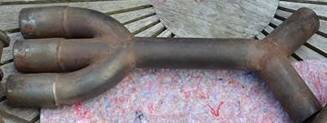

In precis:
The production Laverda 3c was strangled by European noise regulations. The three down pipes entered a single pipe of identical diameter, the outer two arrived at right angles to the centre and virtually fed into one another a worse gas flow dynamic is hard to imagine. Once they managed to escape this disaster they were fed into an horrendously tortuous silencer which called for four complete reversals of direction of flow on top of a myriad of other traps contrary to all sensible exhaust extraction methods.
Fortunately, at the time, in England we were not so restricted by regulation, so Roger Slater recognised that more power could be gained at minimal expense. Simply by angling the outers inward, raising the diameter of the collector pipe and replacing the silencers with copies bereft of internals, then rejetting to suit, an enormous increase in both power and noise resulted. the replacement of the A11 cams with 4C's made things even better (above 5000 RPM), added to higher compression pistons.
Some had the SFC (greater trail) yokes fitted, some didn't.
Roger always knew how to operate the press. The test model was "run in" on a lathe.
If you've ever had the cam buckets out you know it takes a push to get them back in. According to Richard Slater on the test bike you could throw them across the workshop and they would go in " like a rat down a hole" worth 3 BHP on the dyno, and so on through the bike. Production models would take 20-30,000 miles to give the same sort of perfomance. As Slater's started to supply 3cE's the alloy wheeled 3cL came into production and, applying the 3cE upgrades, the Jota was born.
The rest, as they say, is history.
Hope this clears things up.
Last edited:

pf1
Hero member
- Location
- Portsmouth UK
Any 3C can become a 3CE with a couple of mods, just like a 3CL can be turned into a Jota.

helicopterjim
Hero member
- Location
- near Lone Butte, BC, Canada
Any 3C can become a 3CE with a couple of mods, just like a 3CL can be turned into a Jota.
I have a 3CS ....... it's a 3C with 4C cams and it came from Spain.
Jim

chrisk
Hero member
- Location
- Brisbane, Australia
Either that or a collector flattened to an oval with a few wacks via a saucepanI have a 3CS ....... it's a 3C with 4C cams and it came from Spain.
Jim


martymoose
Hero member
- Location
- Sydney, Australia

rocketonarail
Hero member
- Location
- Gloucestershire,England
That sums it up perfectly ....... I like the story about the cam buckets ..... typical Richard ... !!! .......The 3cE was the Father of the Jota.
In precis:
The production Laverda 3c was strangled by European noise regulations. The three down pipes entered a single pipe of identical diameter, the outer two arrived at right angles to the centre and virtually fed into one another a worse gas flow dynamic is hard to imagine. Once they managed to escape this disaster they were fed into an horrendously tortuous silencer which called for four complete reversals of direction of flow on top of a myriad of other traps contrary to all sensible exhaust extraction methods.
Fortunately, at the time, in England we were not so restricted by regulation, so Roger Slater recognised that more power could be gained at minimal expense. Simply by angling the outers inward, raising the diameter of the collector pipe and replacing the silencers with copies bereft of internals, then rejetting to suit, an enormous increase in both power and noise resulted. the replacement of the A11 cams with 4C's made things even better (above 5000 RPM), added to higher compression pistons.
Some had the SFC (greater trail) yokes fitted, some didn't.
Roger always knew how to operate the press. The test model was "run in" on a lathe.
If you've ever had the cam buckets out you know it takes a push to get them back in. According to Richard Slater on the test bike you could throw them across the workshop and they would go in " like a rat down a hole" worth 3 BHP on the dyno, and so on through the bike. Production models would take 20-30,000 miles to give the same sort of perfomance. As Slater's started to supply 3cE's the alloy wheeled 3cL came into production and, applying the 3cE upgrades, the Jota was born.
The rest, as they say, is history.
Hope this clears things up.
helicopterjim
Hero member
- Location
- near Lone Butte, BC, Canada
Either that or a collector flattened to an oval with a few wacks via a saucepan
I guess it should be a 3CSe ....... Sistema de escape
chrisk
Hero member
- Location
- Brisbane, Australia
3C GT.
Gentleman's Tourer
Speaking rather highly of yourself
helicopterjim
Hero member
- Location
- near Lone Butte, BC, Canada
.
Some had the SFC (greaterlesser trail) yokes fitted, some didn't.
Fixed.
Jim