Laverda SF750 mechanic needed in Southern California

I may have an answer to my problem(S). There was fuel in the oil, apparently from a leaking fuel valve. This diluted my engine oil and I am just guessing now, caused my clutch plates to stick. Perhaps the clutch plates had swollen? Does that sound possible? I drained the engine, cleaned out the filter basket and made a few new gaskets for the filter plate.
1)  Is there any sealant applied on the gasket, or any other oil containing cover gaskets on the bike?
2)  I am assuming I need to replace the clutch pack?
3)  If clutch needs service, does it require any special puller, or other special tools?
4)  If clutch needs replacing, would it be a reasonable assumption that I should get a new primary drive chain, just because the side cover is open.
5)  I know I already need to replace my exhaust gaskets because there were none. I do have some spares. Any input would be a great help.

Thank you
Jim
 
Here's my take on your questions. Others may have different ideas:

1. Sealant on gaskets is a matter of preference. If the mating faces are good, you may get away without sealer. If you're troubled by leaks, slap some sealer on.

2. I dunno whether fuel in the oil will damage the friction material on the clutch plates, but the Redax Kevlar/carbon plates seem to grip better than the originals and don't stick together, so you'd be better off with new plates anyway. Red does a trade-in deal with your old friction plates.

3. No puller is required to disassemble the clutch. Just remove the circlip.

4. If the primary drive is in good condition. There's no need to replace it.

5. Is there a question there? Installing exhaust gaskets isn't difficult, but you might find it easier with a dab of grease on them to hold them in place inside the port in the cylinder head while you insert the header pipe.
 
Pretty much what I would recommend too, Cam. Nothing too serious there.

Determining whether the primary chain needs replacing could be tricky if you don't know the history of the bike (ie how many miles on the chain?). The surface of the slipper tensioner may be an indication, or if the adjusting bolt screws in a long way before creating correct tension. While you're in there, check to backlash in the clutch cush drive as it may need new rubbers fitted if they've never been changed or a old and hardened.

 
I agree. Then you know it has been done and service life for future reference.
 
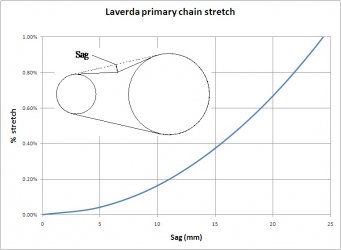
Primary chain wear can be measured. Here's a chart I prepared earlier.
According to our mate Andy the chain man. Up to 1% stretch can be tolerated, so that's as far as the chart goes.

Edit.
Laverda engineers set the shaft spacing to exactly match the 76 pitches of 3/8" roller chain. So the both the top and bottom chain runs should be taut when the chain is new. But in reality, there will always be some measurable "stretch", even in a new chain, because of the clearance between pins, bushes, rollers, side plates, etc. So the measuring the stretch by deflection of the chain between sprockets errs on the safe side when assessing chain wear.
 

Attachments

  • Laverda primary chain stretch 1% max.jpg
    Laverda primary chain stretch 1% max.jpg
    60.7 KB · Views: 22
I think just for the sake of doing it, I have added the primary chain to the list of part needed. Just like Paul Marx  said, it's cheap insurance. I want the satisfaction that everything, or at least most everything within reason will be new where it counts.
Thanks for the input and the new found knowledge.
 
And all this is pretty basic stuff on a very simple bike based on Honda 350 design from the 1960's. Wolfgang is close by for parts and advice, with Green book any competent motorcycle tech should be able to do this work for you if it is not your thing. Must be some guys who work on Guzzi's or old British bikes. In my area there are now guys who specialize in Japanese bikes from the 70 's and 80's.
 
Piranha Brother 2 said:
And checking the slipper tensioner surface for excessive wear and replacing if nec goes without saying.

Grooves worn into the slipper surface by the chain side plates are normal. Don't replace the slipper because of the grooves, or try to file it down to remove them.
 
Dellortoman said:
Grooves worn into the slipper surface by the chain side plates are normal. Don't replace the slipper because of the grooves, or try to file it down to remove them.

Good point, Cam. Once the grooves are so deep the chain is digging in across the width of the slipper it's time to think about replacing. I've also seen them where the rubbery material is coming away from the metal base.
 
The grooves need to be deep enough so that the chain rollers are running on the slipper surface. The tensioner slipper then acts on the rollers, which is he way it's supposed to work. It shouldn't wear much after the initial "groove cutting" wear-in period.

In my limited experience they seem to last a long time. Other things wear out before the tensioner slipper. I don't know what their life expectancy is but I've looked at them in 100,000 km engines and there's still plenty of material on them. I've never looked inside a very high mileage engine like Levo's RGS (300,000 km +). Maybe his got replaced when Red reconditioned the engine. 
 
Back
Top