LED Indicators

AJ

Senior member
I have fitted LED indicators to my 1200 along with the flasher unit for these LEDs. All the indicators come on when the switch is in either direction. I suspect the problem is the indicator light in the instruments. Does this bulb need to be LED too?
Also looking at an LED bulb for the park light in the headlight. Does anyone have a model number for a suitable bulb? Is it a B9 bayonet bulb?
 
AJ said:
I have fitted LED indicators to my 1200 along with the flasher unit for these LEDs. All the indicators come on when the switch is in either direction. I suspect the problem is the indicator light in the instruments. Does this bulb need to be LED too?
Also looking at an LED bulb for the park light in the headlight. Does anyone have a model number for a suitable bulb? Is it a B9 bayonet bulb?

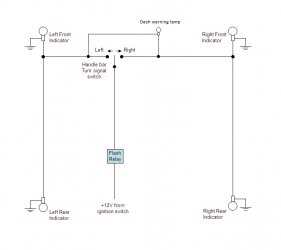
The indicator warning bulb "shorts" the 2 sides, ground connections from both front indicators go to either side of the warning light.  Re-wire the ground connction of the front indicators directly to ground, the system should work OK, but without warning light.

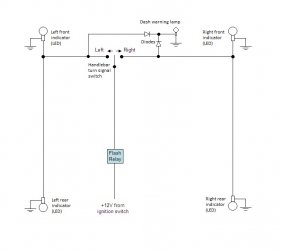
Not sure how to get the entire system to work with only a single warning light.  Possibly a supply from both sides to one side of the warning light (the other to ground) with a diode included in each supply to prevent flow to the other side.

piet
 
sfcpiet said:
The indicator warning bulb "shorts" the 2 sides, ground connections from both front indicators go to either side of the warning light.  Re-wire the ground connction of the front indicators directly to ground, the system should work OK, but without warning light.

Not sure how to get the entire system to work with only a single warning light.  Possibly a supply from both sides to one side of the warning light (the other to ground) with a diode included in each supply to prevent flow to the other side.

piet
Thanks Piet. You confirmed my suspicions. Looks like no warning light for the short term then. Cheers
 
AJ said:
Thanks Piet. You confirmed my suspicions. Looks like no warning light for the short term then. Cheers

You can keep the warning light. It just needs a little re-wiring. Buy a couple of diodes (0.5A rating will be plenty) and wire them in as shown in the second drawing below. The first drawing shows the original wiring.
 

Attachments

  • indicators.jpg
    indicators.jpg
    36.1 KB · Views: 220
  • LED indicators.jpg
    LED indicators.jpg
    38.7 KB · Views: 226
G'day AJ

Rectifier (or blocking) diodes are specified in current and voltage ratings like 1A, 10A and 50, 400 and 1000V.

The little indicator warning lamp would be 4W max, so that's about 300mA current draw which is why I said a 0.5A (500mA) diode would be OK. But looking at what's available on line, it seems 0.5A is not a common rating, so go for 1A. Since you're only dealing with 12V you don't need to worry too much about the voltage rating, but you pay a bit extra for the higher voltage ratings and they may be a little bulkier.

Diodes are dirt cheap. They usually come in packs of 10 but they're only a few cents each. For example, here's a pack of 10 for $2.60 including postage on ebay.
https://www.ebay.com.au/itm/IN4004-Rectifier-Diode-400V-1-Amp-x-10Pcs/302855164854?hash=item46839313b6:g:vaYAAOSw3ZtaLaEv:rk:2:pf:0
The postage would account for $1 of that so the actual diodes are about 16 cents each.

If there's a Jaycar shop near you, they'll sell them one at a time, but will probably charge you a rip-off price of 25 cents each. It'll cost you more in petrol to drive there!

Blocking diodes are normally silicon diodes. If looking on line, you might come across names like Zener or Schottky diodes. Zener diodes are for voltage control applications and are no good for your purposes so avoid those. Shottky diodes will work fine but might cost a couple of cents more. Only difference between Shottky and normal diodes is that Shottky have a lower voltage drop when passing current. We're only talking a few millivolts difference, so don't get all OCD about reducing voltage drop.

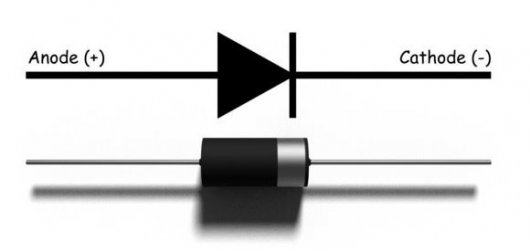
The diodes are not much fatter than the wires in your bike's wiring harness, so I'd suggest you simply solder them in line with the wires to the dash lamp and cover them with electrician's tape or preferably heat shrink tube. The coloured band (usually white or silver) on the diode indicates the current direction and should face towards your dash lamp.

That's pretty much all I can tell you about diodes.

Cheers,
Cam
 
Dellortoman said:
G'day AJ

Rectifier (or blocking) diodes are specified in current and voltage ratings like 1A, 10A and 50, 400 and 1000V.

The little indicator warning lamp would be 4W max, so that's about 300mA current draw which is why I said a 0.5A (500mA) diode would be OK. But looking at what's available on line, it seems 0.5A is not a common rating, so go for 1A. Since you're only dealing with 12V you don't need to worry too much about the voltage rating, but you pay a bit extra for the higher voltage ratings and they may be a little bulkier.

Diodes are dirt cheap. They usually come in packs of 10 but they're only a few cents each. For example, here's a pack of 10 for $2.60 including postage on ebay.
https://www.ebay.com.au/itm/IN4004-Rectifier-Diode-400V-1-Amp-x-10Pcs/302855164854?hash=item46839313b6:g:vaYAAOSw3ZtaLaEv:rk:2:pf:0
The postage would account for $1 of that so the actual diodes are about 16 cents each.

If there's a Jaycar shop near you, they'll sell them one at a time, but will probably charge you a rip-off price of 25 cents each. It'll cost you more in petrol to drive there!

Blocking diodes are normally silicon diodes. If looking on line, you might come across names like Zener or Schottky diodes. Zener diodes are for voltage control applications and are no good for your purposes so avoid those. Shottky diodes will work fine but might cost a couple of cents more. Only difference between Shottky and normal diodes is that Shottky have a lower voltage drop when passing current. We're only talking a few millivolts difference, so don't get all OCD about reducing voltage drop.

The diodes are not much fatter than the wires in your bike's wiring harness, so I'd suggest you simply solder them in line with the wires to the dash lamp and cover them with electrician's tape or preferably heat shrink tube. The coloured band (usually white or silver) on the diode indicates the current direction and should face towards your dash lamp.

That's pretty much all I can tell you about diodes.

Cheers,
Cam
Thanks Cam- I have a couple from an electronics repair guy. Yes they are tiny) I now know which way round to fit them-cheers.
 
Hi, so I had the same issue so tried the wired up diode as you described and still all four blinkers are blinking at the same time WTF? I thought they may have been zenor diode which you said wouldn't work but they aren't, they're active diodes https://www.jaycar.co.nz/1n5404-3a-400v-diode/p/ZR1014

so where to from here? do I have to try resistors now? Ideas?
 
terry66 said:
Hi, so I had the same issue so tried the wired up diode as you described and still all four blinkers are blinking at the same time WTF? I thought they may have been zenor diode which you said wouldn't work but they aren't, they're active diodes https://www.jaycar.co.nz/1n5404-3a-400v-diode/p/ZR1014

so where to from here? do I have to try resistors now? Ideas?

If you're referring to the blocking diodes in the the 2nd diagram (for LED indicators) I posted a couple of years ago, you shouldn't get all 4 indicators operating together. That's what the two diodes are there to stop happening. So there are a couple of possibilities:
1. The diodes are faulty.
2. You wired it incorrectly.

I'm sorry to say that scenario 2 is far more likely.

It's important to get the diodes oriented correctly. In this case the two diodes should have their cathodes connected together, and connected to the dashboard warning light.  The cathode end is the one with the painted band - see diagram below. If you get one of them arse about, all indicators will come on together when the indicator switch is set to one side, but only 2 will come on when the other side is switched on. If you get them both arse about, the indicators will work normally, but the little pilot light in the dash won't work.

Adding resistors won't fix your problem. Their purpose is as to put a dummy load on the flasher relay to achieve the correct flash rate if you're using LED indicators with a thermo-mechanical relay designed for incandescent bulbs. The flash rate is load dependent with the old-type flasher relay, and LED indicators draw bugger-all current in comparison with incandescent lamps. But since you said the indicators are flashing, I guess the flash rate is OK.
 

Attachments

  • diode.JPG
    diode.JPG
    19.2 KB · Views: 133
Great thread !  I wish I had this info when I was doing the same on my 2001 KTM. Lost the warning lamp on that one.
  Technology moves on...
my 2014 Duc actually has the option to select Led or incandescent built into the dash.
 
Back
Top