Magnesium footpeg mounts NOT

Jugs_S

Senior member
Location
Sydney
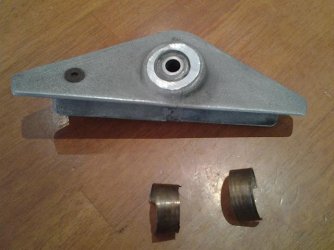
You all know the triangular foot peg mounts I've been told from the word go that these were magnesium and all singing all dancing. I've recently has a set to repair on a 3C I've been doing up. They have bee over tightened and cracked. I wanted to get them welded and as the Magnesium rods are hellaciously expensive I sent them out to find out what exactly they were made of

Plate    Sn      Pb      Zn      Cu      Fe        Al        P      Si          Mg
          0.014  0.028  0.248  6.454  1.243    86.28  0.0    5.059    0.0

As you can see it is a standard Aluminum alloy ( apparently common in the US) the Metallurgist said the high Si is to make it easy to cast.

I also had 2 bushes from the 5th gear (the counter sprocket shaft the sticks out of the gear box) that I had saved tested so I could use the correct material in replacement bushes.

Bush    Sn      Pb      Zn      Cu      Fe        Al        P      Si        Mg
          4.165  4.859  5.319  80.483  0.236  1.643  0.068  2.825  0.0

this pretty much makes it a Pb bronze bush. Pix to follow

Will 


Attachments

  • 20150304_114812 small.jpg
    20150304_114812 small.jpg
    41.2 KB · Views: 17
You could also just have asked here and saved a lot of effort and expense.
 
Interesting, though no surprises.  I've never heard of the rearset plates referred to as Magnesium, Laverda never made much effort to make things light! :)  I repaired a set which had cracked recently, I ground the crack back with a carbide burr and found a large inclusion which was the starting point.  I removed all the crack and inclusion till I had nice bare ally and welded it up just using AL1100 rod IIRC.  I'm no expert ally welder but it worked fine.

An easy way to prove or disprove the Al vs Mg thing at no cost is to just establish the density.  Weigh each plate, then fill a container with water on the kitchen scales and zero it.  Slowly lower the plate into the water and allow the excess to spill off, then slowly remove it.  The reading on the scales in gm will be the spilled water and thus volume of the part.  Weight divided by the volume spilled is the density of the part.  Ally is ~2.8 and Mg ~1.8, so easy enough to differentiate.

Have you found an ally grade that somewhat matches those ingredients?  I was under the impression the sand cast parts were basically A356, but your figures are a long way from that.  Were they definitely factory rearset plates or repro items?  It would be really interesting if you could get the same test performed on a piece of crankcase!
 
While speeking of materials , das anibody knows of wich aluminium are folowing parts made of :

Fork downtubes
Hubs by spoke wheels  - chain sprocket carrier
Triple clamps

Are they sand cast , and with wich procentage of SI and other materials ?
 
breganzane said:
Grant - what is the alloy grade used for the various cast parts used by Laverda?
No idea, but I can tell Aluminium from Magnesium.
 
Not likely to see pure magnesium on a motorcycle, will be a magnesium alloy. The stuff fitted to SFC's was Electron RZ5, have rods for that in stock as I weld the occasional bit of magnesium alloy ( just done a big crankcase repair job on an ex works CCM and the mag parts on that were RZ5 as far as I could tell, certainly welded OK ) It is fairly easy to identify as it is generally harder and lighter than aluminium alloys but it will scratch bright. Welds and machines lovely if you get it nice and clean.


  Keith
 
Early Volkswagen crankcases were magnesium. I once saw a VW beetle engine that had been immersed in sea water for a couple of weeks (car was stolen and driven into the water). The aluminium alloy cylinder heads and gearbox were perfectly OK, as were the cast iron cylinders and other parts, but the crankcase had disappeared completely. It acted as a sacrificial anode for the rest of the car. It's a bit odd to see an engine fully assembled in the vehicle with crank, conrods, cylinders, heads and everything, but no crankcase.
 
always thought those rearset plates were alloy, seen a bunch of them welded up

we use LG2 bronze bar stock for the bushes
 
Cosi said:
Well that's what some old prick told me,

happy to learn some new non weighing method....

From another old prick ... leave the scratched shiny part out in the weather for a short time. Mg oxidises very quicky.

Or you could put the fine shavings in your cigarette, you will see a bit quicker.
 
I had the mag part tested more because of the persistent talk that they were Mag, and I was suspect, as to cost I will have to go drink a beer with a mate to say thanks, So no hardship there.

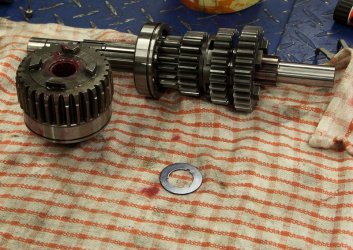
I was really more interested in knowing exactly what the bushes were made out of as I've repaired several gearboxs. On the later boxes with needle rollers in the 5th gear the surface on the end of the main shaft which acts as the inner bearing surface starts to break up, so replacing the needle rollers is a wast of time. the hardening is thick enough to redress the shaft but this leaves it under size for the needle rollers. So I go back to the earlier design and put in a bush. So the interest is what Laverda used originally.

In time when the favour bank has built up I'll see if I can get a bit of crank case done. though I suspect if you tested early to late cases and early to late heads they would come up different.
 
The wear on the end of the later main shafts is, I think, accelerated by a lack of oil. When rebuilding these boxes I file three oil holes in the thrust washer to help let a little more oil into the needle rollers.

  Keith 
 

Attachments

  • DPP_0001 (2).jpg
    DPP_0001 (2).jpg
    198.4 KB · Views: 65
laverdakeith said:
The wear on the end of the later main shafts is, I think, accelerated by a lack of oil. When rebuilding these boxes I file three oil holes in the thrust washer to help let a little more oil into the needle rollers.

  Keith

Actually a mod the factory themselves performed on the last 120s to leave the works. :D

The earlier stock thrust washer indeed stifles oil flow to the needle rollers.  But the majority of bearing and shaft failures can be put down to over-tightened drive chains, #630s in the case of the 120s.  Don't think a #530 chain is any more foregiving than a #630, it will ruin the needle bearings just as quick if constantly over-tightened.

piet
 
Back
Top