Mercedes Primary Chains

Cam,

You remember the chain guide in the sump being off-centre?

The chain run is extremely close to one of the main bearing bosses. Depending on actual chain dimensions, the clip side of the chain can rub on the boss. I've found nicely polished spring clips and pin ends, along with the matching slot in the boss.

Just another of those little things that show up a sloppy engine build.

piet
 
Cam,

You remember the chain guide in the sump being off-centre?

The chain run is extremely close to one of the main bearing bosses. Depending on actual chain dimensions, the clip side of the chain can rub on the boss. I've found nicely polished spring clips and pin ends, along with the matching slot in the boss.

Just another of those little things that show up a sloppy engine build.

piet
Staggering.
Thanks for sharing Piet, that’s getting written down in my book!
 
Cam,

You remember the chain guide in the sump being off-centre?


Just another of those little things that show up a sloppy engine build.

piet
More the point that although Laverda engines are about as simple as they come, there are little peculiarities that can take even a good engine builder without specific Laverda knowledge unawares.
 
All chain manufacturers instructions tell you to fit the spring clip with the curved side pointing in the direction of rotation / movement.
They must have a reason for this. And I am very sure they have tested their chains and found something worth knowing.
Oil drag must not be overlooked either, it can be considerable at thigh speed.

Julian
 
I've always taken the view that, since they designed, built and tested the bikes, the Factory might be best placed to advise on which way round to fit the joining link.
Page 26, of the Operation and Maintenance Handbook that came with my bike, seems pretty clear:

Camchain Cylinder Head Laverda Handbook P26.jpg
 
Last edited:
So, my IWIS timing chain has arrived. Before I delve into this can someone confirm my plan and understanding is correct?
-stuff all orifices with rags to prevent loss of parts into depths of engine.
-remove tensioner and tensioner blade; does blade just pull out? Can it be removed with carbs in situ?
-with number 1 at tdc and link in middle between cam wheels, break chain and connect new chain to old.
-maintain tension on chain, disengage chain from cam wheels and have an assistant rotate the crank until new chain has been fed all the way through (without rotating cam wheels).
-remove old chain from new and locate new chain onto cam wheels, replace link, new clip.
-refit tensioner and blade and correctly tension.

There’s not much room between the cam wheels and the cylinder head wall, but just enough I think?
 
A couple of questions:
The IWIS Timing Chain is what is used as a duplex primary chain on big Laverdas, is that what you've just received?
Are replacing the cam chain on your Laverda?
If you are, Then follow this

Handbook page 9.jpgHandbook page 10.jpg
 
Yes, I am replacing my RGS timing chain with an IWIS timing chain, which also happens to be the same type of chain used on the primary chains (confusing). Thanks for the picture, however this doesn’t really say much unless I’m being extremely thick.

Is the method I outlined correct, or do the diagrams above suggest that I should remove the bolts from the timing wheels and allow them to spin independent of the cam shafts?

I would prefer to use the method I detailed if possible. Cheers.
 
One point isn’t clear at this stage. I understood Andy Forsdick always that way, that for cam chains it would be ok to use “roller” type chains (dimension 3/8" x 1/4"), e. g. IWIS G67WZ or Regina C121HCS.

For primary chains however the same dimensions (3/8" x 1/4") applies, but as “bush” type chain. The difference is the bigger pin diameter (4.41 vs 3.31 mm) – which is important for the primary drive, as the “bush” type chain is capable for higher loads.

Therefore you shouldn’t use the IWIS G67WZ but the G67HP for the primary drive application.


This was explained some time ago (2010) by Andy (the original chain man) and the related post can be found here:
primary chain replacement (see page 3).


Hope this sheds some more light on the topic!

Cheers,
Jo
 
Last edited:
Spark plugs out, holes cloth covered.
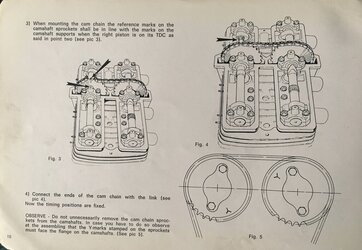
Get the cam sprocket timing marks AND the TDC mark lined up simultaneously with the cam chain joining link being in, more or less, the position illustrated above.
Using old joining link, connect new chain to old (front/exhaust side). Maintaining tension on both ends of the, now double length chain (easier with an assistant), turn the engine clockwise, as viewed from the right hand side, until the old chain is clear.
Using the new split link join the ends, as illustrated above with all marks lined up.
Turn the engine, by hand, through several revolutions and check marks still align (no need to have the chain join in place for this).
If all lines up, job's a good un.


Note the illustrations above, and my principal skillset is based on a 180° original series Triple, but I'm guessing the technique holds good.
Anyone with experience of the later ones, feel free to pitch in?
 
Thanks Jo,

Jason (the new Andy) said it was the same chain but definitely worth checking. I hope the G67HP is being used for both applications?

I’m replacing the timing chain and want to confirm the methodology I outlined will work.
 
One point I notice in the link you sent is that it references duplex pin diameter; I am using two simplex chains.
 
Cam,

You remember the chain guide in the sump being off-centre?

The chain run is extremely close to one of the main bearing bosses. Depending on actual chain dimensions, the clip side of the chain can rub on the boss. I've found nicely polished spring clips and pin ends, along with the matching slot in the boss.

Just another of those little things that show up a sloppy engine build.

piet
Thanks Piet.

Bugger! Now it's going to bother me wondering which way around I fitted my connecting link. I'll have to lift the lid off the engine to have a look. Oh well, it's probably time to check the valve clearances anyway.
 
If the new cam chain is heavier grade than the old one it may have slightly more width in which case the joining link will possibly contact that bearing journal Piet mentions. Orientation of spring clips has always ben open end trailing side - same for all chains, bicycles, engines, whatever.

Out of interest, turning the crank on a triple with the cams in place doesn't risk pistons hitting valves with cams in TDC position? Is TDC for either cylinder OK?
 
Out of interest, turning the crank on a triple with the cams in place doesn't risk pistons hitting valves with cams in TDC position? Is TDC for either cylinder OK?
I haven't had any issues with it on my 180°, Tippie.
120°s I don't know about, but, generally, it's a job I would do with the cams removed, which is best practice, for the above reason.
 
Back
Top