Middle pot misfire

Maybe a blockage in the middle carb then?
Any sign of crud in the float bowl or side filter where the fuel lines enter the carbs?
If it was mine I would strip and check the whole carbs, not just the jets.
Overall, do the carbs look worn?
Slides worn/scratched?
Muck around the bottom of the float bowls.
Float valve/needle jet operating properly?
Float heights all set properly?
 
Thanks Grant

I have stripped them 3 times now, on one of those occassions I had everything off them so am fairly sure there are no blockages. Today I blew through the pilot circuit and all was well.
 
Glen, it's frustrating but you can only keep going through a process of checking and eliminating. I'm assuming you have followed Cam's good advice and eliminated the possibility of a fault in the electrical circuits. The fault is more likely to appear on the low voltage side with the trigger wiring and boxes. If you are satisfied with all these checks I can only advise you to check to make sure the insulators between the head and the carb manifolds are not cracked (again I'm assuming that this is the set up on your bike).

Just keep at it and eventually you'll get that Eureka moment.

Cheers

Ian
 
Hi Glen,

A little  confusion, I'm referring to the insulators between the cylinder head and inlet stubs.

See link below, a set currently on eBay, these are the insulators I'm referring to. Sometimes they crack and these can create a leak path allowing air to be drawn in weakening the mixture and causing mis-fires. I know you are seeing a sooty spark plug but try eliminating each possible cause definitively otherwise you could chase the problem round in circles, of course there may be more than one gremlin to fix. If the plug is oily it wouldn't do any harm to compression test each cylinder and compare the results as Dave suggested earlier.

Cheers

Ian

http://www.ebay.co.uk/itm/LAVERDA-GENUINE-CARB-INSULATORS-1000-1200-series-1-2-/131289682403?pt=UK_Motorcycle_Parts_13&hash=item1e917991e3


Laverdian said:
make sure someone hasn't left the remnants of an old o-ring in the air mixture screw chamber

I discovered exactly that problem on my Jota when I was trying to tune the carbs. I couldn't get the idle mixture right so decided to replace all O-rings. Hooked the old o-ring out of one of the mixture screw holes, peered down the hole and could see another o-ring!
 
Hi All

I have no intention of appearing to insult the knowledgeable amongst us but to need to confirm what I have read on this post and also in various technical articles that the idle screws do in fact richen the mixture as they are unscrewed. Clearly if it's the opposite it will affect my course of action.

The reason I am uncertain is that I have read the "Dellorto carburettor manual" which has confused me somewhat.

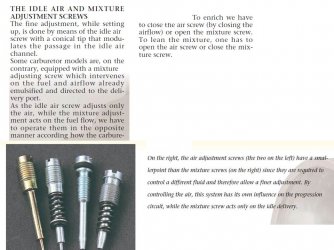
I have attached a picture showing various excerpts (to save everyone reading the whole lot) and it talks about there being two designs depending on the application.

One has "air adjustment screws" and the other "mixture screws". Air screws regulate the air so unscrewing them weakens the mixture whereas mixture screws regulate the fuel so have the opposite effect. All pretty clear so far.

The part that prompted me to write this post is the photo at the bottom of my excerpt that clearly shows the "air screws" on the left with the fine points which are identical to the ones in my carbs.

So have we got air screw type screws doing a mixture screws job?

Yours confused (easily done)

Glen.
 

Attachments

  • Setting the idle mixture.jpg
    Setting the idle mixture.jpg
    89.8 KB · Views: 19
Glen,

I?ve attached a couple of pages (PDFs) on the idle system, taken from the DellOrto tuning Guide document.   

My understanding of our PHF carbs is that they have a mixture adjusting screw on the idle circuit, ie turning the idle mixture screw in reduces the amount of fuel and thus will lean out the mixture.   

Fig 18 in the attached PDFs seems to represent the PHF carb and shows the mixture screw in the fuel circuit. 
Fig 19 shows an air screw, clearly part of the air circuit, and not what the PHF carb uses.     

The second screw from the left in your pic shows a PHF mixture screw.

Tom
 

Attachments

The idle screws on our Dellorto's regulate the mixture so yes the further out the richer you mixture. If you are only half a turn and getting rich then you are pulling fuel somewhere else.
Is the throttle slide on the middle carb closing right down the same as the outer carbs.

Assume your float level is correct and the float is not punctured and in fact is keeping the level OK. Does your bike still have the vent hoses on the carbs are the all unrestricted as from past experience if one is blocked then the carb will continue to flood, if partially blocked will also affect the mixture.

Understand back in the post you said you checked the chokes and there is nice witness marks, however you still might have an issue here, the marks may be for previous and they are now hard. If you are careful you can pick them out and turn them upside down then fit it with lots of free play.


why don't you transpose one of the outer carbs with the middle one, it wont matter for now that the idle (mixture) screws are hard to get at, but if the fault moves with the carb, then you will know it is in fact a fault with that carb,You must of course balance the  throttle slides each time you fit and remove the carbs, what device do you use for this?

If the fault doesn't move when you move  a carb to a new position, then its not a carb fault,

my guess is a very slightly sticking valve (stainless valves per chance? these require a greater clearance than conventional steel ones)
but more probably a wiring fault at the pick ups, this can be hardened insulation, or the strands breaking up (having been tugged through the casings)  maybe damaged just through age and heat/cold cycles of many years,or some similar fault, what that will do is send a poor signal at very low RPM, but recover its strength as the RPM increases, or at least allow the pot to fire when the grunt is gone from the tickover mode
CLEM
 
Thanks Clem

I did look at transposing the carbs, but the midde one is a different design around the throttle linkages. I guess it's possible to swap this about too though. Didn't have time last weekend.

I won't have an opprtunaity to do this for a few weeks as I will be out of the country unfortunately.

Glen.
 
I recently cleaned  my carbs with my new ultrasonic bath and replaced gaskets, accel pumps etc but not the chokes as I "thought they would be alright". After that it would foul one plug sometimes within a couple of minutes and sometimes after 10 miles. I installed new choke plungers and the problem disappeared.
Now with the Redax ignition and alternator it starts and runs beautifully even when the battery is well down. With the original ignition the battery needed to be charged up to start it. I should have done it years ago!
 
Thanks AJ

Here is a list of stuff I have done (crossed out) and stuff I have still got to do. I have some time on Friday afternoon to do the easier ones then I'm off to the Czech Republic for a week, then Spain for another week, so it will all go a bit quiet.

Fueling
Turned choke seals over
Check choke free play
Check float levels
Transpose float valves
Transpose pilot jets
Clean externally/internally
Check pump diaphragms
Check all jets are clear
Balance carbs mechanically

Check compression
Disconnect middle choke
Clean pilot tract
Clean vent tracts
Check mixture - colortune
Balance carbs - vacuum
Transpose carbs
Check Inlet insulators

Electrics
Check coil resistance
Fit new plugs
Cut 1/2" off plug lead
Transposed plug caps

Strobe mid pot
Substitute coil
Check pick up wiring
Swap CDI plugs over
Trigger resistance 70ohms

I'm sure you can all think of more stuff to add.

Cheers, Glen
 
Just a note on the use of colourtune plug. It's an interesting device, but not much use really. It's only any good for idle and brief blips of the throttle under no load. Don't go using it on a dyno. The window in the plug isn't strong enough for the cylinder pressures when the engine is making any kind of horsepower. You don't want it to blow out while you have your eye peering doiwn it!

The instructions that come with it say to tune for a blue flame. I've tried that on a couple of bikes and found it too lean to sustain a good idle and smooth transition from closed to opening trottle. Idle mixture needs to be quite a bit a richer. If you do the old school method and tweak the mixture screw for maximum revs, then adjust the idle speed back to where you want it, you get a better result. Turns out it's a yellow flame when observed with the colourtune plug.
 
Dellortoman said:
Just a note on the use of colourtune plug. It's an interesting device, but not much use really. It's only any good for idle and brief blips of the throttle under no load. Don't go using it on a dyno. The window in the plug isn't strong enough for the cylinder pressures when the engine is making any kind of horsepower. You don't want it to blow out while you have your eye peering doiwn it!

The instructions that come with it say to tune for a blue flame. I've tried that on a couple of bikes and found it too lean to sustain a good idle and smooth transition from closed to opening trottle. Idle mixture needs to be quite a bit a richer. If you do the old school method and tweak the mixture screw for maximum revs, then adjust the idle speed back to where you want it, you get a better result. Turns out it's a yellow flame when observed with the colourtune plug.

OK, understood. I ordered one just to convince myself that out = rich. Should be good enough to demonstate that.
 
screwing the idle jet adjusting needle "out" is definitely richer, at least it has been on all Dellorto equipped Laverda's that I have seen in my workshop and elsewhere during the last 42 years, singles twins and triples and either two or four stroke. no need for a colourtune to check that, its a fuel channel you are adjusting and the wider the gap at the tip of the adjuster to its seat in the carb, the more fuel will get drawn past
CLEM
 
Save the money you'd spend on the ColourTune and buy a set of vacuum gauges instead. You can't really progress at all without those..

AndyW
 
This has helps on my Pantah,Dels also and a few Laverdas.One of the locals uses tiny number drills in a hand turned chuck to clear hard deposits in the idle passages.Even after Ultrasoniced they sometimes don't move.Take care not to snap them, or remove metal if you do it.Don't know what sizes he uses,bloody tiny.Its a last resort to save a carb.
 
AndyW said:
Save the money you'd spend on the ColourTune and buy a set of vacuum gauges instead. You can't really progress at all without those..

AndyW

I have got twin vacuum gauges that I bought for my Ducatis, pretty sure I can use these as the middle carb is the datum so I can use one gauge on the middle and switch the other between the outers.
 
Back
Top