Mikunis again

Cape, when I fitted Mikuni RSs to replace my Dellortos (I admit, probably somewhat worn, but running quite well)
- my fuel consumption dropped by an average of 42%. I can get over 50 miles per US gallon, which is 60+ miles per Imperial gallon, 4.7 litres/100km. I don't ride this way often, though.
- starting (both hot and cold) improved a great deal
- idling in traffic in bloody hot Florida summers went from poor to excellent
- there was more power and torque throughout the rev range (as far as I could tell without a dyno)
- and I had a much lighter throttle action.
I think I made a wise choice. The 25 year old Mikuni (and probably also Keihin, the OEM Keihins on my Honda work pretty damn well too) design is simply better than the 40 year old Dellorto design. Even though it's allegedly based on an Amal design.

Ken
 
Ok, thanks Ken. I have no trouble with any of characteristics mentioned above. Maybe my Dellortos are simply in excellent condition?
 
My local Guzzi dealer and lover of all things Italian fits Miks to Guzzis, and when queried as to why just says "Chalk and cheese"
 
Davo said:
My local Guzzi dealer and lover of all things Italian fits Miks to Guzzis, and when queried as to why just says ""Chalk and cheese

"Chalk and cheese"

Is that Australian slang for I've got a box full of Miks I've got to shift.  :D

                                                                                                Dave
 
Calculation: Kens previous fuel consumption was over 8l/100km and with Mikunis it dropped 42% to 4.7l/100km. This is probably from worst to best. I had 7l/100km on my Dellortos before MAP/TSP installation. So if I had swapped to Mikunis, it would have been 4.1l/100km. Then installing MAP/TPS, dropping consumption 35% would give 2.7l/100km. This wouldn?t actually happen, but a funny calculation?  :D
 
Peppone said:
Peppone said:
What's TPS?
Thanks

Having the choice between 'Throttle Position Sensor' and 'Troublesome Petrol Squirter' I might go for the first one.
But what is it/does it do?
Thanks

a Throttle Position Sensor does exactly that, it is a sensor that outputs an electrical signal that relates to where the throttle is in its rotation, it indicates how far the throttle is open or closed. A TPS is not relevant to carburators unless you have added electronics to monitor things like the actual air/fuel ratio.

there are a number of different products you can use for tuning that utilize the informtation from a TPS. An example of an inexpensive and readily commercially available tuning product is Dynojets Wide Band AFR
http://www.dynojetwb2.com/. To install it, you drill a hole in your exhaust system, weld in a threaded bung, and screw in a "sniffer" sensor, typically a Bosch wide band O2 sensor. The "sniffer" reads the fuel/air ratio and sends a signal to the Dynojet box, which records it on a memory card, and also can send instant readings to a gauge that the rider can watch. The Dynojet box is also typically hooked up to the tach output, telling it what rpm the particular air/fuel ratio is occuring. Then, when the TPS information is added, the tuner then knows what the air/fuel ratio is at any instant, at any particular rpm, and any particular degree of throttle opening.

the next step in the tuning process using the various sensors is that in addition to the data from the TPS, the data from the sniffer, and the data from the tach, is that some of these tuning boxes can also accept data from the ignition, so you then get the data of effects of changes in ignition timing, etc.

this is all much more common in the world of fuel injection. On my Kawasaki ZX 14, the stock fuel injection is "mapped" at the factory, and it is a sealed unit. Then you look to companies like Dynojet to make products that allow people like me to mess with the factory fuel injection settings, bypass the electonic limiter that prevents the bike from exceeding 300 kph, alter the ignition timing, etc. On my ZX 14 I use a Dynojet Power Commander 5 coupled with an AutoTuner. They need information from the TPS, from the tach, from the sniffer I installed in the exhaust, and from the ignition. http://www.powercommander.com/powercommander/default.aspx

With the autotuner having access to all that data, I then use a laptop to program the autotuner to adjust the air/fuel ratio to what I think is optimium for a particular air fuel ratio at a particular rpm at a particular degree of throttle opening. No changing jets or needles, no stinking gasoline covered hands. The autotuner then adjusts air fuel ratio base on my parameters as the bike is being ridden. For my ZX 14 it is particualry useful to "uncork" the motor, as believe it or not, Kawasaki sets the air fuel ratio stinky rich at higher rpm as a bit of a crude limiter, but probably also to avoid warranty claims when ignorant owners fit free flowing exhausts which lean the mixture and might melt the motor.

Back to a TPS on a Laverda fitted with Mikuni's. The end result of using whatever tuning box is chosen, whether it is the Dynojet wideband or whatever, is a bunch of useful real world data. Actual readings of the actual air fuel ratio at a particular rpm at a particular degree of throttle opening at a particular degree of ignition timing. Then, with the carbs, applying that data requires mechanical adjustment of the carbs by the owner, changing settings, jets, needles, etc, then running the bike again in data collection mode, and keep fine tuning until the carbs are set up as close to perfect as you will ever reach in the real world. Essentially, electonic data replacing seat of the pants guess work.

I think more people in the Laverda world may be using the Innovate wide band unit than are using the Dynojet unit, as the Innovate unit has more features and flexibilty, but they all do roughly the same thing, get you useable tuning data you can then apply, then test again....  
http://www.innovatemotorsports.com/

Paul LeClair
 
dja981 said:
Davo said:
My local Guzzi dealer and lover of all things Italian fits Miks to Guzzis, and when queried as to why just says ""Chalk and cheese

"Chalk and cheese"

Is that Australian slang for I've got a box full of Miks I've got to shift.  :D

                                                                                                 Dave

Nah, that's Oz slang for - Wanna go quicker. 

He gets the kits as required from Sudco in South Oz.
 
Rob: Yes indeed the TMR's get delivered with custom sized inlet stubs and my 'bellmouths' where machined by Stephen, to mate properly with the original airfilter rubbers. With an angled manifold (Red?) you could play very well with the length of your inlet ducts and so on. Indeed there is quite a substantial gaine in midrange torque and throttle respons, besides that at least a 20-30 % gaine in mileage.

Paul: You wrote down just all what I wanted to write, so thanks, I don't have to bother....
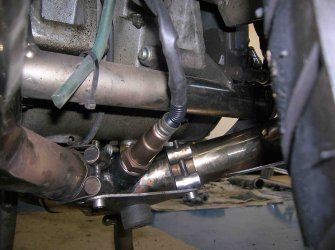
Indeed I use a Dynojet Wideband Commander, which gives me the opportunity to monitor AFR in realtime use (not just on the dyno). I look at it as a usefull safety gadget for avoiding to run too lean, since this is in most cases the reason for severe engine trouble. I'm still running on the rich side, AFR 12-13 throughout the rev range, idle is 14, mainjets are 155, but then I'm one sea level. As you will know, the Dynojet makes it possible to register a 10 minutes time, where all the data TPS, AFR, RPM are logged, which gives usefull info for finetuning. You can view back the data on your laptop; really nice. Attached is a pic off the LSU4 'sniffer". Hein
 

Attachments

  • Bosch LSU4.jpg
    Bosch LSU4.jpg
    164.5 KB · Views: 40
1000/3C_Stefan said:
hkraanen@xs4all.nl said:
Rob: Yes indeed the TMR's get delivered with custom sized inlet stubs[snip]

Hein, with that option those TMR's look the job to me for fitting a set of modern carbies on my 3C (early type cylinderhead with "rubber sock" stubs). Assume its quite a big relief for the engine compared to running a set of sloppy old Dellortos. Did they fit under the tank without hazzle?

Good reason to have a ride over to Topham's, they're fortunately located somewhat around the corner. Piggy bank is already on target for a nice hold up... :-X

Regards,
Stefan

Stefan,

If you plan to use the original "rubber sock" head, you will need to carry out some machining to get normal inlet stubs to fit and seal: Since the original seal is internal and the studs control location, the head ports are pretty random and will not give a proper mating surface for stubs.

Well worth getting rid of the socks, as they are not the easiest to stay sealed (in my case, they got bloody hot, as my 3C has no oil cooler). Fitting an RGS head on my 3C transformed it (no more air leaks  :D  ). Maybe buy another head and keeping the original, as the machining cost won't be trivial.

To be fair to the Dellortos, they work a damned sight better on a 3C than a Jota or 1200. Makes sense - nice old softy engine  :D

Pete
 
1000/3C_Stefan said:
hkraanen@xs4all.nl said:
Rob: Yes indeed the TMR's get delivered with custom sized inlet stubs[snip]

Hein, with that option those TMR's look the job to me for fitting a set of modern carbies on my 3C (early type cylinderhead with "rubber sock" stubs). Assume its quite a big relief for the engine compared to running a set of sloppy old Dellortos. Did they fit under the tank without hazzle?

Yes Stefan, they are a tight fit under the tank. I fitted two rubber rings as extra lift under the rear tank mounting rubber 'domes'. I mentioned red, because with his angled inlet stubs, there will be no issues on this matter for sure. But I kept the straight ones, no problem.
 
1000/3C_Stefan said:
Pete, my idea was to leave the head as it is but have the stubs on the Mikunis machined so that they resemble the original sock stubs. Had no problems with the socks, used a little trick to fit them which seemed to have worked out so far. Lets see what they think at Tophams about this.

You're right with the nice old softy engine and I will keep it that way, just like it as it is now. Gaining hp is not the intention (no oilcooler) but more precise carburation. Will stick to the original diameter too, so TMR32s would it be then. They seem to have less height then the 36mm ones, so there is some hope they might fit under the tank with ease.

Regards,
Stefan

Stefan,

That sounds like a really good plan. If my original head was in good enough condition to use, it would be a good option (even with the Dells). As it is, the 3C head was in poor shape, so I went to an RGS head (works well). Only problem I had was an old set of heat mounts for the stubs that didn't seal well. Fixed now with a great set from Malcolm.

Out of interest, what number is your 3C? Mine is also a non oil cooler model (1544).

Pete
 
what I did to fit the 40mm FCR to the 36mm Head of the 1000 SFC was:

I took the original alloy manifolds, tapered the inside from 36mm to 40mm and the outside to 40mm, too, so that they fit (heat-shrinked) into some japs rubber covered alloy parts, as they hold the carbs stronger than the normal Dell'Orto rubbers (with which the carbs fell of several times...). Holds since 10.000km, pulls like a train from 2.000 to redline and beyond if you want...

But for all these modification: please, please, please make sure you have enough gas supply to the carbs!! I had one carb failing supply and ended up with a burned valve (if not more... engine still to come out of the frame to check that).
 
Hi Stefan,

yep - with 6 bikes plus a 944 Porsche that took a lot of attention plus family, job and other things like a "friendly" neighbor that raised a legal claim against me without any reason, but which took me tons of nerves and money, I am really busy these days... I finally finished the 1000 Classic (and sold it), will shortly sell the #0001 1000 SFC (not yet done, but someone really interested in having it) and have the 944 almost (!) ready, the legal claim is hopefully solved for ever and so I hope that frees up some time...

I burned the valve last year btw if I remember right... More than that, I lost the registration paper on that bike (the "Fahrzeugschein", not the Brief!) and will get in trouble as the T?V meanwhile is overdue...  :'(

But - one thing after the other...  ;)
 
Hi Stefan,

I agree regarding neighbors, however, it is/was a very special case and though it was not our fault nor did we cause it, we finally have to take 1/2 of the cost. Don't know how to translate it correctly, but "Recht haben und Recht bekommen sind zwei v?llig unterschiedliche Dinge"... maybe worth a beer chat next time we meet... Or - maybe not, now I am thinking through it...  :-[ Caused me to much anger already, all lost live quality...

Regarding the 944 (not that we haven't hijacked that thread to death already, but...  :D ): a 3 Liter engine in a 944 is a 944 S2. Must have been built somewhere between 1988 and 1991. I have 944 S2, too, but with a "soft top"...  ;)

DSC_5468.JPG


DSC_3793.JPG


DSC_5541.JPG


If you like young- and oldtimer, take a look: https://picasaweb.google.com/Laverdalothar/YoungtimerTreffenHerten9September2012?authuser=0&authkey=Gv1sRgCJyv2rG7v8qNNw&feat=directlink

that was meeting roughly 1 hour away from me in Herten on a former coal-mine. 2.900 cars were counted on that day... amazing...
 
yeah - I like the color, too. It is a dark blue paint, no flakes in it, just pure blue paint. The rims are painted in that color, too, and the edges are polished. Only shame is that no matter how often you clean them, the moment you drive the car for 10 Km only, they are dirty again...  >:(

But - who cares, right (except me... :-[)?

Car was 2nd hand, only 88.000km on it and was in a general good condition. Some issues with the suspension were fixed, new tires and brakes, different exhaust, some slight modification and now it really makes fun! Hope to be able to get in and out still in 20 years from now...  ;)
 
Back
Top