Peppone said:
Peppone said:
Having the choice between 'Throttle Position Sensor' and 'Troublesome Petrol Squirter' I might go for the first one.
But what is it/does it do?
Thanks
a Throttle Position Sensor does exactly that, it is a sensor that outputs an electrical signal that relates to where the throttle is in its rotation, it indicates how far the throttle is open or closed. A TPS is not relevant to carburators unless you have added electronics to monitor things like the actual air/fuel ratio.
there are a number of different products you can use for tuning that utilize the informtation from a TPS. An example of an inexpensive and readily commercially available tuning product is Dynojets Wide Band AFR
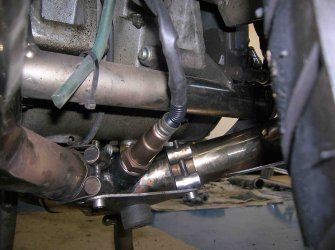
http://www.dynojetwb2.com/. To install it, you drill a hole in your exhaust system, weld in a threaded bung, and screw in a "sniffer" sensor, typically a Bosch wide band O2 sensor. The "sniffer" reads the fuel/air ratio and sends a signal to the Dynojet box, which records it on a memory card, and also can send instant readings to a gauge that the rider can watch. The Dynojet box is also typically hooked up to the tach output, telling it what rpm the particular air/fuel ratio is occuring. Then, when the TPS information is added, the tuner then knows what the air/fuel ratio is at any instant, at any particular rpm, and any particular degree of throttle opening.
the next step in the tuning process using the various sensors is that in addition to the data from the TPS, the data from the sniffer, and the data from the tach, is that some of these tuning boxes can also accept data from the ignition, so you then get the data of effects of changes in ignition timing, etc.
this is all much more common in the world of fuel injection. On my Kawasaki ZX 14, the stock fuel injection is "mapped" at the factory, and it is a sealed unit. Then you look to companies like Dynojet to make products that allow people like me to mess with the factory fuel injection settings, bypass the electonic limiter that prevents the bike from exceeding 300 kph, alter the ignition timing, etc. On my ZX 14 I use a Dynojet Power Commander 5 coupled with an AutoTuner. They need information from the TPS, from the tach, from the sniffer I installed in the exhaust, and from the ignition.
http://www.powercommander.com/powercommander/default.aspx
With the autotuner having access to all that data, I then use a laptop to program the autotuner to adjust the air/fuel ratio to what I think is optimium for a particular air fuel ratio at a particular rpm at a particular degree of throttle opening. No changing jets or needles, no stinking gasoline covered hands. The autotuner then adjusts air fuel ratio base on my parameters as the bike is being ridden. For my ZX 14 it is particualry useful to "uncork" the motor, as believe it or not, Kawasaki sets the air fuel ratio stinky rich at higher rpm as a bit of a crude limiter, but probably also to avoid warranty claims when ignorant owners fit free flowing exhausts which lean the mixture and might melt the motor.
Back to a TPS on a Laverda fitted with Mikuni's. The end result of using whatever tuning box is chosen, whether it is the Dynojet wideband or whatever, is a bunch of useful real world data. Actual readings of the actual air fuel ratio at a particular rpm at a particular degree of throttle opening at a particular degree of ignition timing. Then, with the carbs, applying that data requires mechanical adjustment of the carbs by the owner, changing settings, jets, needles, etc, then running the bike again in data collection mode, and keep fine tuning until the carbs are set up as close to perfect as you will ever reach in the real world. Essentially, electonic data replacing seat of the pants guess work.
I think more people in the Laverda world may be using the Innovate wide band unit than are using the Dynojet unit, as the Innovate unit has more features and flexibilty, but they all do roughly the same thing, get you useable tuning data you can then apply, then test again....
http://www.innovatemotorsports.com/
Paul LeClair